19 past-paper questions on this unit. Five of them are below. Answer on the page: each one is marked the moment you pick, the correct option is shown whether or not you found it, and the full explanation opens either way.
Cambridge IGCSEPaper 1 MCQsFree account
Price elasticity of demand (PED): five questions to try now
Real past-paper questions, the answer key from the mark scheme, and the explanation that goes with it. No account needed to answer them.
Question 1
Some goods take a greater percentage of a typical household’s total spending than others. How is this accounted for in the construction of a consumer prices index?
Answer: B.
A price index has to reflect the fact that a household's budget is not spread evenly across the basket, and weighting is the device that does it: each item is multiplied by its share of typical household spending before the average is taken. So a five per cent rise in housing costs moves the index far more than a five per cent rise in the price of newspapers, which is what makes the index a measure of the cost of living rather than a plain average of prices. A would destroy the very thing being measured, since removing the goods households spend most on would leave a basket that represents nobody. C describes smoothing prices over time, which is a separate matter from how the items are combined at any one date. D confuses the response to a price change with the size of the spending on it, because price elasticity of demand tells you how much less is bought and not how much of the budget the item absorbs.
Question 2
A product has a price elasticity of demand that is greater than one. What will happen to total revenue if the price of the product is reduced by 3%?
Answer: D.
The correct answer is D: it will rise.
Price elasticity of demand greater than one means demand is elastic: the percentage change in quantity demanded exceeds the percentage change in price. Cutting the price by 3% therefore raises quantity demanded by more than 3%. Since total revenue is price multiplied by quantity, the proportionately larger gain in quantity outweighs the smaller loss on price, so total revenue rises.
Why the other options are wrong:
A, falling by more than 3%, describes what happens when demand is inelastic (PED less than 1). Then the quantity response is too small to compensate for the lower price, and revenue falls.
C, unchanged, is the case of unitary elasticity (PED exactly 1), where the percentage changes in price and quantity are equal and exactly offset.
B, falling to zero, would require demand to disappear entirely, which no elasticity value implies.
The rule worth memorising covers all three cases: with elastic demand, price and total revenue move in opposite directions; with inelastic demand they move in the same direction; and with unitary elasticity revenue is unchanged. It is also the practical reason a firm cuts prices only when it believes demand is elastic.
Question 3
What is the most likely cause of a product having a price elasticity of demand greater than one?
Answer: A.
A price elasticity of demand greater than one means demand is elastic: a price rise loses the seller proportionately more custom than the rise itself. That happens when buyers have somewhere else to go, so a close substitute is the direct cause, since consumers can switch with little loss of satisfaction. B, C and D all describe the opposite condition. A necessity has to be bought whatever it costs, so quantity barely moves; a habit-forming good is hard to give up, which is why demand for it is famously inelastic; and a good absorbing only a small share of income is one whose price rise a household hardly notices, so it goes on buying much the same amount.
Question 4
What is included in the construction of the Consumer Prices Index (CPI)?
Answer: A.
A price index has to answer the question 'compared with when?', and a base year is what supplies that comparison: the basket is priced in the base year, that figure is set at 100, and every later year is expressed against it. Without a base year the index would be a list of prices rather than a measure of how much they have changed. B is the commonest confusion here, because the CPI measures what things COST rather than what households earn, and incomes enter only indirectly through the weights, which come from spending patterns rather than from earnings. C and D belong to a different part of the syllabus altogether: price elasticity of demand describes how buyers respond to a price change, and quantity supplied is a producer decision, and neither is used anywhere in building the index.
Question 5
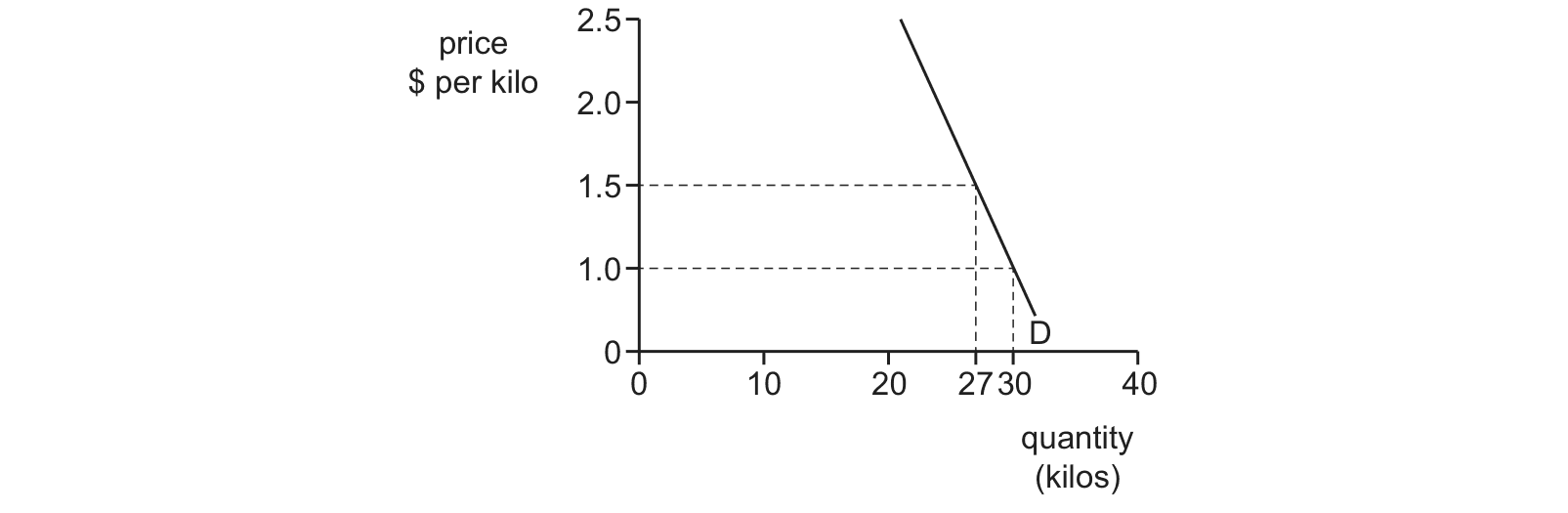
The diagram shows the demand curve for rice. 2.5 price $ per kilo 2.0 1.5 1.0 D 0 0 10 20 2730 40 quantity (kilos) What is the price elasticity of demand (PED) for rice as price increases from $1.0 to $1.5 per kilo?
Answer: C.
Read the quantities off the curve at each price and compare the percentage changes. The price rises by 50%, from $1.00 to $1.50, while quantity demanded falls by only a small fraction, so PED is well below 1 and demand is inelastic, as you would expect for a staple food. You do not need the exact figure: whenever quantity moves proportionately less than price, the answer is 'less than 1'.
These questions are drawn from past Cambridge IGCSE papers and filtered to price elasticity of demand (ped). You answer, you find out immediately whether you were right, and you get the reasoning for the correct option and for each distractor. Wrong answers go to a mistakes locker so you can come back to exactly those.
Practice is free. You need an account only so your progress and your mistakes are still there next time.
These are the errors that cost marks on price elasticity of demand (ped), taken from our own topic notes. Read them before you practise and you will recognise the traps in the questions.
Dividing the wrong way round. Quantity goes on top, price on the bottom.
Saying a price rise always increases revenue, it depends on elasticity.
Confusing elastic with inelastic. Elastic means demand changes a lot.
Calculating PED correctly and then not explaining what it means.
Forgetting that the same good can have different elasticity over different time periods.