Market Failure
Contents: 15 sections
What is market failure?
Market failure happens when the free market does not allocate resources efficiently, too much or too little of a good is produced compared with what is best for society as a whole.
The market is not being irrational. It responds to the costs and benefits that buyers and sellers experience. Market failure happens when there are costs or benefits affecting other people, which the market ignores.
Externalities
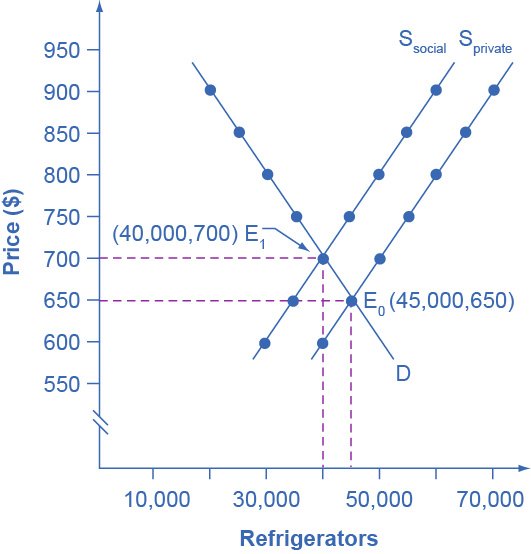
An externality is a cost or benefit affecting a third party, someone who is neither the buyer nor the seller.
- Social cost = private cost + external cost
- Social benefit = private benefit + external benefit
| Type | Meaning | Examples | Result |
|---|---|---|---|
| External cost (negative externality) | Harm to third parties | Pollution, noise, congestion, passive smoking | Market produces too much |
| External benefit (positive externality) | Benefit to third parties | Education, vaccination, restoring a building | Market produces too little |
Why the market gets it wrong: a factory decides how much to produce by comparing its own costs and revenue. The cost of the pollution falls on local residents, so it never enters the decision. The factory therefore produces more than is best for society.
Merit and demerit goods
- A merit good is better for people than they realise, so it is under-consumed in a free market. Examples: education, healthcare, vaccination. People underestimate the benefit, or cannot afford it, and it also creates external benefits.
- A demerit good is worse for people than they realise, so it is over-consumed. Examples: cigarettes, alcohol, junk food. People underestimate the harm, and it also creates external costs.
Public goods
A public good has two features, and both must be present:
- Non-excludable: you cannot stop people who have not paid from using it.
- Non-rival: one person using it does not reduce what is available to others.
Examples: street lighting, national defence, flood defences, lighthouses.
The free-rider problem: because nobody can be excluded, everyone waits for someone else to pay and then uses it for free. No firm can collect enough money, so the market provides none at all. This is why governments provide public goods and pay for them through taxation.
Be careful: a public good is not the same as a good the government happens to provide. State schools are rival and excludable, so they are merit goods, not public goods.
Abuse of monopoly power
A monopoly is a single firm dominating a market. With no competition it can:
- charge higher prices than in a competitive market
- produce less than consumers would like
- have little incentive to improve quality or innovate
- become inefficient, because it does not need to cut costs
Consumers suffer because there is nowhere else to go.
Government responses
| Problem | Possible responses |
|---|---|
| External costs / demerit goods | Indirect taxes, regulation and bans, information campaigns |
| External benefits / merit goods | Subsidies, free or direct provision, information campaigns |
| Public goods | Direct government provision funded by taxation |
| Monopoly power | Competition laws, price controls, breaking up the firm |
Each has drawbacks: taxes may not change behaviour if demand is inelastic, regulation costs money to enforce, and subsidies have an opportunity cost.
Worked example
A factory produces chemicals and releases waste into a river.
- The firm pays for its raw materials, workers and machinery, but not for the harm to people downstream
- so social cost is greater than private cost
- the firm produces more than is best for society
- this is market failure caused by an external cost.
What the government could do:
- A tax on the firm equal to the harm caused, so it has to pay for the pollution and produces less.
- Regulation setting a legal limit on waste, with fines for breaking it.
Which is better? A tax raises revenue and lets the firm choose how to cut pollution, but the government must work out the right amount of harm, which is difficult. Regulation is simpler to understand but needs inspectors to enforce it, and a single limit may be too strict for one firm and too generous for another.
Common exam mistakes
- Saying market failure means the market "stopped working". It means resources are allocated badly.
- Giving only one feature of a public good. Both non-excludable and non-rival are needed.
- Confusing merit goods with public goods. Merit goods are rival and excludable.
- Saying the market produces too little of a demerit good, it produces too much.
- Forgetting that externalities affect third parties, not the buyer or seller.
- Listing government policies without saying a drawback of any of them.
Exam technique
Always identify which type of market failure the question describes, and say whether the market produces too much or too little. That single sentence frames the whole answer.
Use the words third party, social cost and private cost, examiners look for them.
For evaluation, give one drawback for each policy you suggest: cost, difficulty of enforcement, or the risk that it does not change behaviour.
Building an answer
4 marks, "Explain, with an example, what is meant by a negative externality."
A negative externality is a cost of production or consumption that falls on third parties who are not involved in the transaction.
A factory discharging waste into a river is the standard example: the firm pays its private costs of production, but the cost of the polluted water falls on people downstream, who neither produced nor bought the good.
6 marks, "Analyse how a government could correct the market failure caused by a negative externality."
The market over-produces because the firm counts only its private costs, so marginal social cost exceeds marginal private cost and output exceeds the social optimum.
An indirect tax equal to the external cost internalises it: costs rise, supply shifts left and output falls towards the socially optimal level, while the revenue can compensate those harmed.
Regulation is the alternative, emission limits or an outright ban, which is certain in its effect but inflexible, since it imposes the same requirement on firms with very different abilities to cut pollution.
Tradable permits combine both: government fixes the total quantity of pollution and lets firms trade the right to emit, so the cheapest reductions happen first.
The main types of market failure
| Type | What goes wrong | Result |
|---|---|---|
| Negative externalities | Third-party costs ignored | Over-production |
| Positive externalities | Third-party benefits ignored | Under-production |
| Public goods | Non-excludable, so free-riding | Not provided at all |
| Merit goods | Long-run private benefit underestimated | Under-consumption |
| Demerit goods | Private harm underestimated | Over-consumption |
| Monopoly | Market power restricts output | Higher price, lower output |
| Imperfect information | Choices made on bad information | Wrong quantity consumed |
| Factor immobility | Resources cannot move to where they are needed | Unemployment, waste |
The distinction examiners test most
Private cost is what the decision-maker pays. External cost falls on third parties. Social cost is the two added together. The same structure applies to benefits. Market failure exists precisely where social and private values diverge, which is why almost every answer in this topic should use both words.
A real case to quote
The EU Emissions Trading System. A cap on total emissions with tradable permits, so firms that can cut cheaply do so and sell their spare permits to those who cannot. Emissions from covered sectors have fallen substantially. It is the best available example of a market-based solution to a market failure, using prices to fix what prices got wrong.
Quick revision
- Market failure = resources allocated inefficiently.
- Social cost = private + external cost. Social benefit = private + external benefit.
- External cost → over-production. External benefit → under-production.
- Merit good = under-consumed (education). Demerit good = over-consumed (cigarettes).
- Public good = non-excludable and non-rival → free-rider problem → market provides none.
- Public goods ≠ government-provided goods.
- Monopoly abuse: higher prices, less output, less innovation.
Check you have it
Question 1
A private sector firm is given a contract by the government to supply a country’s water. Which government directive will minimise the risk of market failure?
Answer: B.
Water is a merit good with strong positive externalities: clean water improves public health, reduces disease and raises productivity, and those benefits reach far beyond the individual customer. A profit-seeking supplier would serve only the areas where revenue exceeds the cost of connection, abandoning remote or poor districts where pipes are expensive to lay. Requiring universal supply prevents that under-provision, which is precisely the market failure the government is guarding against.
Why the other options would cause market failure:
- D, providing water only to those who can pay, is the outcome to be prevented. It leaves the poorest without a basic necessity and allows disease to spread, a negative externality affecting everyone.
- A, allowing the firm to ration water rather than meet demand, hands a monopolist the power to restrict supply, which is exactly how monopoly power harms consumers.
- C, insisting the firm maximises profits, is the sharpest trap. A private water supplier is a natural monopoly with no competition to discipline it, so profit maximisation means restricting output and charging above cost. Profit maximisation produces efficient outcomes only in competitive markets.
Question 2
To help reduce the price of oil, new supplies are needed. However, objectors oppose exploration of new sites because of the environmental damage it may cause. Why is this statement an example of the basic economic problem?
Answer: A.
The basic economic problem is scarcity: limited resources against unlimited wants, and the passage illustrates it directly. The world wants more oil than is currently available, which is why the price is high and new supplies are sought. Because the resource is limited, society faces a choice it cannot avoid: extract more oil and accept environmental damage, or protect the environment and accept less oil. Both are wanted; both cannot be had in full.
Why the other options are wrong:
- D, external costs in production, is a genuine feature of the scenario, the environmental damage falls on people outside the transaction. But an externality is a market failure, a separate concept from the basic economic problem, and it explains why the market may get the quantity wrong rather than why a choice must be made at all.
- C, involving demand and supply, describes the mechanism through which the market responds to scarcity, not the problem itself.
- B, oil being expensive, is a symptom. The price is high because the resource is scarce, so this states the consequence rather than the cause.
Question 3
Which characteristics of a product will cause market failure?
Answer: C.
Those two properties define a public good, and they cause complete market failure. Non-excludability means a supplier cannot prevent a non-payer from consuming, so everyone has an incentive to free-ride and wait for someone else to pay. With no revenue obtainable, a profit-seeking firm supplies nothing at all: provision falls to zero rather than merely being too low. Non-rivalry means one person's consumption leaves as much available for everyone else, so charging would be inefficient even if it were possible.
Why the other options describe conditions where markets work well:
- A, information known equally by consumers and producers, is symmetric information. Information failure causes market failure; its absence does not.
- B, consumption having no external benefits, means there are no positive externalities to be under-priced, so private and social benefit coincide.
- D, production having no external costs, means there are no negative externalities, so private and social cost coincide.
What the syllabus asks for on this topicSyllabus points
Syllabus points
- Define market failure.
- Explain the causes: externalities, merit and demerit goods, public goods, and abuse of monopoly power.
Related Cambridge IGCSE topics
Not the topic you were looking for? Describe what you are stuck on in your own words and we will take you to the notes that answer it.