Monetary Policy
Contents: 14 sections
What is monetary policy?
Monetary policy is the use of interest rates and the money supply to influence the economy.
It is operated by the central bank (3.1), usually independently of the government. That independence matters: a government facing an election might be tempted to cut interest rates to boost the economy, storing up inflation later. Leaving the decision to the central bank makes the commitment to low inflation more believable.
The main aim is usually low and stable inflation, often with a target such as 2%.
The instruments:
- The interest rate: the main tool.
- The money supply: the total amount of money in the economy.
- Rules on bank lending, such as how much banks must hold in reserve.
How interest rates affect the economy
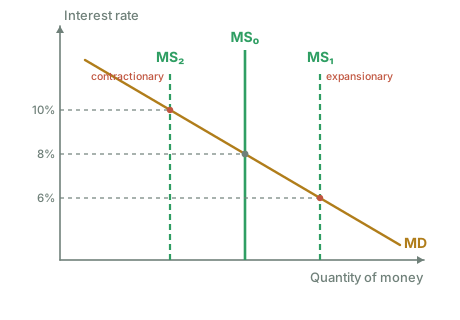
The interest rate is the reward for saving and the cost of borrowing. Changing it affects spending through several routes at once.
Lower interest rates:
- Borrowing becomes cheaper and saving less rewarding
- households borrow and spend more, and save less
- firms borrow to invest because more projects become worthwhile
- total demand rises
- firms produce more and hire more workers
- output and employment rise, with upward pressure on prices.
There is also an exchange rate effect worth mentioning:
- Lower interest rates make the country less attractive to foreign savers
- demand for the currency falls
- the currency weakens
- exports become cheaper abroad and imports dearer
- net exports rise, adding to demand.
Higher interest rates work in reverse: spending and investment fall, inflation eases, the currency strengthens, and unemployment may rise.
Who gains and who loses
A useful structure for evaluation questions:
| Group | Lower interest rates | Higher interest rates |
|---|---|---|
| Borrowers / mortgage holders | Gain: repayments fall | Lose: repayments rise |
| Savers and pensioners | Lose: interest income falls | Gain |
| Firms | Gain: cheaper to invest | Lose: investment costs more |
| Exporters | Gain: weaker currency | Lose: stronger currency |
Expansionary and contractionary monetary policy
| Stance | Action | Aim | Risk |
|---|---|---|---|
| Expansionary | Cut interest rates, increase money supply | Raise demand, cut unemployment | Inflation; a weaker currency raising import prices |
| Contractionary | Raise interest rates, reduce money supply | Reduce inflation | Slower growth, higher unemployment |
Limitations
- Time lags. Changes take months, often up to a year and a half, to work through. The central bank has to act on a forecast, which may be wrong.
- Confidence matters more than cost. In a recession, even very cheap borrowing may not tempt people to spend if they fear losing their jobs.
- Rates cannot fall much below zero. If they are already near zero, there is little room to cut further.
- It cannot fix cost-push inflation. If prices are rising because of a global oil shock, raising interest rates does nothing about the cause, it just reduces demand and raises unemployment.
- Uneven effects. It helps borrowers and harms savers, and hits some regions and industries harder than others.
Worked example
Inflation has risen to 8%, caused by strong consumer spending. The central bank raises the interest rate from 2% to 5%.
- Borrowing becomes more expensive and saving more rewarding
- households cut back on borrowing and spending, especially on cars and houses
- firms postpone investment
- total demand falls
- the upward pressure on prices eases and inflation comes down.
Side effects:
- Growth slows and unemployment may rise.
- The currency strengthens as foreign savers move money in, making exports dearer and harming exporters.
- Mortgage holders are squeezed; savers gain.
Evaluation. This works because the inflation is demand-pull. If instead it had been caused by a rise in world oil prices (cost-push), higher interest rates would reduce output and jobs while doing nothing about the oil price, the wrong tool for the problem.
Identifying which type of inflation you are dealing with, before choosing a policy, is exactly what top answers do.
Common exam mistakes
- Confusing monetary policy (central bank, interest rates) with fiscal policy (government, tax and spending).
- Saying lower interest rates "always" increase spending, ignoring confidence.
- Recommending higher interest rates for cost-push inflation without qualification.
- Forgetting the exchange rate effect.
- Discussing only borrowers, ignoring savers.
- Stating the outcome without tracing the chain.
Exam technique
Trace the full chain: interest rate → borrowing and saving → consumer spending and investment → total demand → output, employment and prices. Marks are given for the links.
Always say whether the policy is expansionary or contractionary before explaining it.
For evaluation, structure by group, borrowers, savers, firms, exporters, and mention time lags and the type of inflation.
Building an answer
4 marks, "Explain how a rise in interest rates could reduce inflation."
Higher rates make borrowing more expensive and saving more rewarding, so households and firms spend less and save more.
Lower total demand reduces the upward pressure on prices, so demand-pull inflation eases.
6 marks, "Analyse the effects of a cut in interest rates on an economy."
Borrowing becomes cheaper, so consumption of credit-financed goods rises and firms find more investment projects profitable.
Mortgage holders on variable rates have lower repayments, raising disposable income and spending.
The currency tends to weaken, because lower returns make it less attractive to foreign investors, which raises export competitiveness and import prices.
Total demand therefore rises, supporting output and employment, but with a risk of higher inflation, especially if the economy is near capacity.
The effects work with a lag of a year or more, which is why central banks must act on forecasts rather than current data.
The transmission mechanism, step by step
Learn this as a chain, because the marks are for the links:
- Interest rate falls
- borrowing cheaper and saving less rewarding
- consumption and investment rise
- total demand rises
- output and employment rise
- if near capacity, the price level rises.
The currency channel runs alongside: rate falls → currency weakens → exports cheaper and imports dearer → net trade improves → total demand rises.
Why monetary policy is not enough on its own
| Limitation | Why it bites |
|---|---|
| Time lags | Effects take 12–24 months to work through |
| Confidence | If firms are pessimistic, cheap borrowing does not produce investment |
| The lower bound | Rates cannot fall far below zero, so the tool runs out in a deep recession |
| Bank willingness | Lower official rates only help if banks pass them on |
| Cost-push inflation | Higher rates cannot cure inflation caused by import or energy prices |
That last row explains most of what central banks faced in 2022.
A real case to quote
The Bank of England, 2021–23. Bank Rate rose from 0.1% to over 5% in under two years to fight inflation driven substantially by energy and supply chains. Inflation did fall, but the episode showed both the blunt force of the tool and its awkwardness against cost-push pressure, since raising rates does nothing about the price of imported gas.
Quick revision
- Monetary policy = interest rates and the money supply, run by the central bank.
- Main aim: low and stable inflation.
- Lower rates → more borrowing and spending, more investment, weaker currency → higher demand.
- Higher rates → the reverse; inflation falls but unemployment may rise.
- Borrowers gain from cuts; savers lose. Exporters gain from a weaker currency.
- Limits: time lags, confidence, the zero floor, and no answer to cost-push inflation.
Check you have it
Question 1
A government wishes to pursue an expansionary monetary policy. What should it do?
Answer: D.
Question 2
An economy has a deficit on its balance of trade in manufactured goods. Which government policy will reduce this deficit?
Answer: D.
Question 3
What would be most likely to encourage saving?
Answer: D.
What the syllabus asks for on this topicSyllabus points
Syllabus points
- Define monetary policy.
- Explain how interest rates and the money supply affect the economy.
Related Cambridge IGCSE topics
Not the topic you were looking for? Describe what you are stuck on in your own words and we will take you to the notes that answer it.