Firms' Costs, Revenue and Objectives
Contents: 12 sections
Costs
| Cost | Definition | Examples |
|---|---|---|
| Fixed cost (FC) | Does not change with output: paid even at zero output | Rent, insurance, loan repayments, salaries of permanent managers |
| Variable cost (VC) | Changes directly with output | Raw materials, packaging, electricity used in production, piece-rate wages |
| Total cost (TC) | All costs added together | TC = FC + VC |
| Average cost (AC) | Cost per unit produced | AC = TC ÷ output |
The test for fixed or variable: ask whether the cost still exists if the firm produces nothing this month. Rent still has to be paid, so it is fixed. Raw materials do not, so they are variable.
Fixed costs only exist in the short run. Over a long enough period, a firm can end its lease and sell its machinery, so every cost becomes variable.
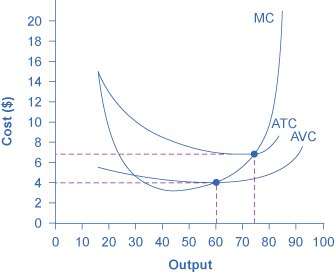
Average cost usually falls then rises as output grows: fixed costs are spread over more units (helpful), but eventually the firm becomes too large to manage efficiently. That is the link to economies and diseconomies of scale (3.6).
Revenue
| Term | Definition |
|---|---|
| Total revenue (TR) | The money received from sales: TR = price × quantity sold |
| Average revenue (AR) | Revenue per unit: AR = TR ÷ quantity, which equals the price |
Average revenue equals price, provided every unit is sold at the same price. Students often over-complicate this.
Profit
Profit = total revenue − total cost
- If TR > TC, the firm makes a profit.
- If TR < TC, the firm makes a loss.
- If TR = TC, the firm breaks even.
Two ways a firm can raise profit: increase revenue (raise price if demand is inelastic, or sell more) or cut costs. Whether raising the price works depends on price elasticity of demand (2.7), a link worth making.
Objectives of firms
Profit maximisation is the usual assumption, but IGCSE expects you to know that firms pursue other aims too:
- Profit maximisation: the standard assumption; profit funds investment and rewards owners.
- Survival: the priority for new firms and for any firm in a recession.
- Growth: a larger firm gains economies of scale and market power; managers may also prefer running a bigger business.
- Increasing market share: sometimes by cutting prices and accepting lower profit now to win customers for later.
- Social objectives: treating workers well, reducing environmental harm, supporting the community. Charities and social enterprises put these first.
- Satisficing: making enough profit to keep owners satisfied, rather than the absolute maximum.
Public-sector organisations often do not aim for profit at all. A state hospital aims to provide healthcare, so judging it by profit would be the wrong measure.
Worked example
A bakery has fixed costs of $2,000 a month. Each loaf costs $1 in ingredients and labour. It sells 4,000 loaves at $2.50 each.
Variable cost = $1 × 4,000 = $4,000
Total cost = $2,000 + $4,000 = $6,000
Average cost = $6,000 ÷ 4,000 = $1.50
Total revenue = $2.50 × 4,000 = $10,000
Profit = $10,000 − $6,000 = $4,000
Now test a decision. The bakery considers cutting the price to $2.00 to sell more.
If sales rise to 5,000: TR = $10,000 (unchanged), VC = $5,000, TC = $7,000 → profit falls to $3,000.
If sales rise to 7,000: TR = $14,000, VC = $7,000, TC = $9,000 → profit rises to $5,000.
So the price cut is only worth it if demand is sufficiently elastic. That is the kind of reasoning that turns a calculation into economics.
Common exam mistakes
- Classifying wages as always variable. Permanent salaried staff are a fixed cost.
- Confusing total revenue with profit. Revenue is money in; profit is what is left.
- Forgetting that average revenue equals price.
- Dividing by the wrong figure when calculating average cost.
- Assuming every firm maximises profit.
- Confusing average cost with variable cost per unit.
Exam technique
Show every step in a calculation, VC, TC, AC, TR, then profit. Method earns marks even if one number is wrong, and these questions are usually worth several marks.
Label your figures with units and say what each represents. "Total cost = $6,000" is clearer than an unlabelled number.
When asked whether a firm should change its price. Use elasticity; that is what the question is really testing.
Building an answer
4 marks, "A firm has fixed costs of $2,000 and variable costs of $6 per unit. It produces 500 units and sells them at $14. Calculate total cost, total revenue and profit."
Total variable cost = $6 × 500 = $3,000.
Total cost = $2,000 + $3,000 = $5,000.
Total revenue = $14 × 500 = $7,000.
Profit = $7,000 − $5,000 = $2,000.
Set the working out line by line. Examiners award method marks even when an arithmetic slip changes the final figure, but only if they can see the method.
6 marks, "Analyse why a firm might not aim to maximise profit."
A firm may pursue growth instead, accepting lower profit now to build market share that yields higher profit later.
It may aim at survival, particularly a new firm or one in recession, where staying solvent matters more than returns.
Managers who do not own the firm may pursue their own objectives, larger departments, higher salaries, because ownership is divorced from control.
Social objectives are increasingly common: a firm may sacrifice profit for environmental or ethical standards, partly from principle and partly because reputation affects long-run demand.
The cost formulas worth memorising
| Term | Formula |
|---|---|
| Total cost | Fixed cost + variable cost |
| Average total cost | Total cost ÷ output |
| Average fixed cost | Fixed cost ÷ output |
| Average variable cost | Variable cost ÷ output |
| Total revenue | Price × quantity sold |
| Profit | Total revenue − total cost |
Fixed costs do not vary with output and are paid even at zero output, rent, insurance, loan interest. Variable costs rise with each unit made, raw materials, packaging, piece-rate wages. The distinction is short-run only: given enough time, every cost is variable.
A real case to quote
Airlines during the 2020 grounding. Aircraft leases, insurance and maintenance continued while almost no flights operated, so fixed costs were paid against near-zero revenue and losses were enormous. It is the clearest possible demonstration of why the fixed/variable distinction matters, and why a firm may keep operating at a loss in the short run, so long as revenue covers its variable costs.
Quick revision
- Fixed costs do not change with output; variable costs do. TC = FC + VC.
- Test: would the cost still be paid at zero output?
- AC = TC ÷ output. All costs are variable in the long run.
- TR = price × quantity. AR = price.
- Profit = TR − TC.
- Objectives: profit maximisation, survival, growth, market share, social aims, satisficing.
- Whether a price cut raises profit depends on elasticity.
Check you have it
Question 1
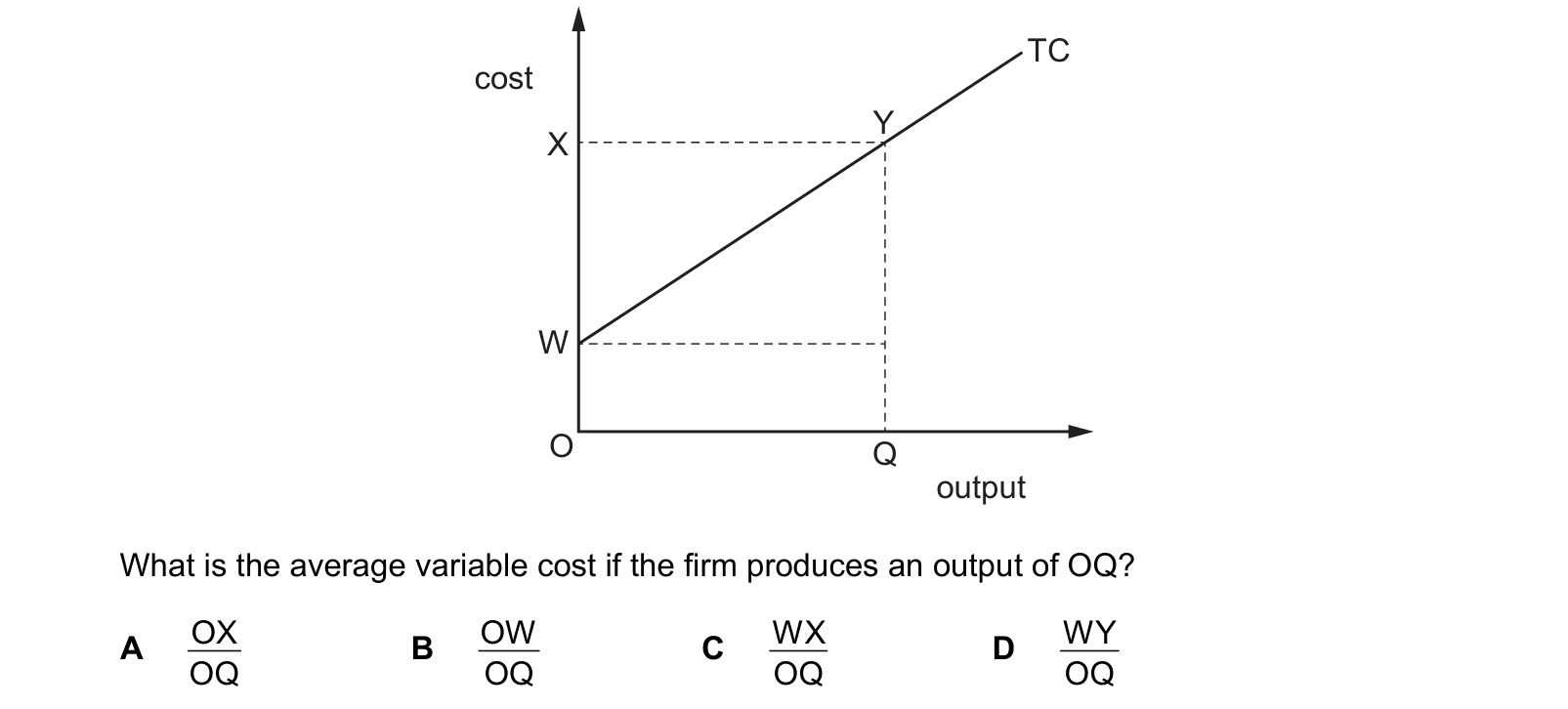
The diagram shows a firm’s total cost (TC) curve.
What is the average variable cost if the firm produces an output of OQ?
Answer: C.
The total cost curve starts on the vertical axis at W rather than at the origin, and that intercept is the fixed cost, the amount the firm pays even at zero output. At the output OQ total cost is OX. Variable cost is total cost minus fixed cost, which on the diagram is OX minus OW, or the distance WX. Average variable cost is variable cost divided by output, so it is WX divided by OQ.
Why the other options are wrong:
- A, OX divided by OQ, is average total cost, because OX is the whole of total cost at that output.
- B, OW divided by OQ, is average fixed cost, since OW is the fixed cost on its own.
- D, WY divided by OQ, uses the length of the sloping line from W up to the point Y rather than the vertical distance between the two cost levels. Only the vertical measurement represents a sum of money on this diagram.
Question 2
A firm that sells its product for $6 a unit has the following total costs. output (units) 0 10 20 30 total costs ($) 40 100 120 150 Which statement is correct?
Answer: B.
Check it directly. At 20 units, total revenue is 20 × $6 = $120, and the table gives total cost at 20 units as $120. Revenue equals cost, so profit is exactly zero; this is the break-even output.
Why the other options are wrong:
- A says average cost is lowest at 10 units. Compute all three: at 10 units AC = $100 ÷ 10 = $10; at 20 units AC = $120 ÷ 20 = $6; at 30 units AC = $150 ÷ 30 = $5. Average cost is lowest at 30 units, not 10.
- C says the firm has no fixed costs. Total cost at zero output is $40, and a cost incurred when nothing is produced is by definition a fixed cost. So fixed costs are $40.
- D says total variable costs fall continuously. Total variable cost is total cost minus the $40 fixed: $60 at 10 units, $80 at 20, $110 at 30. It rises throughout, as it must when more is being produced.
Question 3
Dimitry owns a firm that produces and sells bottles of lemonade. He only sells one size of bottle. How would Dimitry calculate the total revenue of the firm?
Answer: B.
Total revenue is the whole amount received from sales: TR = P × Q. Since Dimitry sells only one size of bottle at a single price, multiplying that price by the number of bottles sold gives his total revenue.
Why the other options are wrong:
- A, quantity multiplied by the cost per bottle, gives total cost, not revenue. Revenue is money coming in from customers; cost is money going out to produce.
- C, quantity multiplied by the profit per bottle, gives total profit. Profit is what remains after costs have been deducted, so it is smaller than revenue and a different quantity altogether.
- D, quantity multiplied by the tax per bottle, gives the total tax paid, money owed to the government rather than earned by the firm.
What the syllabus asks for on this topicSyllabus points
Syllabus points
- Define fixed, variable, total and average costs.
- Define total and average revenue.
- Explain the objectives of firms and how profit is calculated.
Related Cambridge IGCSE topics
Not the topic you were looking for? Describe what you are stuck on in your own words and we will take you to the notes that answer it.