Foreign Exchange Rates
Contents: 14 sections
What is an exchange rate?
The foreign exchange rate is the price of one currency in terms of another, for example £1 = $1.25.
Two systems:
- Floating exchange rate: the rate is set by demand for and supply of the currency in the foreign exchange market, with no government intervention.
- Fixed exchange rate: the government or central bank sets the rate and maintains it by buying or selling its own currency using reserves.
The vocabulary depends on the system, and examiners check it:
| Term | Meaning | System |
|---|---|---|
| Appreciation | The currency rises in value | Floating: caused by the market |
| Depreciation | The currency falls in value | Floating: caused by the market |
| Revaluation | The currency is deliberately raised | Fixed: a policy decision |
| Devaluation | The currency is deliberately lowered | Fixed: a policy decision |
Using "devaluation" for a market-driven fall is the single most common error in this topic.
How a floating rate is determined
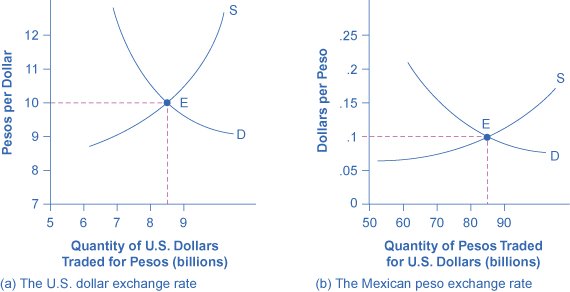
The rate settles where demand equals supply for the currency.
Demand for a country's currency comes from:
- Foreigners buying its exports; they must obtain the currency to pay.
- Foreign investment into the country.
- Speculators who expect the currency to rise.
- Tourists visiting the country.
Supply of the currency comes from:
- Residents buying imports; they must sell their currency to obtain foreign currency.
- Investment going abroad.
- Residents travelling abroad as tourists.
Causes of changes
| Change | Effect on the currency |
|---|---|
| Exports rise | Appreciation: more demand for the currency |
| Imports rise | Depreciation: more supply of the currency |
| Domestic interest rates rise | Appreciation: foreign savers move money in |
| Domestic inflation higher than abroad | Depreciation: exports become less competitive |
| Foreign investment flows in | Appreciation |
| Speculators expect a rise | Appreciation now |
Consequences of a depreciation
The core effect: exports become cheaper abroad, imports become dearer at home.
A memory aid used widely: SPICED, Stronger Pound, Imports Cheaper, Exports Dearer. A depreciation is the reverse.
- The currency falls
- domestic goods cost less in foreign currency
- export demand rises
- and foreign goods cost more at home
- import demand falls
- the current account may improve
- higher demand for domestic output raises output and employment.
But there are costs:
- Imported goods cost more, so the cost of living rises.
- Imported raw materials and components cost more, raising firms' costs and causing cost-push inflation (4.8).
- The improvement depends on elasticity: if demand for exports and imports is inelastic, volumes barely change and the current account may worsen at first.
Consequences of an appreciation
The mirror image: exports become dearer and imports cheaper.
- Exporters lose competitiveness; export volumes fall.
- Output and employment may fall in export industries.
- Imports are cheaper, which lowers the cost of living and helps firms that use imported inputs, so appreciation reduces inflationary pressure.
- The current account is likely to worsen.
Worked example
A country's currency depreciates by 15% against its trading partners.
- Its goods now cost 15% less in foreign currency
- foreign buyers demand more
- export revenue rises, provided demand is reasonably elastic
- meanwhile imports cost 15% more, so households and firms buy fewer of them
- the current account improves
- higher net exports raise demand for domestic output, so output and employment rise.
The costs, which the best answers include:
- Imported food, fuel and consumer goods all cost more
- the cost of living rises.
- Firms using imported components face higher costs
- cost-push inflation, which erodes the competitiveness gain over time.
- If demand for exports is inelastic, the extra volume may not make up for the lower price, and the current account may not improve at all.
Judgement: a depreciation helps exporters and employment in the short run, but only improves the current account if demand is sufficiently elastic, and it raises inflation, which eventually undoes some of the advantage.
Common exam mistakes
- Using devaluation for a market movement; that is depreciation.
- Getting SPICED backwards.
- Saying a depreciation is simply good, ignoring imported inflation.
- Forgetting that a depreciation raises the cost of imported raw materials for domestic firms.
- Ignoring elasticity when judging the effect on the current account.
- Confusing demand for and supply of the currency. Remember imports supply the domestic currency.
Exam technique
State clearly whether the currency has appreciated or depreciated before discussing effects, and use the right word for the exchange rate system.
Then trace the chain: exchange rate → export and import prices → volumes → current account → output and employment.
For evaluation, use elasticity, imported inflation, and the fact that different groups are affected differently, exporters gain from a depreciation while importers and consumers lose.
Building an answer
4 marks, "Explain the effect of a depreciation on a country's exports and imports."
A weaker currency means exports become cheaper when priced in foreign currency, so foreign buyers demand more and export volumes rise.
Imports become more expensive in domestic currency, so buyers switch to domestic substitutes and import volumes fall.
6 marks, "Analyse the effects of a currency appreciation on an economy."
Exports become more expensive abroad, so export demand falls, reducing output and employment in exporting industries.
Imports become cheaper, which lowers the price of imported raw materials and finished goods, helpful for inflation, and for firms that import components.
Net trade therefore worsens, reducing total demand, though the fall in import prices eases cost-push inflationary pressure.
The size of the effect depends on elasticity: if demand for exports and imports is inelastic, quantities change little and the main effect falls on the value of trade rather than its volume.
SPICED is the mnemonic worth carrying into the exam: Strong Pound, Imports Cheap, Exports Dear.
What moves an exchange rate
| Cause | Effect on the currency |
|---|---|
| Rise in demand for exports | Appreciates |
| Rise in demand for imports | Depreciates |
| Higher domestic interest rates | Appreciates: foreign capital flows in |
| Inward foreign direct investment | Appreciates |
| Speculation that it will rise | Appreciates: expectations are self-fulfilling in the short run |
| Higher domestic inflation than trading partners | Depreciates over time |
Floating against fixed
A floating rate is set by demand and supply in the foreign exchange market: it adjusts automatically to trade imbalances, and the central bank keeps its freedom to set interest rates for domestic purposes. A fixed rate is held at a set value by the central bank buying and selling its own currency: it gives certainty for traders and investors, but requires large reserves and ties monetary policy to defending the peg.
A real case to quote
Sterling after June 2016. The pound fell roughly 10% against the dollar within days. Exporters and tourism gained competitiveness; import prices rose and CPI inflation climbed above 3% within a year, squeezing real wages. It gives you both sides of a depreciation with dates and numbers, which is exactly what an evaluation needs.
Quick revision
- Exchange rate = price of one currency in another.
- Floating = set by demand and supply. Fixed = set by the authorities.
- Appreciation/depreciation = market. Revaluation/devaluation = policy.
- Demand comes from exports and inward investment; supply from imports and outward investment.
- Higher interest rates → appreciation. Higher domestic inflation → depreciation.
- SPICED: Strong Pound, Imports Cheaper, Exports Dearer.
- Depreciation helps exporters and employment but causes imported inflation.
- Whether the current account improves depends on elasticity.
Check you have it
Question 1
What is an increase in the value of an exchange rate of a currency in a floating system called?
Answer: A.
The terminology depends on the system and the direction. Under a floating system the rate is determined by supply and demand, so changes happen to the currency rather than being decided: a rise is an appreciation and a fall a depreciation. Under a fixed system the authorities set an official parity, so a change is a deliberate announcement: raising it is a revaluation and lowering it a devaluation.
The question specifies a floating system and an increase in value, so the answer is appreciation.
Why the other options are wrong:
- D, revaluation, is the right direction but describes a deliberate policy change under a fixed rate. This is the trap: only the system is wrong.
- B, depreciation, is the right system but the wrong direction.
- C, devaluation, is wrong on both counts.
Question 2
Why might the macroeconomic aim of full employment conflict with the aim of stable prices?
Answer: C.
At full employment there are very few unemployed workers left, so an employer wanting to expand must attract staff away from other firms by offering higher pay. Wages rise faster than productivity, so unit labour costs increase and firms pass the increase into prices, cost-push inflation. At the same time the strong demand that produced full employment presses against a capacity limit, adding demand-pull pressure. Both channels push the price level up, which is why the two objectives conflict.
Why the other options are wrong:
- A says full employment leads to a higher cost of imports. Import prices depend on world prices and the exchange rate, not on the domestic employment rate. Higher domestic incomes raise the quantity of imports demanded, but not their price.
- B says it leads to increased income inequality. Full employment generally reduces inequality, because those who gain jobs are typically at the lower end of the distribution and a tight labour market strengthens the bargaining position of low-paid workers.
- D says it leads to lower exports. Export volumes depend on competitiveness and on foreign incomes. Full employment can damage competitiveness eventually, but only through the wage and price rises in option C, so C states the mechanism and D at best a later consequence.
Question 3
What would cause a favourable change in the Kenyan trade in services (invisible) account?
Answer: A.
The trade in services account records exports and imports of services. Transport is a service, so a Kenyan firm supplying freight or shipping services to a Ugandan customer is exporting a service. Foreign currency flows into Kenya as a credit, which improves the services balance.
Why the other options are wrong:
- B, a Kenyan tea company increasing its exports, is genuinely an export earning foreign currency, but tea is a good, so it improves the trade in goods account rather than services. This is the sharpest trap, since only the goods-versus-services division rules it out.
- C, a trade delegation visiting India to promote coffee, is expenditure by Kenyans abroad. Their travel and accommodation costs in India are an import of services for Kenya, so this is a debit. Any coffee sales that follow would count later, and as goods.
- D, a Zambian company increasing exports to Kenya, means Kenya is importing. That is a debit, and again of goods.
What the syllabus asks for on this topicSyllabus points
Syllabus points
- Define the foreign exchange rate.
- Explain how it is determined and the causes of changes.
- Explain the consequences of appreciation and depreciation.
Related Cambridge IGCSE topics
Not the topic you were looking for? Describe what you are stuck on in your own words and we will take you to the notes that answer it.