Globalisation and trade restrictions
Contents: 14 sections
Globalisation
Globalisation is the growing interconnection of the world's economies through trade, investment, migration and the flow of technology and ideas, so that national economies increasingly behave as one world market.
Causes: falling transport costs (containerisation), improved communications and the internet, the removal of trade barriers, trading blocs, and the growth of multinational companies.
Multinational companies
A multinational company (MNC) produces in more than one country.
Firms go multinational to reach new markets, obtain cheaper labour or raw materials, avoid trade barriers by producing inside the market, and benefit from lower taxes.
| Benefits to the host country | Drawbacks to the host country |
|---|---|
| Employment and wages | Jobs may be low-skilled; managers brought from abroad |
| Investment and capital inflow | Profits sent home, not reinvested locally |
| Technology and skills transfer | Local firms may be driven out of business |
| Tax revenue for the government | Tax avoidance through transfer pricing |
| Higher output and exports | Environmental damage; exploitation of weak labour laws |
| More choice for consumers | The MNC can leave if conditions change elsewhere |
Free trade
Free trade is examined under 6.1 Specialisation and free trade from 2027, not here. Cambridge moved it when it renamed this topic to "Globalisation and trade restrictions". The definition, the advantages and the disadvantages are all in that note.
What stays here is what free trade is measured against: the restrictions below, why governments use them, and what they cost.
Methods of protection
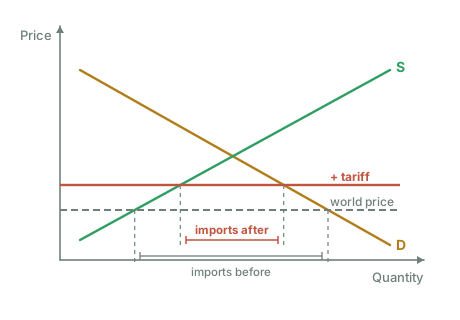
| Method | What it is | Effect |
|---|---|---|
| Tariff | A tax on imports | Raises the price of imports; raises revenue for the government |
| Quota | A physical limit on the quantity imported | Restricts supply, raising price; no revenue for the government |
| Subsidy to domestic producers | A payment to home firms | Lowers their costs so they undercut imports; costs the taxpayer |
| Embargo | A total ban on trade in a good or with a country | Usually political |
| Administrative barriers | Complex paperwork, strict standards, licensing | Raises the cost and delay of importing |
| Exchange control | Limiting the foreign currency available for imports | Restricts imports indirectly |
Tariff versus quota is a favourite exam distinction: both raise the price of imports, but only the tariff generates government revenue, and a quota fixes the quantity regardless of how badly foreign producers want to sell.
Reasons for protection
- Infant industry argument: new domestic industries need shelter until they achieve economies of scale.
- Protecting employment in industries facing cheap imports.
- Preventing dumping: foreign firms selling below cost to destroy domestic competitors.
- Improving the current account by reducing imports (6.4).
- Strategic industries: food, energy and defence, where dependence on imports is a national risk.
- Declining industries: protection to slow the decline so workers can retrain rather than face sudden mass unemployment.
- Raising government revenue through tariffs, which matters in countries with weak tax systems.
Consequences of protection
- Higher prices for consumers, and less choice, protection is a transfer from consumers to producers.
- Higher costs for domestic firms that use imported components.
- Inefficiency, because sheltered firms have less incentive to cut costs or innovate.
- Retaliation: other countries impose their own barriers, so exports fall and the current account may not improve at all. This is the most important consequence to state.
- Lower world output, as specialisation is reduced.
- Infant industries may never grow up if the protection is never removed.
Worked example
A country imposes a tariff on imported steel to protect its domestic steel industry.
- Imported steel now costs more
- buyers switch to domestic steel
- domestic output and employment rise in steel
- and the government collects tariff revenue.
But follow the chain further, which is what earns the higher marks:
- Steel-using firms: car makers, construction, now pay more for their main input → their costs rise → their prices rise and they become less competitive internationally.
- Consumers pay more for cars and buildings.
- The protected steel firms face less competition, so they have less incentive to become efficient.
- Other countries retaliate with tariffs on this country's exports → export industries lose sales and shed workers → the jobs saved in steel may be outnumbered by the jobs lost elsewhere.
Judgement: the tariff clearly helps the steel industry and raises revenue, but the costs fall on consumers and on every firm that uses steel. It is defensible as temporary protection while the industry modernises or workers retrain; as a permanent policy it entrenches inefficiency and invites retaliation.
Common exam mistakes
- Confusing a tariff (a tax) with a quota (a quantity limit).
- Saying protection saves jobs without mentioning jobs lost through retaliation and higher input costs.
- Forgetting that consumers pay for protection.
- Listing MNC benefits without the drawbacks, especially profit repatriation.
- Treating globalisation as a synonym for free trade, globalisation also covers investment, migration and technology flows.
- Giving the infant industry argument without noting that protection is meant to be temporary.
Exam technique
For "reasons for protection", give the argument and its weakness, the infant industry case only works if the protection is removed later.
For consequences, always separate the effects on domestic producers, consumers, firms using imports and exporters facing retaliation. Four groups, four developed points.
For MNC questions, organise as benefits and drawbacks to the host country, and conclude on whether the technology and employment gains outweigh profit outflows and the risk of the firm leaving.
Building an answer
4 marks, "Explain two methods of protection a government could use."
A tariff is a tax on imports. It raises the price of imported goods, so consumers switch towards domestic substitutes and import volumes fall, while the government collects revenue.
A quota is a physical limit on the quantity that may be imported. It restricts supply directly, raising the price, though unlike a tariff it raises no revenue for the government.
6 marks, "Analyse the arguments for and against protectionism."
For: infant industries may need temporary protection to reach a scale where they can compete; protection can save jobs in declining industries and give time to adjust; it can prevent dumping, where foreign firms sell below cost to drive out domestic rivals; and some industries are protected for strategic reasons, such as food or defence.
Against: protection raises prices for consumers and reduces choice; it shields domestic firms from the competitive pressure that drives efficiency; it invites retaliation, so export industries suffer; and infant-industry protection frequently becomes permanent because the protected industry lobbies to keep it.
The balance usually favours free trade for consumers and total output, while the costs of adjustment fall on identifiable groups of workers, which is why the politics rarely follows the economics.
The methods, and what each does
| Method | How it works | Who gains the revenue |
|---|---|---|
| Tariff | Tax raises the price of imports | Government |
| Quota | Physical limit on quantity imported | Importers holding the licences |
| Subsidy to domestic firms | Lowers their costs so they undercut imports | Domestic producers; costs the taxpayer |
| Embargo | Complete ban on trade with a country or in a good | Nobody: usually political |
| Administrative barriers | Standards and paperwork that raise the cost of importing | Nobody directly |
A real case to quote
US steel and aluminium tariffs, 2018. Steel producers and their workers gained protection, but US manufacturers using steel faced higher input costs, and trading partners retaliated against unrelated American exports including agriculture. Studies afterwards found the cost to consumers and downstream industries exceeded the gains to protected producers, the standard result, with named winners and losers to quote.
Quick revision
- Globalisation = growing interconnection through trade, investment, migration and technology.
- MNCs bring jobs, capital, technology and tax, but repatriate profits and can leave.
- Free trade brings lower prices, choice, economies of scale, competition and growth.
- Protection: tariff (tax, raises revenue), quota (quantity limit), subsidy, embargo, admin barriers, exchange control.
- Reasons: infant industry, employment, dumping, current account, strategic industries, revenue.
- Consequences: higher prices, inefficiency, higher input costs, and above all retaliation.
Check you have it
Question 1
A manufacturing firm in a low-income country has decided to close. What is most likely to have caused this decision?
Answer: A.
Multinationals arrive with advantages a local manufacturer cannot match, far greater scale and therefore lower average costs, better technology, cheaper access to finance, and established brands. A domestic firm competing against them loses sales and margins, and may be unable to survive. This crowding out of local producers is one of the recognised costs of relying on foreign investment for development.
Why the other options are wrong:
- B, increased global demand for its products, means more sales and higher revenue. That is a reason to expand, not to close.
- C, increased productivity, lowers unit costs and makes the firm more competitive.
- D, increased government subsidies, reduces costs and improves profitability, again supporting survival.
Question 2
The US government decides to reduce the size of the quota on a good it buys from China. What is likely to happen?
Answer: D.
A quota is a limit on the quantity of a good that may be imported. Reducing the size of the quota lowers that limit, so fewer units are allowed in and import volumes fall. This is the direct and certain effect, because the government is fixing the quantity itself rather than relying on how buyers respond to a price change.
Why the other options are wrong:
- A, the good becoming cheaper in the US, is the wrong direction. Restricting supply while demand is unchanged pushes the price up, and domestic producers facing less competition can raise their prices too.
- B, the US balance of trade worsening, is also reversed. Fewer imports means lower import expenditure, so the trade balance improves: at least until trading partners retaliate.
- C, government revenue declining, confuses a quota with a tariff. A tariff raises revenue because it taxes each unit imported; a quota collects nothing, since it simply forbids imports beyond the limit. Tightening a quota therefore has no effect on tariff revenue.
Question 3
What is the most likely benefit for a low-income economy if it removes tariffs on imported goods
and services?
Answer: A.
Removing tariffs makes imported goods cheaper in the domestic market, so more foreign varieties become affordable and viable to sell there. Consumers gain access to a wider range of products at lower prices, the most direct and reliable benefit of liberalisation, and one that accrues immediately.
Why the other options are wrong:
- B, more employment in declining industries, is the reverse. Removing protection exposes weak domestic industries to foreign competition, so they contract and shed workers. Structural unemployment during that adjustment is the main cost of the policy.
- C, more exports by domestic firms, is a possible indirect benefit, cheaper imported inputs lower costs, and trading partners may reciprocate, but it is not the most likely direct effect of removing one's own import tariffs.
- D, more tax revenue from imports, is contradicted outright. Abolishing tariffs removes the tax, so tariff revenue falls. This matters particularly for low-income countries, where border taxes are administratively easy to collect and can form a significant share of government revenue.
What the syllabus asks for on this topicSyllabus points
Syllabus points
- Define globalisation and multinational companies, and explain their role.
- Explain the benefits of free trade.
- Describe methods of protection and explain the reasons for and consequences of protection.
Related Cambridge IGCSE topics
Not the topic you were looking for? Describe what you are stuck on in your own words and we will take you to the notes that answer it.