Employment and Unemployment
Contents: 13 sections
What is unemployment?
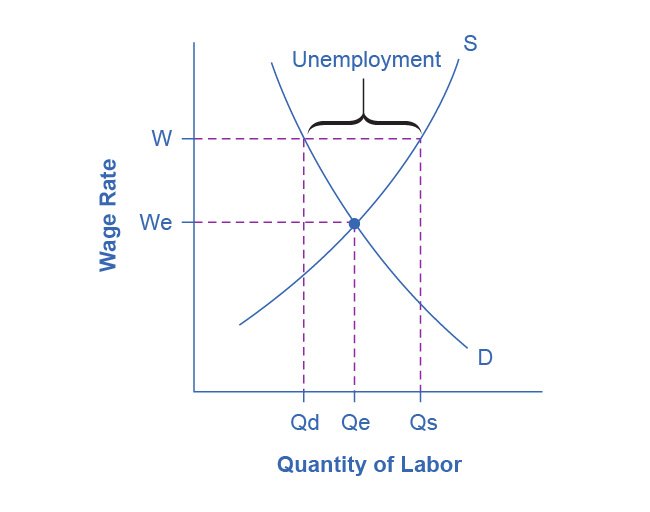
The unemployed are people of working age who are able and willing to work, actively seeking work, but without a job.
All parts of that definition matter. Someone who has stopped looking, or is not able to work, is not counted as unemployed; they are economically inactive.
Unemployment rate = (number unemployed ÷ labour force) × 100
The labour force is everyone employed plus everyone unemployed. It does not include students, retired people, carers or the long-term sick.
Dividing by the total population, or by the working-age population, is the classic error. The denominator is the labour force.
Measuring unemployment
Two methods, and the syllabus expects both:
- The claimant count: the number of people claiming unemployment benefits. It is cheap and quick, but understates unemployment, because some people who want work do not qualify for or do not claim benefits.
- The Labour Force Survey: a large sample survey asking people about their work status. It follows an international standard, so comparisons between countries are easier, but it is expensive and based on a sample, so it has a margin of error.
Both measures miss hidden unemployment: discouraged workers who have given up looking, and people in part-time work who want full-time hours.
Types of unemployment
Identifying the type is what decides which policy will work.
| Type | Cause | Example |
|---|---|---|
| Cyclical (demand-deficient) | A downturn in the economy: total demand falls | Workers laid off during a recession |
| Structural | Long-term change in the pattern of demand or technology; skills no longer match jobs | Coal miners after pit closures |
| Frictional | People between jobs, searching for the right one | A graduate looking for a first job |
| Seasonal | Demand varies through the year | Ski instructors in summer; farm workers out of season |
| Voluntary | Choosing not to accept available work at current wages | Someone holding out for a better offer |
Only cyclical unemployment responds to demand-side policy. Structural unemployment needs retraining and improved mobility, pumping demand into the economy will not help someone whose skills no longer match any vacancy.
Frictional unemployment is not really a problem. Some job searching is healthy: it helps people find work that suits them.
Consequences of unemployment
For the unemployed:
- Loss of income and a lower standard of living.
- Skills decay the longer they are out of work, making re-employment harder.
- Stress, poorer health, and loss of confidence.
For the government:
- Lower tax revenue, because fewer people earn and spend.
- Higher spending on unemployment benefits.
- So the budget position worsens from both directions at once.
For the economy:
- Output is lost permanently: goods not produced this year can never be recovered.
- Lower incomes mean lower consumer spending, which can deepen a downturn.
- Resources sit idle: the economy operates inside its PPC (1.4).
For society:
- Greater inequality and poverty.
- Often associated with higher crime and social problems.
- Certain regions can suffer badly if a major local employer closes.
Policies to reduce unemployment
| Type of unemployment | Appropriate policy |
|---|---|
| Cyclical | Expansionary fiscal policy (4.3) or lower interest rates (4.4) to raise demand |
| Structural | Retraining, education, relocation support, regional investment |
| Frictional | Better job information and employment services |
| Seasonal | Encouraging year-round industries; diversification |
Worked example
A country's largest steelworks closes. Two thousand workers lose their jobs in a town where most other employers want different skills.
- The workers' skills match steel production, not the jobs available
- they are occupationally immobile (1.2)
- moving elsewhere may be impossible if housing is expensive, so they are also geographically immobile
- this is structural unemployment.
Why demand-side policy fails here: cutting interest rates raises demand across the economy, but the vacancies created need different skills or are in different regions. The steelworkers remain unemployed while those vacancies go unfilled.
What would work: government-funded retraining in skills local employers actually need, plus help with relocation costs. Both take time and money, and the training must match real vacancies, otherwise it wastes resources and the workers are no better off.
Common exam mistakes
- Dividing by the population instead of the labour force.
- Counting economically inactive people as unemployed.
- Recommending demand-side policy for structural unemployment.
- Treating all unemployment as damaging, some frictional unemployment is normal.
- Giving consequences only for the unemployed, ignoring the government and the wider economy.
- Confusing the claimant count with the Labour Force Survey.
Exam technique
Identify the type first. The stimulus almost always contains the clue, a recession points to cyclical, a closing industry to structural, someone between jobs to frictional. Then match the policy and say why the alternative would not work.
For consequences, organise by group: the unemployed, the government, the economy, society. That produces a full answer almost automatically.
Use the phrase labour force whenever you write the formula.
Building an answer
4 marks, "Explain two causes of unemployment."
Cyclical unemployment arises when total demand in the economy falls during a recession: firms sell less, produce less and therefore need fewer workers.
Structural unemployment arises when the pattern of demand changes permanently, an industry declines and its workers' skills no longer match the jobs available, so they remain unemployed even when the economy recovers.
6 marks, "Analyse the consequences of high unemployment for an economy."
Output is lost permanently: the economy operates inside its production possibility curve, and the goods not produced this year cannot be recovered.
Government finances worsen from both sides, less income tax and VAT collected, more spent on benefits, so the budget deficit grows.
The unemployed lose income and, over time, skills, which makes re-employment harder and can turn short-term joblessness into long-term exclusion.
There are social costs too: unemployment is associated with poorer health outcomes and higher crime, and these persist after the economic cycle turns.
The types, and what each needs
| Type | Cause | What actually helps |
|---|---|---|
| Cyclical | Fall in total demand during recession | Expansionary fiscal or monetary policy |
| Structural | Long-term change in industry and skills | Retraining, relocation support |
| Frictional | Normal time between jobs | Better job information; some is unavoidable |
| Seasonal | Demand varies through the year | Diversification of local employment |
| Technological | Automation replacing labour | Retraining into growing sectors |
| Voluntary | Choosing not to work at the going wage | Adjusting incentives: but not always a problem |
Matching the policy to the type is where the marks are. Expansionary demand policy does nothing for structural unemployment, because the jobs and the skills are in different places.
A real case to quote
UK coal mining communities after the 1980s. Pit closures created structural unemployment that persisted for decades, because the skills were specific, the jobs were concentrated in particular towns, and workers could not easily move. It is the standard example for why structural unemployment is the hardest type to cure and why demand-side policy alone would not have touched it.
Quick revision
- Unemployed = able, willing, actively seeking, but without work.
- Rate = unemployed ÷ labour force × 100.
- Measures: claimant count (understates) and Labour Force Survey (sample-based).
- Types: cyclical, structural, frictional, seasonal, voluntary.
- Only cyclical responds to demand-side policy; structural needs retraining.
- Costs: lost income and skills, lower tax revenue, higher benefits, lost output, social problems.
- The economy operates inside its PPC when unemployment is high.
Check you have it
Question 1
Which type of unemployment is the result of a permanent fall in the demand for the products of
an industry?
Answer: D.
Question 2
During periods of high unemployment across the entire labour force, the highest unemployment rate in an economy is often in the 16–19 year-old age group. Which statement explains why 16–19 year-olds may find it difficult to find a job?
Answer: C.
Question 3
Which change, as a percentage of GDP, would be unlikely to be found in a country as it
develops?
Answer: C.
What the syllabus asks for on this topicSyllabus points
Syllabus points
- Define unemployment and how it is measured.
- Explain the causes and types of unemployment.
- Explain the consequences of unemployment.
Related Cambridge IGCSE topics
Not the topic you were looking for? Describe what you are stuck on in your own words and we will take you to the notes that answer it.