Differences in Economic Development Between Countries: five questions to try now
Real past-paper questions, the answer key from the mark scheme, and the explanation that goes with it. No account needed to answer them.
Question 1
Developing countries are sometimes given aid by charities and foreign governments. Which aid programme would be least likely to lead to long-term economic growth?
Answer: C.
Food aid meets an urgent humanitarian need, and in a famine it saves lives. But it does nothing for long-term growth: once the food is eaten, no productive capacity remains. It can even do harm, by depressing local food prices and undercutting the farmers whose output the country needs in the long run, and by creating dependence on continued donations.
Why the other options do support long-term growth:
- A, an irrigation system, is capital investment. It raises agricultural yields permanently, so output and incomes are higher year after year.
- B, a new airport, is infrastructure. It improves access to export markets and supports tourism and trade, which raises output over decades.
- D, training technical staff, builds human capital. Skills stay with the workers, raising productivity permanently, and may spread to others they train in turn.
Question 2
A government in a developing country has given extra funds to promote trade in rural areas by encouraging the establishment of small shops. What is likely to increase as a result?
Answer: D.
Two classifications have to be right.
Tertiary: shops sell goods rather than producing them. Retailing is a service, and services belong to the tertiary sector. (Primary is extraction and agriculture; secondary is manufacturing and construction.)
Private sector: the shops are being established with the help of government funds, but they will be owned and run by the individuals who set them up, not by the state. A grant does not transfer ownership. Government money supporting privately owned businesses is a subsidy, and the businesses remain private.
Why the other options are wrong:
- A and B call the activity primary industry. Farming and mining are primary; a shop extracts nothing and grows nothing.
- B and C place the activity in the public sector. This is the more interesting error, and it comes from assuming that government funding implies government ownership. The two are separate questions: who pays, and who owns.
Question 3
The table shows the percentage (%) contribution of agriculture to the GDP of three countries in a year. country % X 18.5 Y 3.9 Z 2.2 What can be concluded from the table?

Answer: B.
Question 4
A country’s minister for agriculture said “the biggest challenge the country faces is to develop irrigation so that we are not at the mercy of the weather for crucial export earnings”. Which type of country is this most likely to be?
Answer: C.
Two clues in the quotation point the same way. The minister is concerned with irrigation and being "at the mercy of the weather", which means the country's output depends on rainfall, the characteristic vulnerability of agriculture. And those crops provide "crucial export earnings", meaning the country's foreign currency comes from selling primary products rather than manufactures or services. Dependence on weather-sensitive primary commodity exports is a defining feature of many developing economies.
Why the other options are wrong:
- A, developed exporting manufactured goods, would not describe a country whose export earnings hinge on rainfall. Factory output is unaffected by the weather.
- B, developed exporting services, is likewise insulated. Banking, tourism and software do not depend on irrigation.
- D, developing exporting services, gets the level of development right but the export type wrong. A service exporter would have no reason to describe irrigation as its biggest challenge.
Question 5
The table shows the percentage employment in the primary, secondary and service sectors in four countries. Which country is likely to be the most developed? Each answer gives, in order: primary sector (% employment); secondary sector (% employment); service sector (% employment).
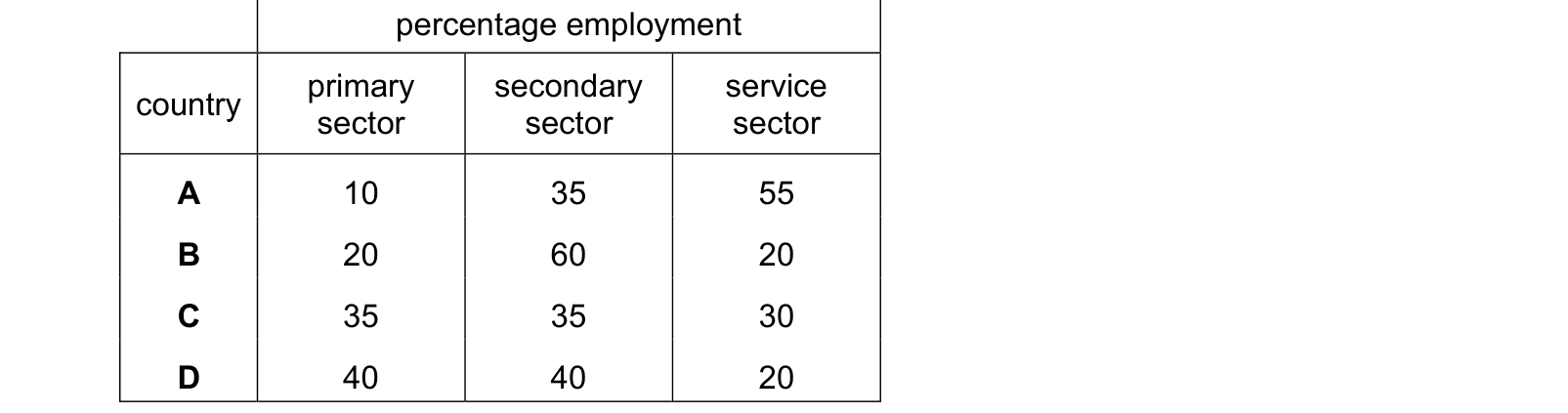
Answer: A.
What this practice covers
These questions are drawn from past Cambridge IGCSE papers and filtered to differences in economic development between countries. You answer, you find out immediately whether you were right, and you get the reasoning for the correct option and for each distractor. Wrong answers go to a mistakes locker so you can come back to exactly those.
Practice is free. You need an account only so your progress and your mistakes are still there next time.
What examiners see students get wrong here
These are the errors that cost marks on differences in economic development between countries, taken from our own topic notes. Read them before you practise and you will recognise the traps in the questions.
- Treating growth and development as the same thing.
- Saying developing countries are poor simply because they are "less advanced", with no mechanism.
- Forgetting the poverty cycle, which explains why the gap persists.
- Ignoring population growth when comparing living standards. Always think per capita.
- Assuming all developing countries are alike; they differ enormously.
- Listing causes without saying which the country could actually change.
Revise it first
If any of the above is unfamiliar, work through the notes before practising: Differences in Economic Development Between Countries revision notes.