Population: five questions to try now
Real past-paper questions, the answer key from the mark scheme, and the explanation that goes with it. No account needed to answer them.
Question 1
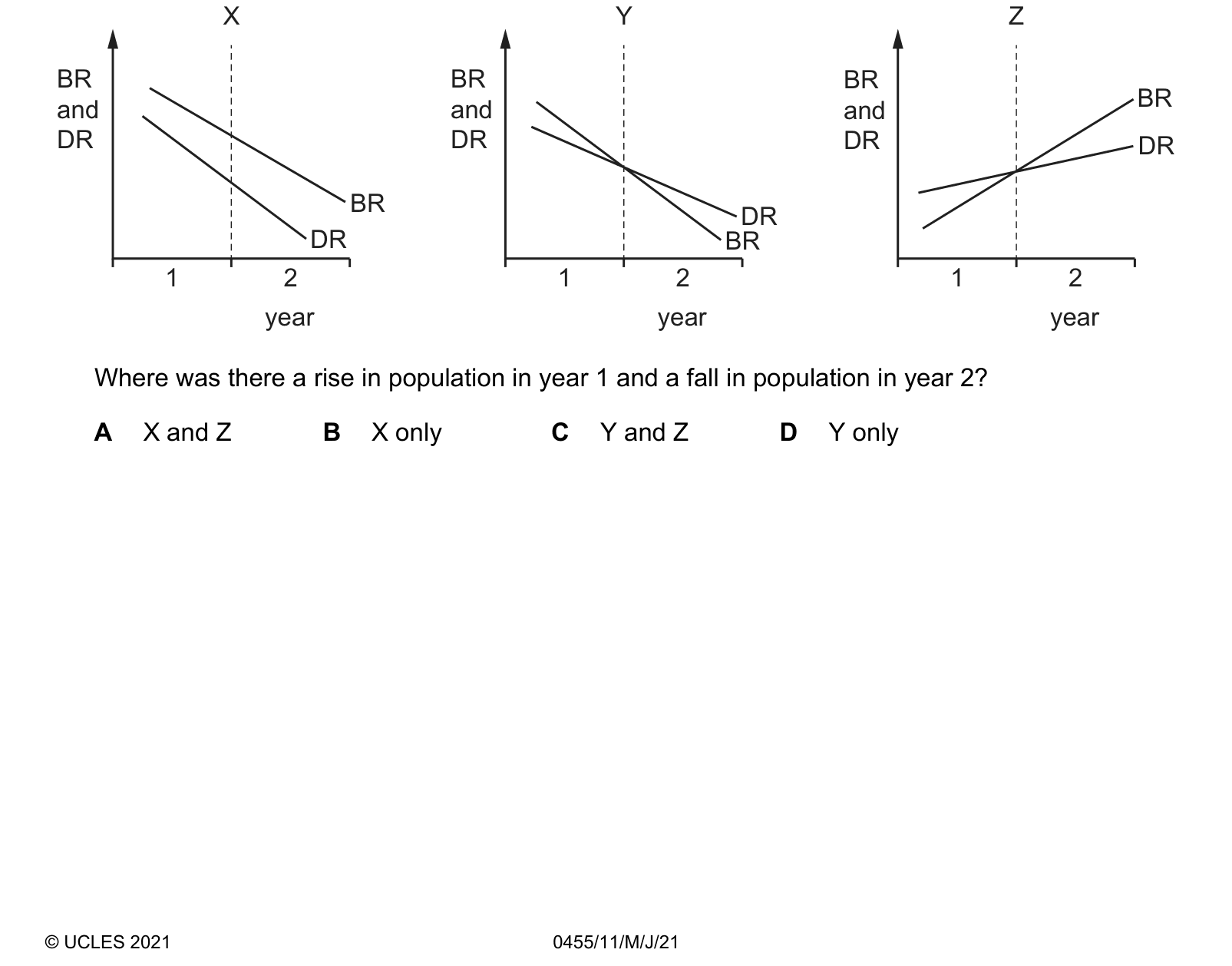
The diagrams show birth rate (BR) and death rate (DR) in three countries, X, Y and Z, in two years, 1 and 2. There was no migration.
Answer: D.
Population rises when the birth rate is above the death rate and falls when it is below. Look at which line is on top in each half of each diagram. In Y the birth rate line starts above the death rate line and crosses below it partway through, so in year 1 births exceed deaths and the population grows, and in year 2 deaths exceed births and it shrinks. That is the pattern the question asks for.
Why the other options are wrong:
- X has the birth rate above the death rate for the whole period, so the population rises in both years. Both lines are falling, but what matters is which is higher, not which way they slope.
- Z has the birth rate starting below the death rate and crossing above it, so the population falls in year 1 and rises in year 2, exactly the reverse of what is wanted.
- A, C and B all include X or Z for those reasons.
Question 2
A country has a declining population. It also has a changing population structure in which the size of the 15–64 age group is becoming smaller. How could it immediately reduce labour supply shortages?
Answer: A.
The word carrying the question is immediately. The 15–64 age group is shrinking, so the country needs more workers now. Immigrants arrive already of working age and, if skilled, can start work at once. This is the only measure among the four that adds to labour supply in the short term, which is why countries with ageing populations rely on it.
Why the other options are wrong:
- B, encouraging larger families, adds children. They will join the workforce in fifteen years or more, and in the meantime they increase the dependency ratio, making the immediate problem worse rather than better.
- C, investing in technological research, substitutes capital for labour and can genuinely relieve a shortage, but research takes years to produce usable results, and the equipment then has to be built and installed.
- D, lower taxes and higher basic wage rates, improves the incentive to work and may draw some economically inactive people into the labour force. That effect is real but limited in size and gradual, since it depends on people changing their minds and finding jobs.
Question 3
The United Nations (UN) predicts that the population in low-income countries will increase. What is likely to be a cause of this?
Answer: D.
This is the first stage of the demographic transition. Improvements in medicine, vaccination, clean water and sanitation cut death rates, especially infant and child mortality, very quickly, because they do not require families to change their behaviour. Birth rates, by contrast, fall only slowly, since they depend on education, women's employment and changing expectations about family size. While death rates have fallen and birth rates have not yet followed, births greatly exceed deaths and the population grows rapidly. That gap is exactly why low-income countries' populations are projected to increase.
Why the other options are wrong:
- A, climate change causing lower food output and starvation, would raise death rates and reduce population growth.
- B, improved education for girls leading to a small decline in birth rates, works against population growth. Female education is one of the strongest forces reducing birth rates, so it slows the increase rather than causing it.
- C, migration to higher-income countries, removes people from low-income countries, again reducing their populations.
Question 4
In a country the birth rate increased but the population decreased. What could have happened to other factors to cause this?
Answer: C.
Population change has two sources: natural change (births minus deaths) and net migration (immigration minus emigration). The puzzle is that the birth rate went up while the population went down, so something else must have more than offset the extra births.
With migration unchanged, the only remaining possibility is deaths. If the death rate rose enough to exceed the birth rate, natural change turns negative and the population falls despite more babies being born. That is exactly option C.
Why the other options are wrong:
- A, falling infant mortality with an unchanged death rate, means more babies survive. Combined with a higher birth rate, the population would rise.
- B, rising net immigration with an unchanged death rate, adds people. Combined with more births, the population rises further.
- D, a falling death rate with no change in migration, means fewer people die. Combined with a higher birth rate, the population must rise.
Question 5
The birth rate in a country is higher than the death rate. What might prevent the country’s population from rising?
Answer: A.
Population change has two components: natural change (births minus deaths) and net migration. The question states that the birth rate exceeds the death rate, so natural change is positive and pushing the population up. For the population not to rise, the other component must offset it, net outward migration, meaning more people leaving than arriving.
Why the other options are wrong:
- B, a falling birth rate, only narrows the gap between births and deaths. As long as the birth rate still exceeds the death rate, natural change stays positive and the population continues to grow. A falling rate slows growth; it does not prevent it.
- C, improving medical care, lowers the death rate, which widens the gap and makes the population rise faster.
- D, a rising death rate, again only narrows the gap. The question's premise is that births exceed deaths, and the option does not say the death rate rises far enough to overtake the birth rate.
What this practice covers
These questions are drawn from past Cambridge IGCSE papers and filtered to population. You answer, you find out immediately whether you were right, and you get the reasoning for the correct option and for each distractor. Wrong answers go to a mistakes locker so you can come back to exactly those.
Practice is free. You need an account only so your progress and your mistakes are still there next time.
What examiners see students get wrong here
These are the errors that cost marks on population, taken from our own topic notes. Read them before you practise and you will recognise the traps in the questions.
- Forgetting migration, population change is not just births minus deaths.
- Saying an ageing population is caused only by people living longer; the falling birth rate matters just as much.
- Confusing a falling birth rate with a falling population, a population can still grow.
- Saying population growth is always bad; a larger labour force and market are genuine advantages.
- Defining optimum population as the population a country can "fit", rather than the one maximising output per head.
Revise it first
If any of the above is unfamiliar, work through the notes before practising: Population revision notes.