National Income and Price Determination Exam Questions
Four practice questions are below. Answer on the page: each one is marked the moment you pick, the correct option is shown whether or not you found it, and the full explanation opens either way.
AP Economicsconcept drillsFree account
National Income and Price Determination: four questions to try now
Real questions, the answer key from the mark scheme, and the explanation that goes with it. No account needed to answer them.
Cross-board concept practice · originally a CIE 9708 question, used here because the concept is the same. It is not AP Economics past-paper material.
Question 1
Country X has a low rate of inflation and a stable currency and unemployed resources. It attracts $25 billion of direct foreign investment. What is most likely to be a positive benefit of the inflow of this foreign direct investment for country X?
Answer: A.
The question asks for a positive benefit, and three of the four options are costs or risks dressed as consequences, so reading the stem carefully does most of the work. The inflow of 25 billion dollars is spending in country X: it pays for construction, equipment and wages, and each of those payments becomes income that is partly spent again, so the multiplier turns the initial injection into a larger rise in national income. The stem's mention of unemployed resources is what makes this the answer rather than a hope, because with idle labour and capital the extra demand raises output rather than only prices. Profits flowing out to foreign owners is a genuine long-run cost of foreign direct investment, appearing as a debit in the primary income account, but it is a drawback rather than a benefit. Having to use foreign reserves to cover a trade deficit is a burden too. Inflation arising if the country tries to expand capacity is a risk, and the stem has already told us inflation is low and resources are idle, which makes it the least likely outcome as well as not a benefit.
Cross-board concept practice · originally a CIE 9708 question, used here because the concept is the same. It is not AP Economics past-paper material.
Question 2
According to Keynesian theory, what will cause the rate of interest to rise?
Answer: D.
In Keynesian liquidity preference theory the rate of interest is the price of money, set where the demand for money meets the supply of it. A decrease in the SUPPLY of money leaves the same demand chasing a smaller stock, so the price of holding money is bid up and the interest rate rises, which is D. A moves the demand side the wrong way, because a decrease in liquidity preference is a fall in the demand for money, and less demand against an unchanged supply lowers the rate. B also lowers it, since a smaller national income means fewer transactions to finance and therefore less transactions demand for money. C is not a direct influence on the rate at all in this model; in Keynesian analysis the rate of interest is one of the things that DETERMINES investment rather than the other way round, so a fall in investment is a consequence of a higher rate, not a cause of one.
Cross-board concept practice · originally a CIE 9708 question, used here because the concept is the same. It is not AP Economics past-paper material.
Question 3
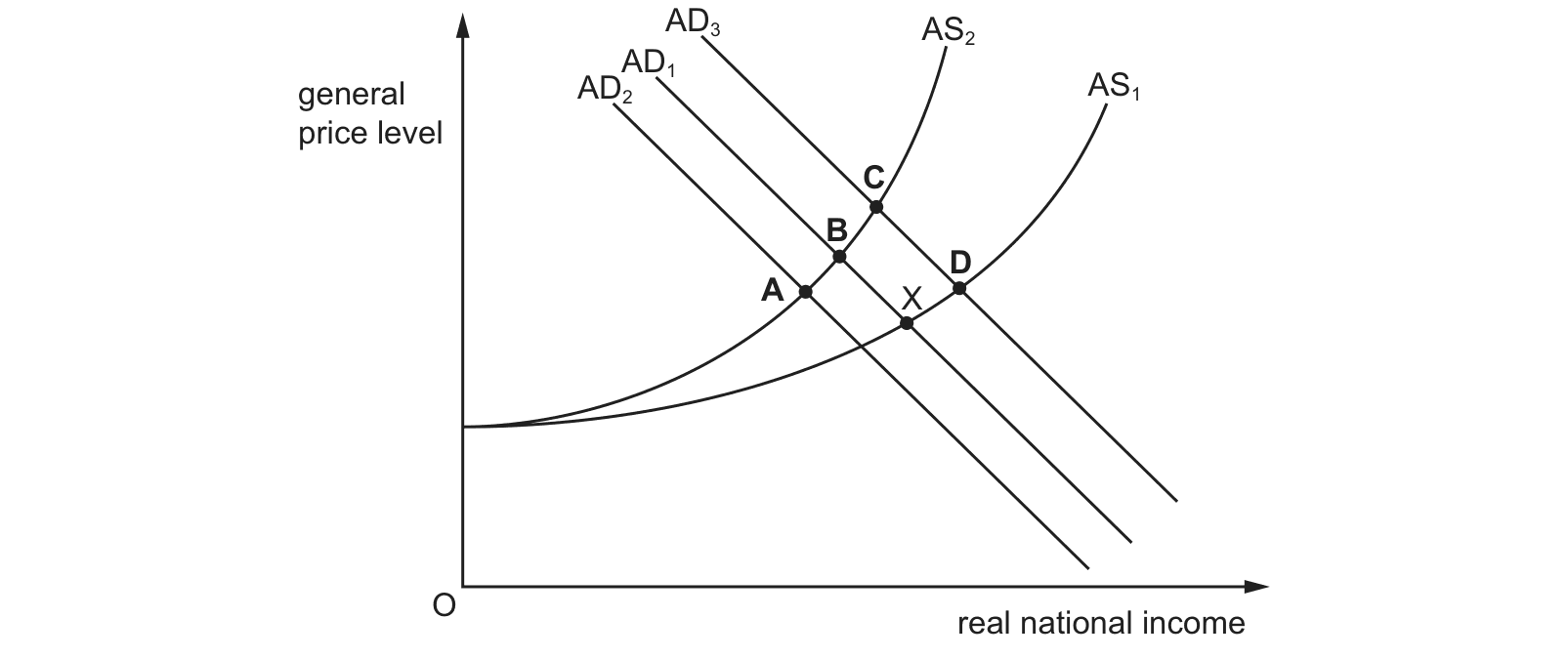
The aggregate demand (AD) and aggregate supply (AS) diagram shows an economy in equilibrium at X. In this economy, a severe shortage of raw materials causes a large rise in their price. The effect of this change is shown by a move to which point?
Answer: B.
A shortage of raw materials raises production costs, which shifts aggregate SUPPLY left from AS1 to AS2 while aggregate demand stays put on AD1. The new equilibrium is therefore where AD1 meets AS2, point B, up and to the left of X. That is cost-push in its textbook form: the price level rises and real national income falls at the same time. Points reached by moving to a different AD curve would require a change in spending, which is not what has happened.
Cross-board concept practice · originally a CIE 9708 question, used here because the concept is the same. It is not AP Economics past-paper material.
Question 4
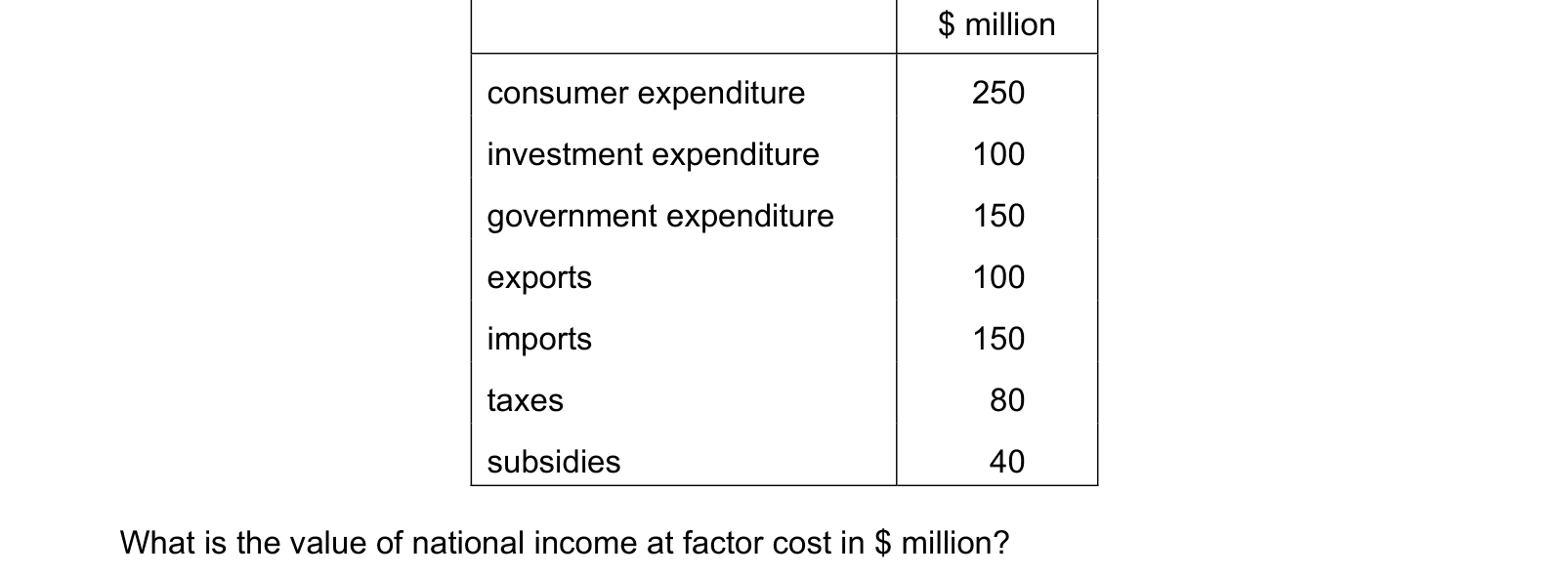
The information in the table is taken from a country’s national income accounts. $ million consumer expenditure 250 investment expenditure 100 government expenditure 150 exports 100 imports 150 taxes 80 subsidies 40 What is the value of national income at factor cost in $ million?
Answer: A.
Start with expenditure at market prices: 250 + 100 + 150 + 100 − 150 = $450m. Then convert to FACTOR COST by subtracting taxes and adding subsidies: 450 − 80 + 40 = $410m. Taxes inflate market prices above what producers actually receive, and subsidies do the reverse, which is why both adjustments are needed.
These questions are drawn from past Cambridge papers, mapped across to this topic because the concept is the same. You answer, you find out immediately whether you were right, and you get the reasoning for the correct option and for each distractor. Wrong answers go to a mistakes locker so you can come back to exactly those.
Practice is free. You need an account only so your progress and your mistakes are still there next time.
These are the errors that cost marks on national income and price determination, taken from our own topic notes. Read them before you practise and you will recognise the traps in the questions.
Explaining AD's slope with substitution between goods.
Shifting AD by the initial injection rather than the multiplied amount.
Using the spending multiplier for a tax change.
Forgetting the tax multiplier is negative and smaller in magnitude.
Reading the multiplied AD shift as the increase in real GDP, ignoring the slope of SRAS.
Drawing LRAS as upward-sloping, in AP it is vertical at Yf.
Shifting LRAS for a temporary supply shock, or for a change in AD.