Production, Cost, and the Perfect Competition Model Exam Questions
Five practice questions are below. Answer on the page: each one is marked the moment you pick, the correct option is shown whether or not you found it, and the full explanation opens either way.
AP Economicsconcept drillsFree account
Production, Cost, and the Perfect Competition Model: five questions to try now
Real questions, the answer key from the mark scheme, and the explanation that goes with it. No account needed to answer them.
Cross-board concept practice · originally a CIE 9708 question, used here because the concept is the same. It is not AP Economics past-paper material.
Question 1
Assuming the absence of price controls, in which industry is an individual firm least likely to be able to alter the price at which it sells its product?
Answer: D.
The correct answer is D: wheat farming.
Wheat farming comes closest to perfect competition. There are very many producers, each supplying a negligible share of world output, and wheat is a homogeneous commodity, one farmer's grain of a given grade is indistinguishable from another's. An individual farmer is therefore a price taker: raise the price above the market level and buyers simply purchase from someone else, and there is no reason to sell below it. Price is set by total market supply and demand, and the individual firm has no influence over it.
Why the other options are wrong:
A, air transportation, is an oligopoly. A few large carriers each have significant market power, and route-by-route differences in schedules and service allow considerable price setting, as anyone comparing fares can see.
B, hairdressing, is monopolistic competition. There are many small firms, but each differentiates itself by location, skill and reputation, so each has a little pricing discretion and faces a downward-sloping demand curve.
C, steel production, involves a relatively small number of large producers with differentiated grades and specifications, giving them some price-setting ability.
The two features that make a firm a price taker are a very large number of sellers and a genuinely homogeneous product. Only wheat has both.
Cross-board concept practice · originally a CIE 9708 question, used here because the concept is the same. It is not AP Economics past-paper material.
Question 2
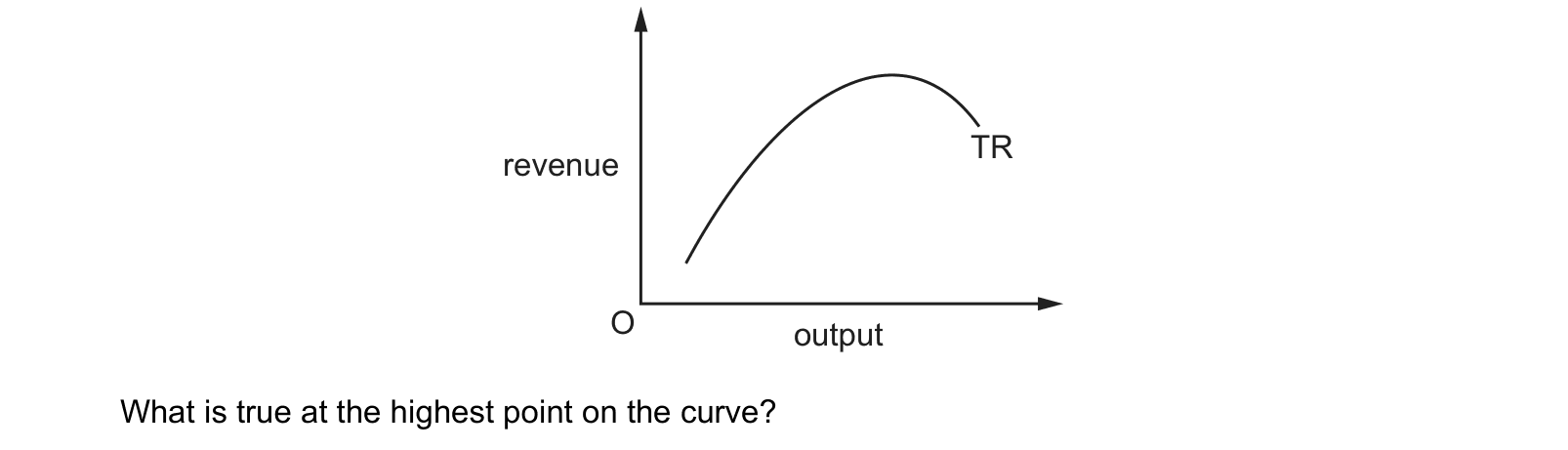
The diagram shows a firm’s total revenue curve. What is true at the highest point on the curve?
Answer: C.
The total revenue curve plots revenue against output, so its slope at any point is the extra revenue earned from one more unit, which is marginal revenue. A curve reaches its highest point where its slope is zero, so the top of the total revenue curve is the output at which marginal revenue equals zero; to the left of that point marginal revenue is positive and revenue is still climbing, to the right it is negative and revenue falls away. Average revenue is total revenue divided by output, and since total revenue is at its largest here, average revenue is certainly not zero. Average revenue equals marginal revenue only when the demand curve is horizontal, which is perfect competition, and there total revenue rises in a straight line and has no highest point at all. Maximum profit is the most tempting answer, because peak revenue looks like peak success, but profit depends on costs as well, and costs are still rising at this output, so the profit maximising point lies to the left of the revenue maximising one.
Cross-board concept practice · originally a CIE 9708 question, used here because the concept is the same. It is not AP Economics past-paper material.
Question 3
What must equal marginal cost when a profit-maximising firm produces at its allocatively efficient output?
Answer: A.
Allocative efficiency is the condition that price equals marginal cost: the price measures the value consumers place on the last unit, marginal cost measures what society gave up to produce it, and when they are equal no reallocation could raise welfare. Price is the same thing as AVERAGE revenue, since average revenue is total revenue divided by quantity, which is the price per unit. So the magnitude that must equal marginal cost is average revenue, which is A. B, average total cost, equals marginal cost at the lowest point of the average cost curve, and that is PRODUCTIVE efficiency, a different condition entirely. C and D compare a per-unit figure with a whole, since marginal cost is the cost of one further unit while total revenue and total cost cover all units, so neither equality is even dimensionally sensible. Profit maximisation is marginal cost equal to MARGINAL revenue, which coincides with this condition only in perfect competition, where average and marginal revenue are the same.
Cross-board concept practice · originally a CIE 9708 question, used here because the concept is the same. It is not AP Economics past-paper material.
Question 4
In which market structure will the industry price be unaffected by a change in the output of one individual firm?
Answer: D.
Only in perfect competition is each firm so small a part of the market that its own output decision leaves the price where it was, which is what being a price taker means and why the firm's demand curve is drawn horizontal. In monopoly there is only one firm, so its output decision is the industry's output decision and the price moves with it. In oligopoly a few firms share the market and each is large enough for a change in its output to move the market price, which is the source of the interdependence that defines the structure. In monopolistic competition each firm faces a downward sloping demand curve because its product is differentiated, so it too must accept a lower price to sell more; the effect is smaller than under monopoly but it is not zero. The general rule is that the firm's demand curve is horizontal only when the firm is negligible relative to the market, and perfect competition is the only structure that assumes it.
Cross-board concept practice · originally a CIE 9708 question, used here because the concept is the same. It is not AP Economics past-paper material.
Question 5
To maximise total revenue, up to which point should a monopolist increase output?
Answer: C.
Total revenue rises for as long as each extra unit adds something to it and falls once extra units subtract, so the monopolist should keep expanding output until marginal revenue reaches zero and stop there. That output is also where price elasticity of demand equals one, since revenue peaks exactly at the boundary between the elastic and inelastic stretches of the demand curve. Marginal revenue equal to average revenue happens only when the demand curve is horizontal, which describes perfect competition rather than a monopoly; for a downward sloping demand curve marginal revenue always lies below average revenue. The point at which marginal revenue is maximised is somewhere else entirely, near the top of the demand curve at very low output, and stopping there would leave a great deal of revenue unearned while marginal revenue was still positive. Price elasticity of demand equal to zero means perfectly inelastic demand, which lies far out on the inelastic stretch where marginal revenue has already turned negative, so carrying on to that point would push revenue back down.
These questions are drawn from past Cambridge papers, mapped across to this topic because the concept is the same. You answer, you find out immediately whether you were right, and you get the reasoning for the correct option and for each distractor. Wrong answers go to a mistakes locker so you can come back to exactly those.
Practice is free. You need an account only so your progress and your mistakes are still there next time.
These are the errors that cost marks on production, cost, and the perfect competition model, taken from our own topic notes. Read them before you practise and you will recognise the traps in the questions.
Drawing a downward-sloping demand curve for a perfectly competitive firm. It is horizontal.
Using ATC instead of AVC for the shut-down decision.
Saying zero economic profit means the firm makes no money.
Ignoring implicit costs, and so reporting accounting profit as economic profit.
Confusing diminishing returns (short run) with diseconomies of scale (long run).
Drawing MC cutting ATC anywhere other than its minimum.
Drawing AFC as U-shaped, it falls continuously.
Putting AVC's minimum at the same output as ATC's. AVC turns first.