Question 1
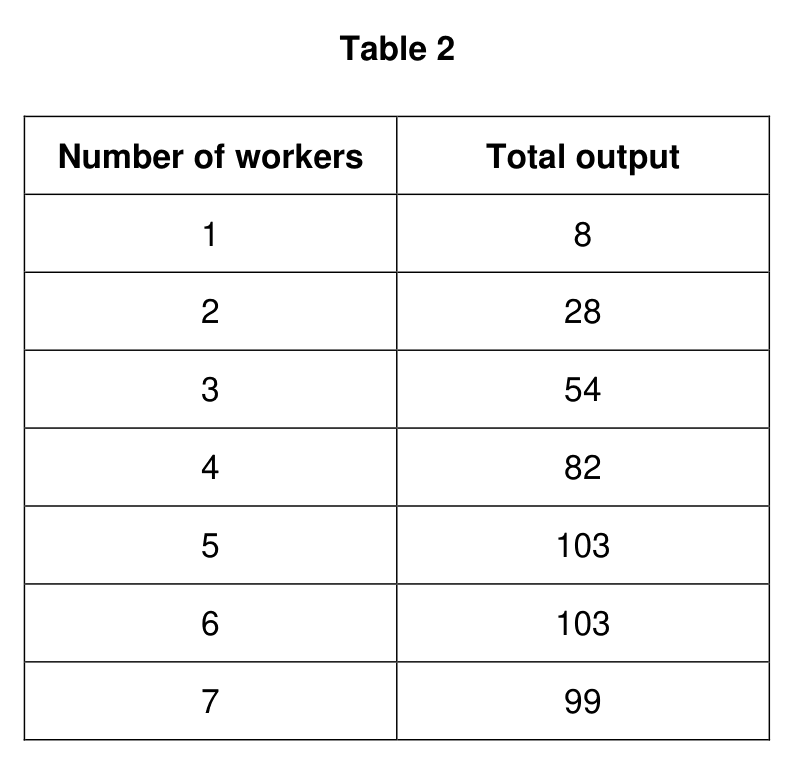
Table 2 shows the relationship between the number of workers employed by a firm and the total output of a product. The amount of other factors of production employed remains the same. Number of workers / Total output: 1/8, 2/28, 3/54, 4/82, 5/103, 6/103, 7/99. For this firm, diminishing marginal returns to labour occur when the
Answer: B.
What this practice covers
Real past-paper questions, the answer key from the mark scheme, and the explanation that goes with it. Each one is marked the moment you pick, the correct option is shown whether or not you found it, and the full explanation opens either way. No account needed to answer them.
These questions are drawn from past AQA A-Level papers. You answer, you find out immediately whether you were right, and you get the reasoning for the correct option and for each distractor. Wrong answers go to a mistakes locker so you can come back to exactly those.
Practice is free. You need an account only so your progress and your mistakes are still there next time.
What examiners see students get wrong here
These are the errors that cost marks on production and costs, taken from our own topic notes. Read them before you practise and you will recognise the traps in the questions.
- Confusing diminishing returns (short run, one fixed factor) with diseconomies of scale (long run, all factors variable). This is the single biggest discriminator.
- Confusing production (total output) with productivity (output per input).
- Saying diminishing returns means total output falls; it is the marginal product that falls; total output usually still rises.
- Drawing MC cutting ATC anywhere other than its minimum.
- Treating external economies as internal, external ones come from the industry, not the firm.
- Listing economies of scale without explaining how each lowers average cost.
Revise it first
If any of the above is unfamiliar, work through the notes before practising: Production and Costs revision notes.