35 past-paper questions on this unit. Five of them are below. Answer on the page: each one is marked the moment you pick, the correct option is shown whether or not you found it, and the full explanation opens either way.
CIE 0452 AccountingPaper 1 MCQsFree account
Control accounts: five questions to try now
Real past-paper questions, the answer key from the mark scheme, and the explanation that goes with it. No account needed to answer them.
Question 1
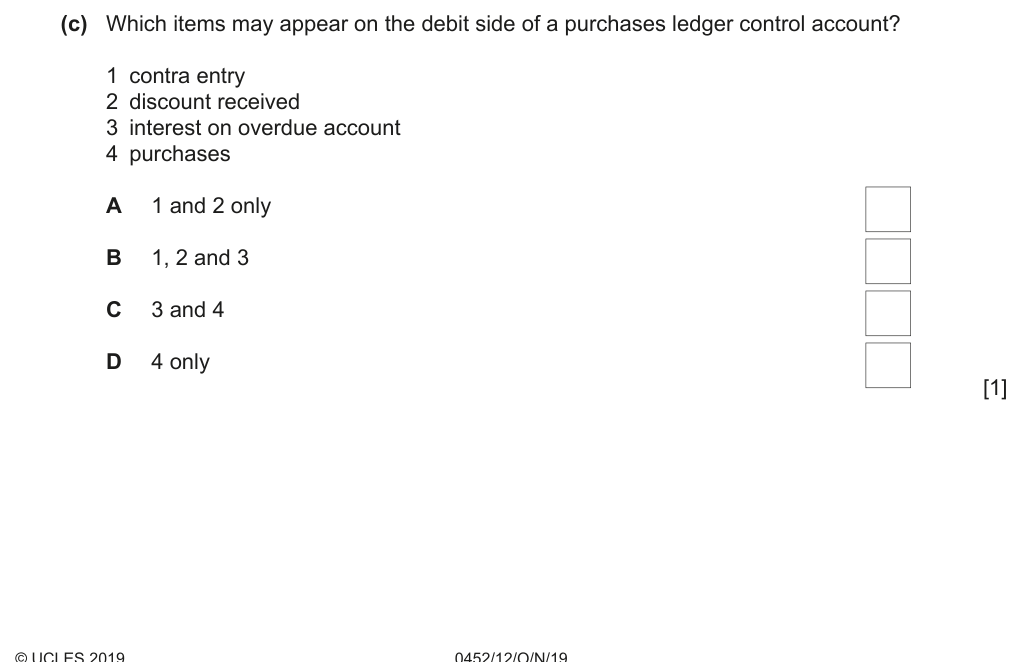
Which items may appear on the debit side of a purchases ledger control account? 1 contra entry 2 discount received 3 interest on overdue account 4 purchases Use the complete source image for the question and answer choices. Source reference: W19 Paper 12, Q1(c).
Answer: A.
The debit side of a purchases ledger control account holds everything that REDUCES what the business owes its suppliers. A contra entry does that, setting a receivable off against a payable, so item 1 belongs there. Discount received does too, since it is part of the debt cancelled on settlement, so item 2 belongs there. A is correct. Item 3, interest charged on an overdue account, increases the debt and so sits on the credit side. Item 4, purchases, is the very thing that creates the debt and is the largest credit entry of all. B and C each include an item that belongs on the opposite side, and D names only purchases.
Question 2
Why is a sales ledger control account usually prepared by a different member of staff than the person who maintains the sales ledger?
Answer: A.
The question is not why a control account is prepared but why a DIFFERENT person prepares it, and the answer to that is independence. If the same person wrote the sales ledger and the account that checks it, any figure invented in the ledger could be matched by an equal invention in the check, so separating the two makes fraud far harder to conceal. A is correct. B, C and D are all genuine benefits of having a control account at all, but every one of them would still hold if the same clerk did both jobs, so none of them explains the division of duties.
Question 3
Javid’s sales ledger control account had a debit balance of $12 000. Interest on an overdue account, $40, and discount allowed, $150, had been omitted. What was the correct balance on the sales ledger control account?
Answer: B.
Deal with the two omissions separately, since they belong on opposite sides. Interest charged on an overdue account increases what the customer owes, so it is a debit and 40 is added, taking the balance to 12 040. Discount allowed cancels part of the debt, so it is a credit and 150 is deducted, giving 11 890. B is correct. A of 11 810 deducts both, treating the interest as though it reduced the debt. D of 12 190 adds both. C of 12 110 has each one on precisely the wrong side, which is the answer a student reaches by assuming that anything omitted must be added.
Question 4
When preparing a sales ledger control account, what is the source of information for amounts received from credit customers?
Answer: B.
Money received from credit customers is entered in the cash book when it arrives, so the cash book is the book of prime entry that supplies the total, and B is correct. C is the trap: taking the figure from the sales ledger accounts would draw both sides of the comparison from the same source and prove nothing. A, the bank statement, is prepared by the bank and shows what reached the account, not what the business recorded, so it belongs to reconciliation rather than to control. D, statements of account, are summaries the business sends OUT to customers.
Question 5
A business keeps a complete set of books of accounts. What is not used as a source of information for making entries in control accounts?
Answer: D.
Control accounts are written up from the books of prime entry: the sales and purchases journals, the returns journals, the cash book and the general journal. The one source that must NOT be used is the ledger the account exists to check, so D is the answer. Taking the totals out of the sales ledger would guarantee agreement and prove nothing, because both figures would come from the same place and any error would appear identically in each. A, B and C are all books of prime entry and are exactly where the totals come from.
These questions are drawn from past CIE 0452 Accounting papers and filtered to control accounts. You answer, you find out immediately whether you were right, and you get the reasoning for the correct option and for each distractor. Wrong answers go to a mistakes locker so you can come back to exactly those.
Practice is free. You need an account only so your progress and your mistakes are still there next time.
These are the errors that cost marks on control accounts, taken from our own topic notes. Read them before you practise and you will recognise the traps in the questions.
Including cash sales or cash purchases.
Putting discount allowed on the debit side of the sales ledger control account.
Including the allowance for irrecoverable debts.
Putting the contra on the wrong side of one account.
Treating the sales ledger control account as a credit balance.
Saying an agreeing control account proves the ledger is correct.
Leaving out the dishonoured cheque, which is a debit in the sales ledger control account because the customer owes the money again.