Other payables and other receivables Exam Questions
41 past-paper questions on this unit. Five of them are below. Answer on the page: each one is marked the moment you pick, the correct option is shown whether or not you found it, and the full explanation opens either way.
CIE 0452 AccountingPaper 1 MCQsFree account
Other payables and other receivables: five questions to try now
Real past-paper questions, the answer key from the mark scheme, and the explanation that goes with it. No account needed to answer them.
Question 1
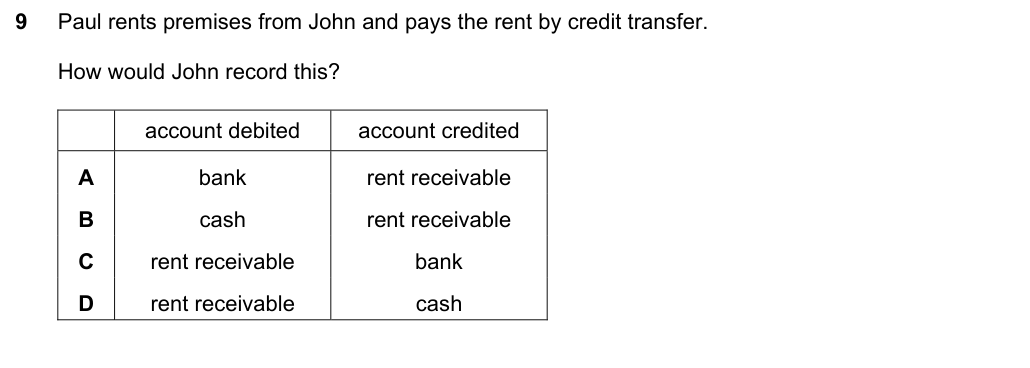
Paul rents premises from John and pays the rent by credit transfer. How would John record this? Use the complete source image for the question and answer choices. Source reference: S20 Paper 12, Q9.
Answer: A.
The question asks how JOHN records it, and John is the landlord receiving the money. A credit transfer puts the rent straight into his bank, so bank is debited, and the matching credit goes to rent receivable because the income has now been earned and received. A is correct. B names cash, but a credit transfer moves money between bank accounts and never passes through the cash box. C and D reverse the entry, which would show John paying rent out rather than taking it in, and that is Paul's side of the transaction.
Question 2
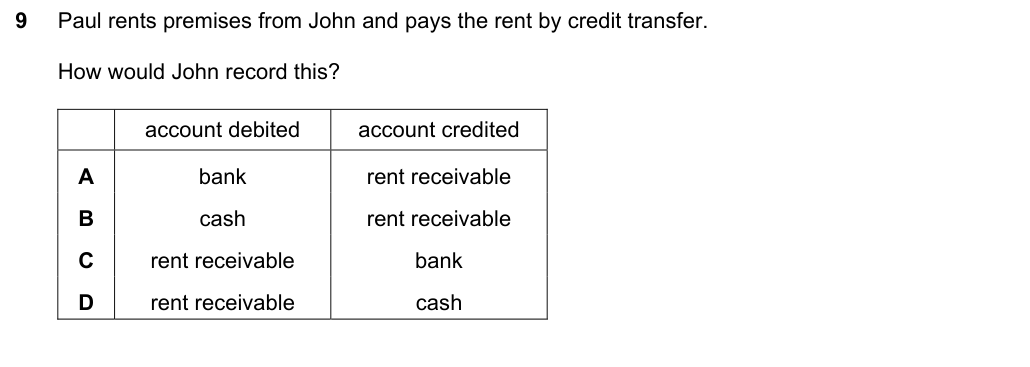
Paul rents premises from John and pays the rent by credit transfer. How would John record this? Use the complete source image for the question and answer choices. Source reference: S20 Paper 13, Q9.
Answer: A.
The question asks how JOHN records it, and John is the landlord receiving the money. A credit transfer puts the rent straight into his bank, so bank is debited, and the matching credit goes to rent receivable because the income has now been earned and received. A is correct. B names cash, but a credit transfer moves money between bank accounts and never passes through the cash box. C and D reverse the entry, which would show John paying rent out rather than taking it in, and that is Paul's side of the transaction.
Question 3
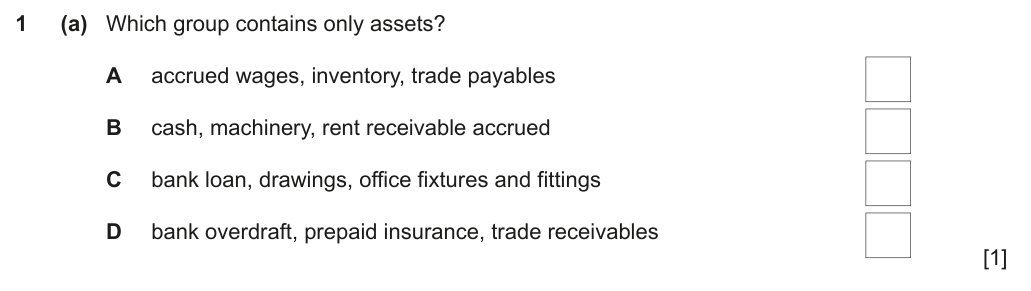
Which group contains only assets? Use the complete source image for the question and answer choices. Source reference: W19 Paper 12, Q1(a).
Answer: B.
An asset is something the business owns or is owed, so test each item. B holds cash, machinery and rent receivable accrued, and the last of those is rent earned but not yet received, which is money owed TO the business. All three qualify, so B is correct. A contains accrued wages and trade payables, both amounts owed BY the business. D contains a bank overdraft, which is money owed to the bank. C contains a bank loan, also a liability, and drawings, which are neither asset nor liability but a reduction of capital.
Question 4
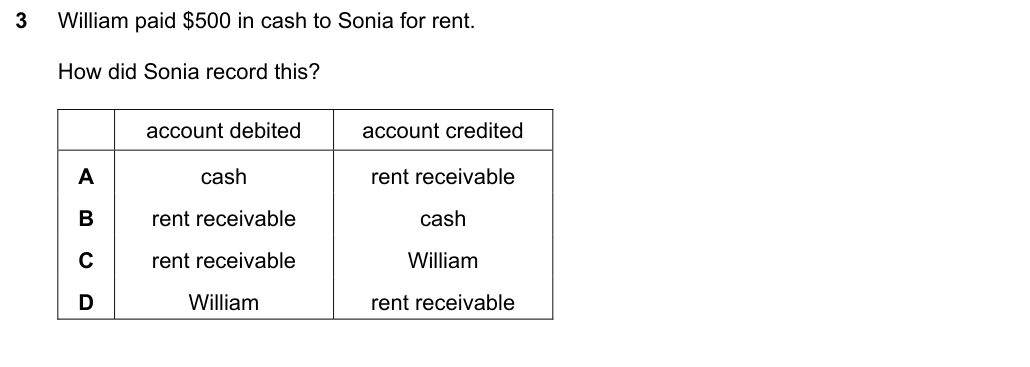
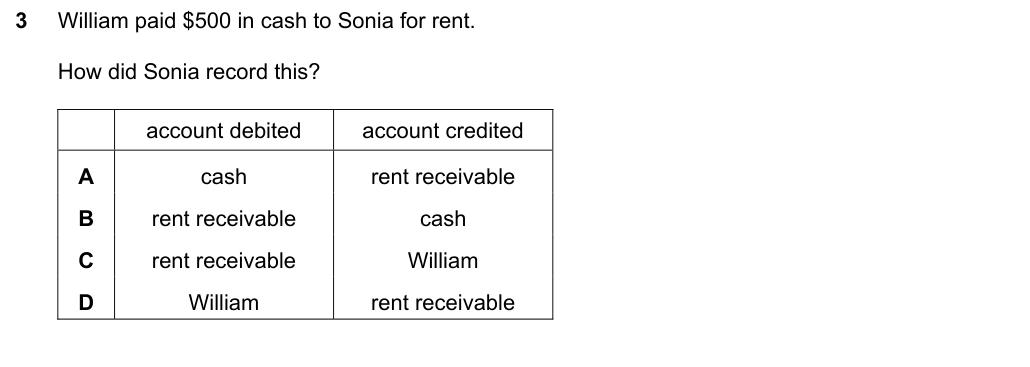
William paid $500 in cash to Sonia for rent. How did Sonia record this? Use the complete source image for the question and answer choices. Source reference: S21 Paper 12, Q3.
Answer: A.
The question asks how SONIA recorded it, and Sonia is the landlord receiving 500 in cash. Cash coming in is a debit, and the matching credit goes to rent receivable, since the income has been earned. A is correct. B reverses those two, which would show cash leaving. C and D bring William's personal account in, but no credit was given: he paid in cash at the time, so no balance is owed either way and there is nothing to record on a personal account.
Question 5
William paid $500 in cash to Sonia for rent. How did Sonia record this? Use the complete source image for the question and answer choices. Source reference: S21 Paper 13, Q3.
Answer: A.
The question asks how SONIA recorded it, and Sonia is the landlord receiving 500 in cash. Cash coming in is a debit, and the matching credit goes to rent receivable, since the income has been earned. A is correct. B reverses those two, which would show cash leaving. C and D bring William's personal account in, but no credit was given: he paid in cash at the time, so no balance is owed either way and there is nothing to record on a personal account.
These questions are drawn from past CIE 0452 Accounting papers and filtered to other payables and other receivables. You answer, you find out immediately whether you were right, and you get the reasoning for the correct option and for each distractor. Wrong answers go to a mistakes locker so you can come back to exactly those.
Practice is free. You need an account only so your progress and your mistakes are still there next time.
These are the errors that cost marks on other payables and other receivables, taken from our own topic notes. Read them before you practise and you will recognise the traps in the questions.
Reversing the treatment: adding a prepayment to the expense instead of deducting it.
Putting prepaid expenses among current liabilities.
Treating income received in advance as an asset.
Adjusting the income statement and forgetting the statement of financial position, or the reverse.
Ignoring the opening accrual or prepayment and adjusting only for the closing one.
Using the amount paid as the expense when the question clearly gives adjustments.