77 past-paper questions on this unit. Five of them are below. Answer on the page: each one is marked the moment you pick, the correct option is shown whether or not you found it, and the full explanation opens either way.
CIE 0625 PhysicsPaper 1 and Paper 2 MCQsFree account
The nuclear model of the atom: five questions to try now
Real past-paper questions, the answer key from the mark scheme, and the explanation that goes with it. No account needed to answer them.
Question 1
Which diagram represents the positions of the charged particles of an atom? Use the source image for S23 Paper 12, question 34.
Answer: A.
An atom has a tiny central nucleus containing the positively charged protons, with the negatively charged electrons out in the space around it. A is the only diagram that puts plus signs inside the small inner circle and minus signs on the outer path, so A is correct. B has the charges the wrong way round, with electrons crammed into the nucleus and positive charge orbiting outside. C mixes a positive and a negative charge in the nucleus and puts one of each outside, and D shows all four charges bunched together with no separate nucleus and no orbiting electrons at all.
Question 2
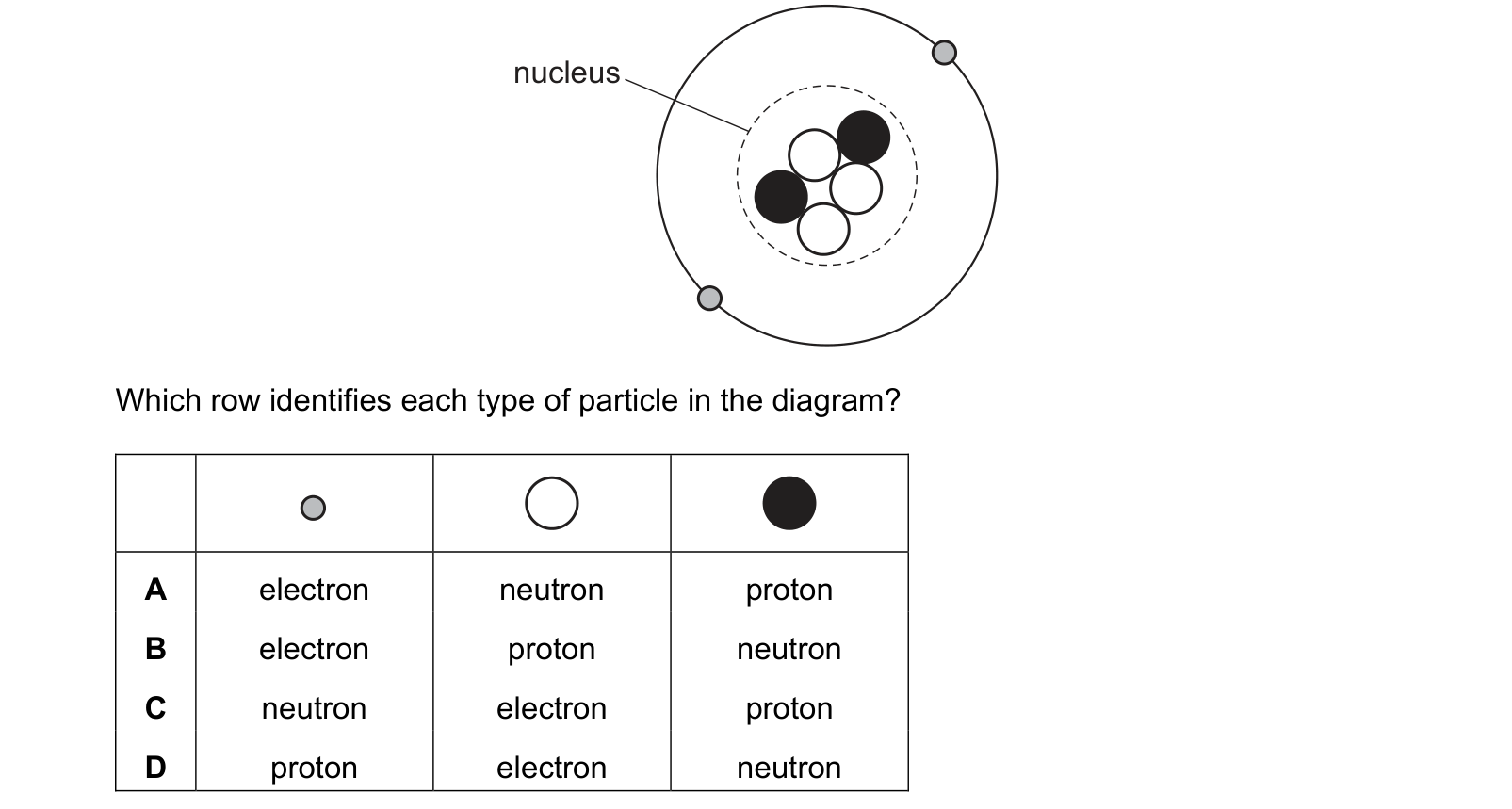
The diagram represents a neutral atom. Which row identifies each type of particle in the diagram? Use the source image for W19 Paper 13, question 37.
Answer: A.
Two particles orbit outside the nucleus, so those grey circles must be the electrons, since protons and neutrons are always inside. That leaves the two black and three white circles in the nucleus. The atom is neutral, so the number of protons must match the two electrons, which makes the two black circles the protons and the three white ones the neutrons. A is correct. C and D each place an electron inside the nucleus, and B has the two nuclear particles swapped, which would give three protons against two electrons.
Question 3
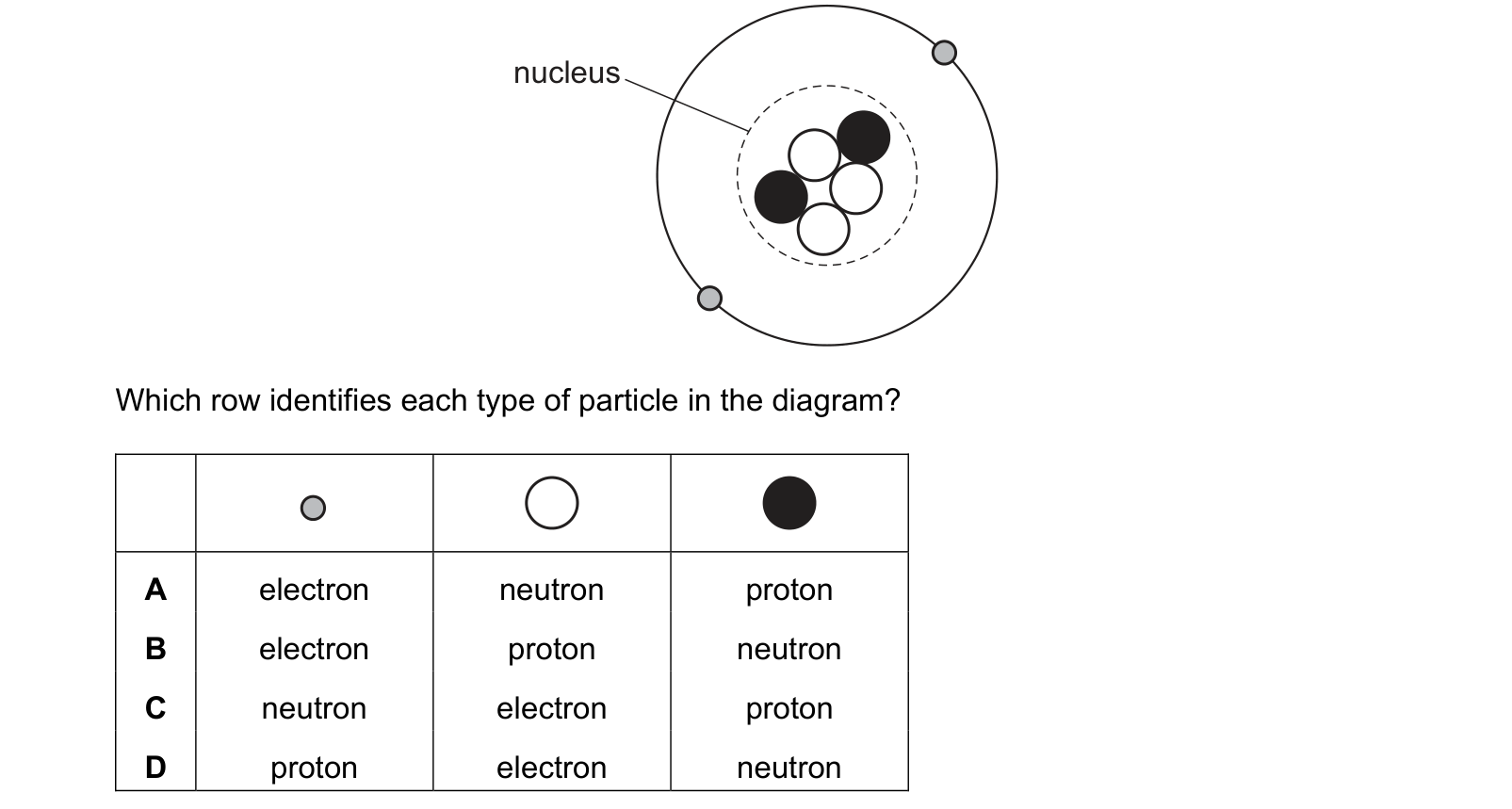
The diagram represents a neutral atom. Which row identifies each type of particle in the diagram? Use the source image for W19 Paper 23, question 38.
Answer: A.
Two particles orbit outside the nucleus, so those grey circles must be the electrons, since protons and neutrons are always inside. That leaves the two black and three white circles in the nucleus. The atom is neutral, so the number of protons must match the two electrons, which makes the two black circles the protons and the three white ones the neutrons. A is correct. C and D each place an electron inside the nucleus, and B has the two nuclear particles swapped, which would give three protons against two electrons.
Question 4
When Rutherford bombarded thin gold foil with α-particles, he found that some α-particles were deflected through large angles. Which statement explains this deflection?
Answer: B.
A large deflection needs a concentrated target: something small enough to be hit rarely, massive enough not to be pushed aside, and charged strongly enough to repel an alpha particle sharply. That is the nucleus, and B says so. A is a true conclusion from the experiment but explains the particles that passed STRAIGHT through, not the ones that bounced back. C describes the plum pudding model the experiment disproved, since spread out charge could never deflect sharply. D makes the centre negative, which would attract rather than repel.
Question 5
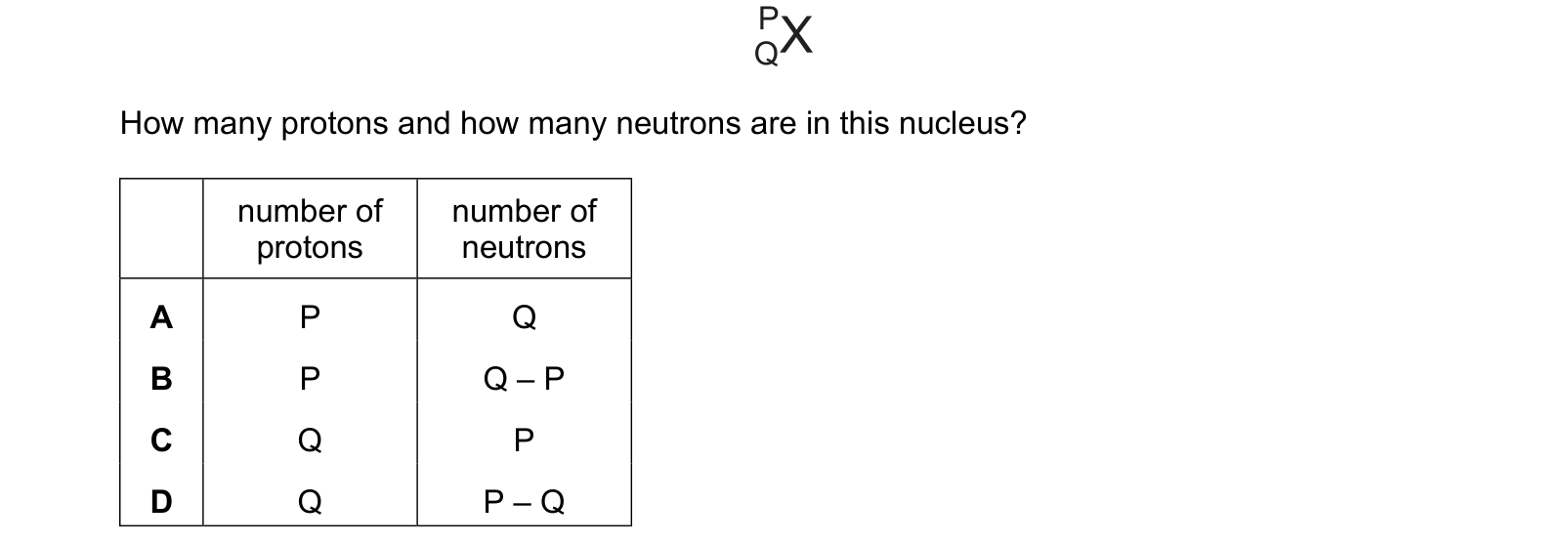
The nucleus of an atom X is represented by the notation shown. How many protons and how many neutrons are in this nucleus? Each answer gives, in order: number of protons; number of neutrons.
Answer: D.
In the notation P is on top and Q below, so P is the nucleon number and Q the proton number. The protons are therefore Q, and the neutrons are what is left when the protons are taken out of the total, P less Q. D is correct. A reads P as the protons and Q as the neutrons, swapping both. C gets the protons right but calls the nucleon number the neutron count. B subtracts in the wrong order, and since P is the larger of the two, Q less P would be negative.
These questions are drawn from past CIE 0625 Physics papers and filtered to the nuclear model of the atom. You answer, you find out immediately whether you were right, and you get the reasoning for the correct option and for each distractor. Wrong answers go to a mistakes locker so you can come back to exactly those.
Practice is free. You need an account only so your progress and your mistakes are still there next time.
These are the errors that cost marks on the nuclear model of the atom, taken from our own topic notes. Read them before you practise and you will recognise the traps in the questions.
Saying the electrons are in the nucleus, or that neutrons are charged.
Saying isotopes have different numbers of protons.
Saying isotopes react differently in chemical reactions.
Giving the number of neutrons as the nucleon number, rather than A − Z.
Saying most alpha particles were deflected in Rutherford's experiment; most passed straight through.
Concluding from a single observation what needs all three.
Saying an ion has a different number of protons from its atom.
Failing to balance both numbers in a nuclear equation.