The nuclear model of the atom
Contents: 7 sections
Structure of the atom
An atom has a tiny, dense, positively charged nucleus containing protons and neutrons, surrounded by electrons in orbits or shells.
| Particle | Relative charge | Relative mass | Location |
|---|---|---|---|
| Proton | +1 | 1 | Nucleus |
| Neutron | 0 | 1 | Nucleus |
| Electron | −1 | about 1/2000 | Orbiting the nucleus |
Almost all the mass is in the nucleus, and almost all the volume is empty space. The nucleus is roughly ten thousand times smaller in diameter than the atom.
A neutral atom has equal numbers of protons and electrons. An ion has gained or lost electrons: losing electrons gives a positive ion, gaining them a negative one. The number of protons never changes in ionisation.
The Rutherford scattering experiment
Alpha particles were fired at a very thin sheet of gold foil, and a detector recorded where they went.
Observations:
- Most passed straight through with little or no deflection.
- A small number were deflected through large angles.
- A very few, about one in eight thousand, bounced almost straight back.
Conclusions, taken one at a time:
- The atom is mostly empty space.
- The nucleus is positively charged, repelling the positive alpha particles.
- The nucleus is very small and contains almost all the mass, since only a rare direct approach could reverse an alpha particle.
Matching each observation to its conclusion is what the question asks for. The experiment replaced the earlier "plum pudding" model, in which positive charge was spread evenly through the atom and would have deflected nothing significantly.
Nuclide notation
A nuclide is written with two numbers before the chemical symbol:
- Nucleon number A (mass number), the top one: the total number of protons and neutrons.
- Proton number Z (atomic number), the bottom one: the number of protons.
So for carbon-14, A = 14 and Z = 6.
number of neutrons = A − Z
For carbon-14 that gives 14 − 6 = 8 neutrons.
The proton number identifies the element. Change it and you have a different element; change only the neutron number and you have a different isotope of the same element.
Isotopes
Isotopes are atoms of the same element with the same number of protons but different numbers of neutrons.
Carbon-12, carbon-13 and carbon-14 all have 6 protons and have 6, 7 and 8 neutrons respectively.
Because chemical behaviour is decided by the electrons, and the number of electrons follows the number of protons, isotopes of an element are chemically identical. They differ in mass, and they differ in nuclear stability, which is why some are radioactive and others are not.
Do not say isotopes have different numbers of protons, and do not say they behave differently in chemical reactions. Both are common and both are wrong.
Nuclear equations
Nucleon number and proton number are both conserved: the totals on each side of the equation must match.
- Alpha decay emits a helium nucleus, so A falls by 4 and Z falls by 2.
- Beta-minus decay emits an electron from the nucleus, so A is unchanged and Z rises by 1. A neutron has turned into a proton.
- Gamma emission changes neither A nor Z; the nucleus simply loses energy.
Checking that both totals balance is the quickest way to test an answer.
Common mistakes
- Saying the electrons are in the nucleus, or that neutrons are charged.
- Saying isotopes have different numbers of protons.
- Saying isotopes react differently in chemical reactions.
- Giving the number of neutrons as the nucleon number, rather than A − Z.
- Saying most alpha particles were deflected in Rutherford's experiment; most passed straight through.
- Concluding from a single observation what needs all three.
- Saying an ion has a different number of protons from its atom.
- Failing to balance both numbers in a nuclear equation.
Check you have it
Question 1
A simple model of the atom consists of small particles orbiting a central nucleus. Which row is correct? Each answer gives, in order: charge on nucleus; charge on orbiting particles.
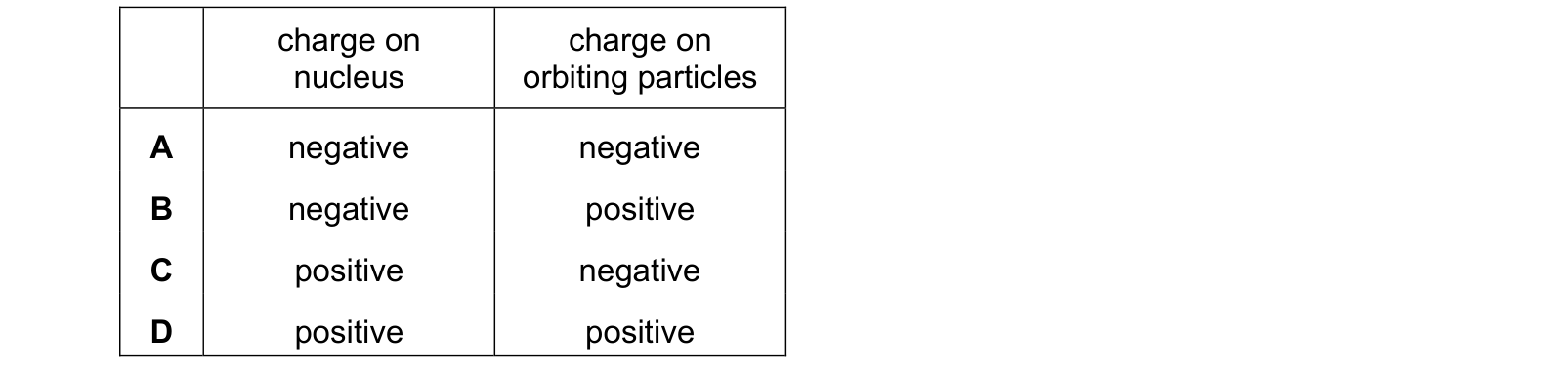
Answer: C.
Question 2
Which diagram shows the structure of an atom containing a nucleus and two orbiting electrons? Use the source image for M22 Paper 12, question 37.

Answer: C.
Question 3
The diagrams show the simple atomic structure for two neutral atoms X and Y of different elements. Which row is correct? Each answer gives, in order: atom with more electrons; atom with a more positively charged nucleus.
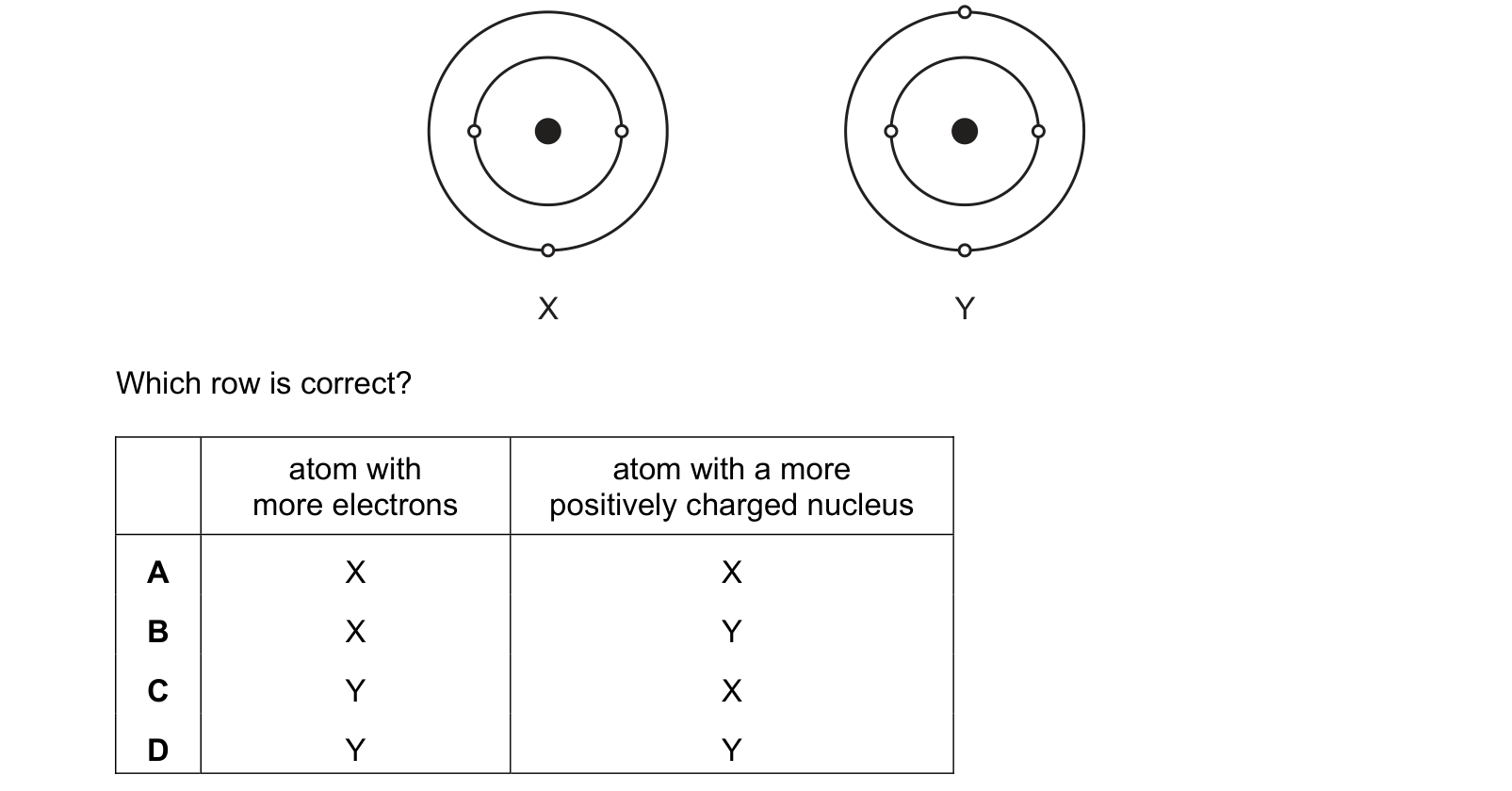
Answer: D.
What the syllabus asks for on this topicSyllabus points
Syllabus points
- Describe the structure of the atom in terms of a nucleus and electrons.
- Describe the Rutherford scattering experiment and the evidence it gave.
- Define proton number and nucleon number, and use nuclide notation.
- Explain what isotopes are.
- Describe the composition of the nucleus in terms of protons and neutrons.
Related CIE 0625 Physics topics
Not the topic you were looking for? Describe what you are stuck on in your own words and we will take you to the notes that answer it.