Electrical quantities
Contents: 8 sections
Charge
There are two kinds of charge, positive and negative. Charge is measured in coulombs (C).
Like charges repel; unlike charges attract.
An insulator can be charged by friction. Rubbing transfers electrons from one material to the other:
- The material that gains electrons becomes negatively charged.
- The material that loses electrons becomes positively charged.
Only electrons move. Protons stay in the nuclei, so an object never becomes positive by gaining protons. Explanations that move positive charge around lose the mark.
A charged rod attracts small uncharged pieces of paper because it induces a charge on them: the nearer surface acquires the opposite charge and is pulled in.
Conductors have delocalised electrons free to move, so charge flows through them. Insulators do not, so charge stays where it is put.
Electric fields
An electric field is a region where a charge experiences a force. Field lines point in the direction of the force on a positive charge.
- Around a positive point charge, lines radiate outwards.
- Around a negative point charge, they point inwards.
- Between two oppositely charged parallel plates, the field is uniform and the lines run straight from the positive plate to the negative.
Current
Current is the rate of flow of charge.
I = Q/t, so Q = It
Current is measured in amperes (A) with an ammeter, connected in series.
Conventional current flows from positive to negative round a circuit. In a metal, the actual carriers are electrons, which flow the other way, from negative to positive. Both statements are true and questions test whether you can hold both.
Potential difference and e.m.f.
Potential difference (p.d.) across a component is the energy transferred from the electrical store per unit charge passing through it.
V = E/Q
Electromotive force (e.m.f.) of a source is the energy transferred to the electrical store per unit charge passing through it.
Both are measured in volts (V) with a voltmeter, connected in parallel across the component.
One volt is one joule per coulomb.
Resistance
R = V/I
Resistance is measured in ohms (Ω). It is a measure of how strongly a component opposes the current.
Worked example. A 12 V supply drives 0.50 A through a lamp.
R = 12 / 0.50 = 24 Ω.
Resistance of a wire
For a wire of a given material:
- Resistance is proportional to length. Double the length, double the resistance.
- Resistance is inversely proportional to cross-sectional area. Double the area, halve the resistance.
So the thinnest, longest wire has the greatest resistance, and the shortest, thickest has the least. A question showing four wires is asking you to compare length divided by area.
Ohm's law and I-V graphs
For a metallic conductor at constant temperature, current is directly proportional to potential difference. The I-V graph is a straight line through the origin.
Two components break this and both appear:
- A filament lamp gives a curve that flattens. As the current rises the filament heats, the ions vibrate more, the electrons collide with them more often, and the resistance increases.
- A diode conducts in one direction only. Its graph shows almost no current in reverse and a sharp rise in the forward direction.
Resistance at any point on an I-V graph is V/I at that point, not the gradient, unless the line is straight through the origin.
Electrical power and energy
P = IV
and, combining with V = IR:
P = I²R and P = V²/R
Energy transferred:
E = Pt = IVt
Worked example. A 2.0 kW heater runs for 30 minutes. How much energy does it transfer?
t = 1800 s. E = 2000 x 1800 = 3 600 000 J, or 3.6 MJ.
Time in seconds gives joules. Time in hours with power in kilowatts gives kilowatt-hours, which is what an electricity meter records: 2.0 kW for 0.5 h is 1.0 kWh.
The P = I²R form explains why power is transmitted at high voltage. For a given power, higher voltage means smaller current, and since the heating loss in the cables goes as the square of the current, halving the current cuts the loss to a quarter.
Common mistakes
- Saying an object becomes positively charged by gaining protons.
- Connecting an ammeter in parallel or a voltmeter in series.
- Saying electrons flow from positive to negative, or that conventional current flows negative to positive.
- Leaving a time in minutes or hours when calculating energy in joules.
- Reading resistance as the gradient of a curved I-V graph.
- Saying a filament lamp's resistance falls as it heats.
- Confusing e.m.f. with potential difference: one supplies energy, the other transfers it away.
- Saying a thicker wire has more resistance.
Check you have it
Question 1
Four students draw a circuit diagram of the apparatus used to measure the resistance of resistor R. Which circuit is correct? Use the source image for S23 Paper 11, question 26.
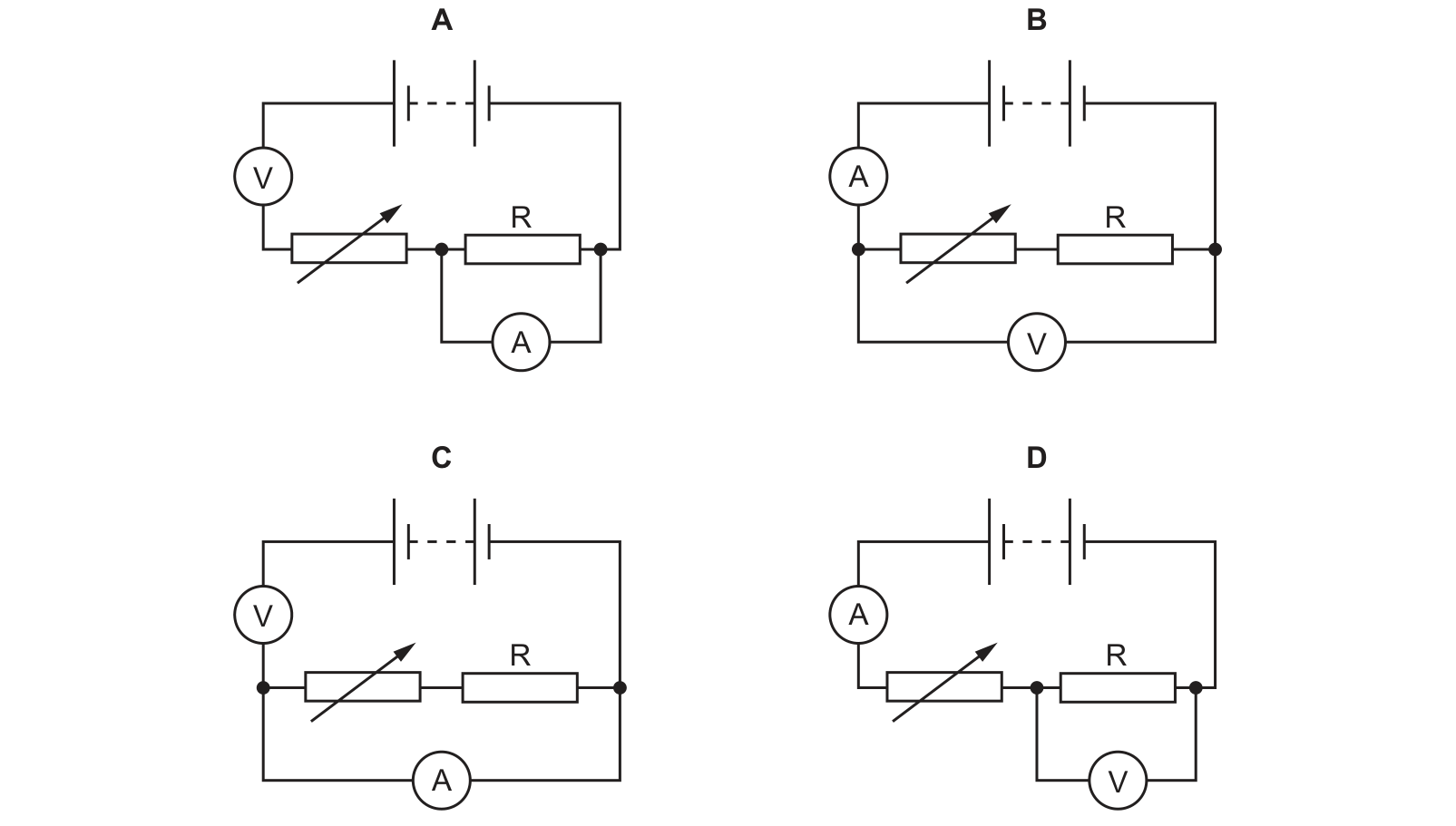
Answer: D.
Question 2
The circuit diagram shows a circuit used to run a d.c. motor from an a.c. supply. Which graph shows the current in the motor? Use the source image for W23 Paper 22, question 29.
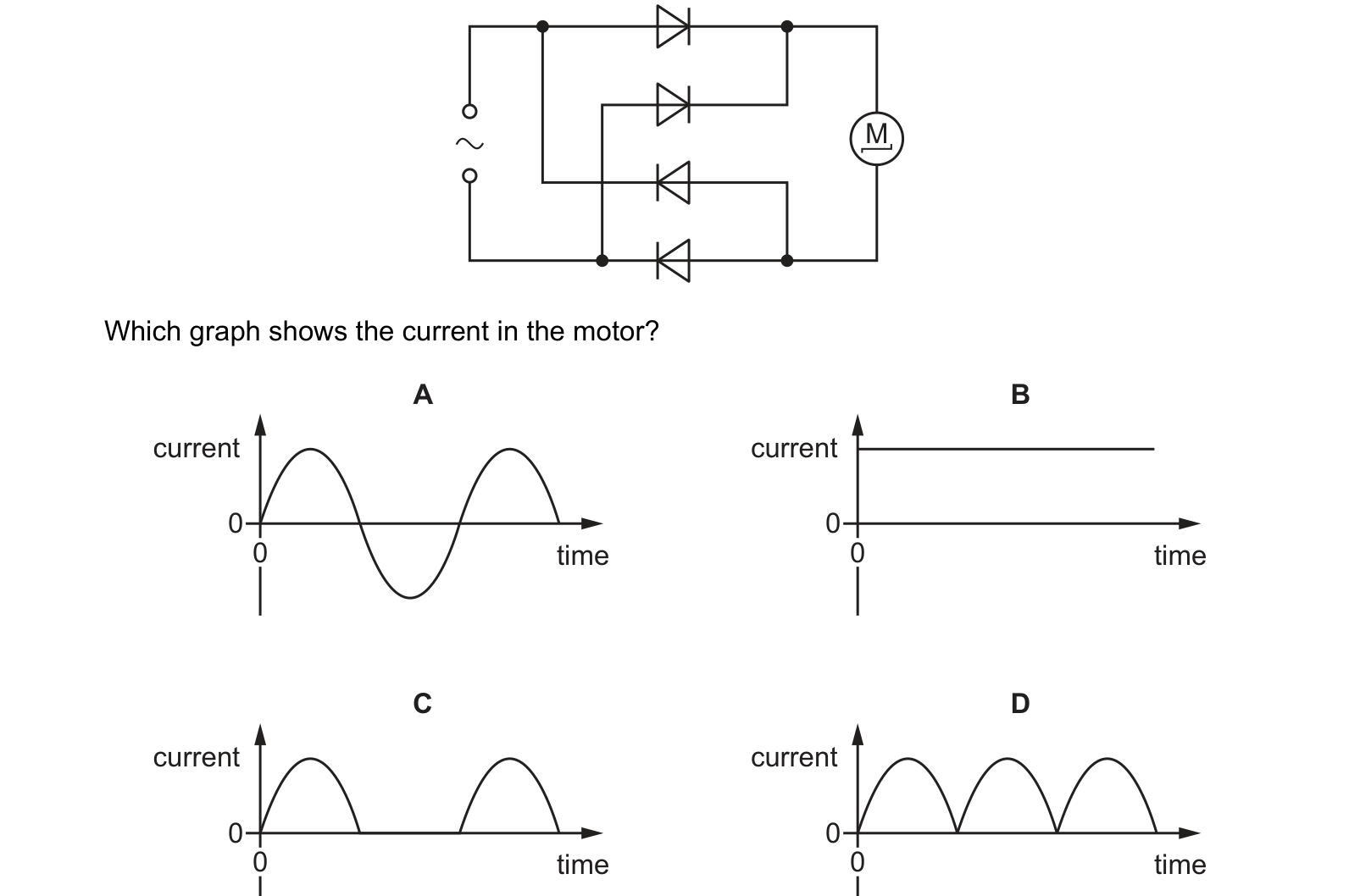
Answer: D.
Question 3
The graph shows the current–voltage characteristic for a filament lamp. Which statement describes how the resistance of the lamp changes as the voltage increases?
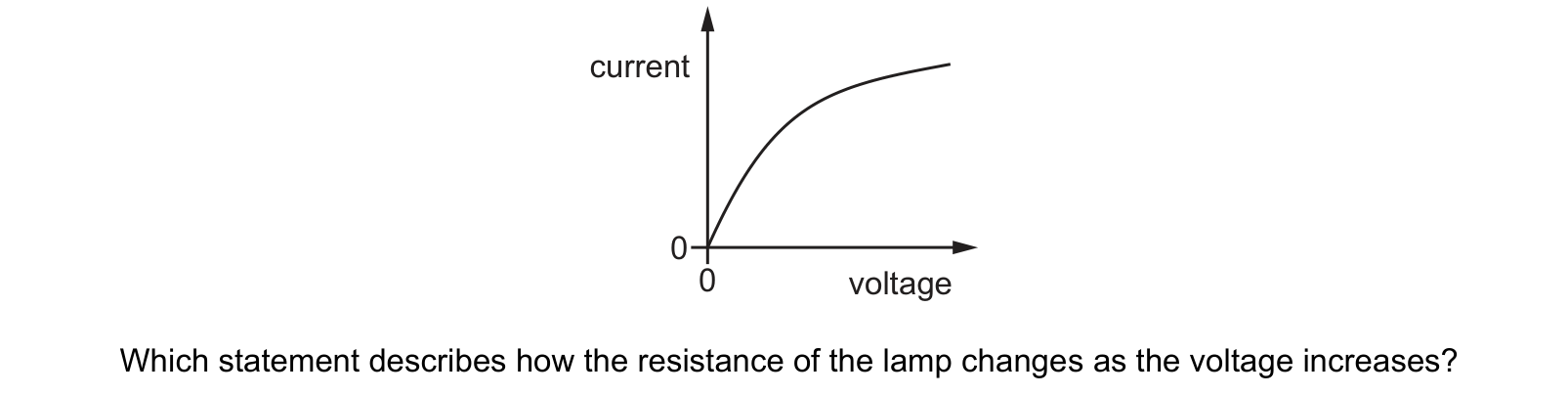
Answer: C.
What the syllabus asks for on this topicSyllabus points
Syllabus points
- Describe electrical charge, the forces between charges, and methods of charging by friction.
- Describe electric fields and draw field patterns.
- Define current as the rate of flow of charge, and recall Q = It.
- Define potential difference and electromotive force, and recall the energy relationships.
- Define resistance and recall V = IR.
- Describe how the resistance of a wire depends on its length and cross-sectional area.
- Recall and use the equations for electrical power and energy.
Related CIE 0625 Physics topics
Not the topic you were looking for? Describe what you are stuck on in your own words and we will take you to the notes that answer it.