Thermal properties and temperature
Contents: 7 sections
Thermal expansion
Heating a substance makes its particles vibrate or move more, so their average separation increases and the substance expands. Cooling does the reverse.
The particles themselves do not change size. It is the spacing that changes, and saying otherwise loses the mark.
Gases expand most, then liquids, then solids, because the forces holding the particles together are weakest in a gas and strongest in a solid.
Where it matters
- Bridges and railway lines are built with expansion gaps, or laid on rollers, so they are not buckled by summer heat.
- Overhead power cables are hung slightly slack in summer, so they do not snap when they contract in winter.
- A bimetallic strip is two metals bonded together that expand by different amounts. Heated, it bends towards the metal that expands less, which is used in thermostats and fire alarms.
- Liquid-in-glass thermometers work entirely on the expansion of the liquid.
Water is the useful exception. Between 0 °C and 4 °C it contracts as it warms, so ice is less dense than the water beneath it and lakes freeze from the top down.
Thermometers
Any physical property that varies with temperature can be used: the volume of a liquid, the resistance of a wire or thermistor, the e.m.f. of a thermocouple, the pressure of a fixed volume of gas.
A liquid-in-glass thermometer has a bulb of liquid joined to a narrow capillary tube. The bulb is thin-walled so heat passes quickly into the liquid; the tube is narrow so that a small change in volume gives a large, visible movement along the scale.
Three properties are named in the syllabus:
- Range is the span between the lowest and highest temperatures it can read. A wider bulb and a wider tube give a greater range.
- Sensitivity is how far the liquid moves for a given temperature change. A larger bulb and a narrower tube both increase it.
- Linearity is whether equal temperature changes give equal movements along the scale.
Range and sensitivity pull against each other: a narrower tube is more sensitive but fills sooner, so it covers less range.
Specific heat capacity
The specific heat capacity of a substance is the energy needed to raise the temperature of 1 kg by 1 °C.
E = mcΔθ
- E is energy in joules
- m is mass in kilograms
- c is specific heat capacity in J/(kg °C)
- Δθ is the change in temperature
Water has an unusually high specific heat capacity, about 4200 J/(kg °C). That is why it is used in heating systems and car radiators, and why coastal places have milder temperatures than places inland.
Worked example. How much energy raises 2.0 kg of water from 20 °C to 70 °C?
Δθ = 70 − 20 = 50 °C. E = 2.0 x 4200 x 50 = 420 000 J.
The temperature change goes into the equation, not the final temperature. Using 70 instead of 50 is the usual slip.
Latent heat
While a substance changes state, energy is supplied but the temperature does not change. That energy goes into breaking the forces between particles rather than into speeding them up.
- Specific latent heat of fusion is the energy needed to change 1 kg from solid to liquid at its melting point.
- Specific latent heat of vaporisation is the energy needed to change 1 kg from liquid to gas at its boiling point.
E = mL
Vaporisation always requires far more energy than fusion, because the particles must be separated completely rather than merely freed to slide past one another.
On a heating curve of temperature against time, the flat sections are the changes of state. Their length shows how much energy the change requires; the sloping sections are governed by specific heat capacity.
Boiling and evaporation compared
| Boiling | Evaporation | |
|---|---|---|
| Temperature | Only at the boiling point | Any temperature |
| Where | Throughout the liquid | Surface only |
| Bubbles | Yes | No |
| Effect on the liquid | Temperature stays constant | Liquid cools |
Evaporation cools the liquid because only the fastest particles escape, lowering the average kinetic energy of those left behind.
Common mistakes
- Saying the particles themselves expand when a substance is heated.
- Using the final temperature instead of the temperature change in E = mcΔθ.
- Leaving a mass in grams when c is in J/(kg °C).
- Saying the temperature rises during melting or boiling.
- Saying a narrower capillary tube increases the range; it increases sensitivity and reduces range.
- Saying a bimetallic strip bends towards the metal that expands more.
- Forgetting that water contracts between 0 °C and 4 °C.
Check you have it
Question 1
The diagram shows a liquid-in-glass thermometer. Which row gives the correct labels for the thermometer? Each answer gives, in order: X; Y.
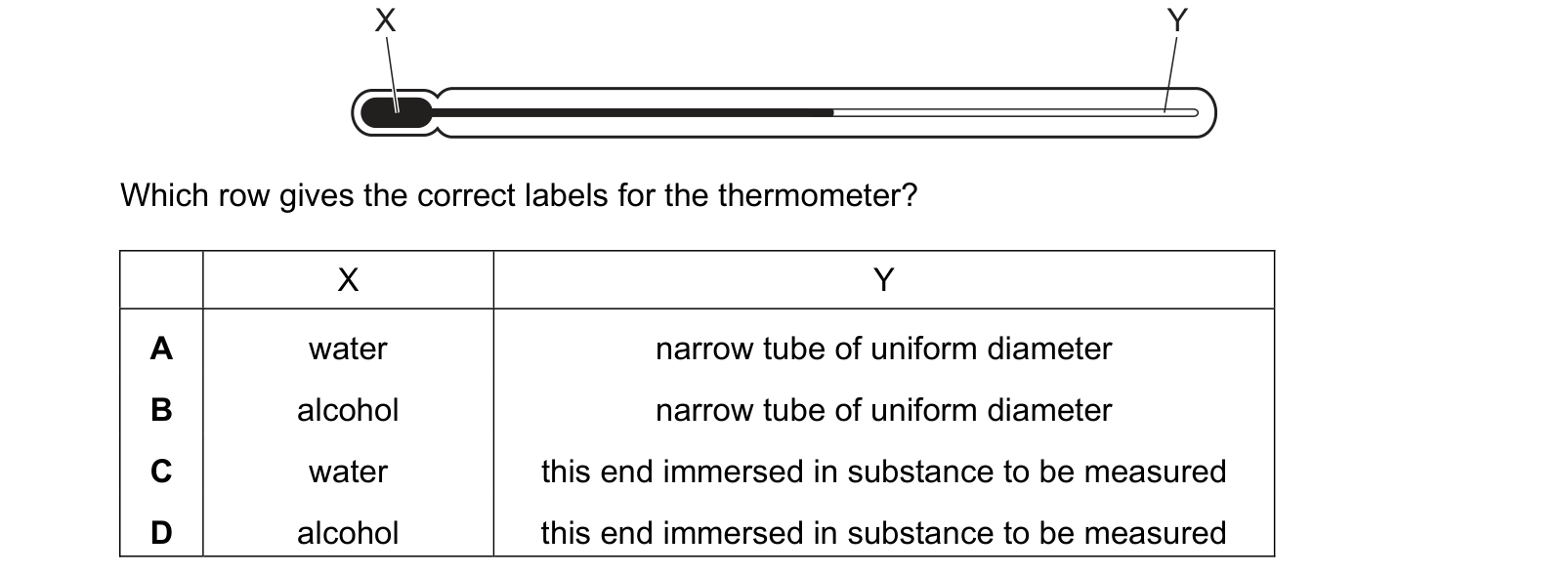
Answer: B.
Question 2
Thermal energy ΔE is supplied to an object of mass m which does not change its state during the heating process. The temperature of the object rises by ΔT.
What is the specific heat capacity of the object?

Answer: A.
Question 3
The diagram shows a liquid-in-glass thermometer. What is the temperature difference between the two fixed points on the Celsius scale?

Answer: B.
What the syllabus asks for on this topicSyllabus points
Syllabus points
- Describe thermal expansion of solids, liquids and gases, and its everyday consequences.
- Describe how a physical property that varies with temperature is used in a thermometer.
- Describe the structure and action of a liquid-in-glass thermometer, and the meaning of sensitivity, range and linearity.
- Define specific heat capacity and recall the equation.
- Describe melting, boiling and evaporation in terms of energy, and define specific latent heat.
Related CIE 0625 Physics topics
Not the topic you were looking for? Describe what you are stuck on in your own words and we will take you to the notes that answer it.