Pressure
Contents: 7 sections
The equation
pressure = force / area
p = F/A, in N/m² (pascals) or N/cm².
The force pressing on a surface is the weight of whatever rests on it, in newtons. Mass in kilograms is not a force and does not belong in this equation.
Because the area is on the bottom:
- The same weight on a larger area gives less pressure.
- The same weight on a smaller area gives more pressure.
Skis and snowshoes work by making the area large so the pressure stays low enough not to sink. A drawing pin and a knife blade work the other way, concentrating a modest force onto a tiny area.
Worked example. A skier weighs 550 N and his skis touch the snow over 0.015 m².
p = 550 / 0.015 = 36 667 N/m², which to two significant figures is 37 000 N/m².
Dividing by a number smaller than one makes the answer bigger, so any option below 550 can be discarded on sight.
Choosing the right face
When a block can rest on different faces, the weight does not change but the contact area does.
- Least pressure comes from resting on the largest face.
- Greatest pressure comes from resting on the smallest face.
The word "least" tempts people towards the smallest face. Least pressure needs the greatest area.
For a block 40 cm by 20 cm by 80 cm, the three faces are 3200 cm², 1600 cm² and 800 cm². Reading the diagram to see which dimensions form the base is the whole question, and papers often give a separate option for each wrong pairing of two dimensions.
Worked example. A block 1 m by 1 m by 5 m weighs 125 000 N. What happens to the pressure if it is stood on its end rather than laid on its long side?
Lying down: base = 1 x 5 = 5 m², so p = 125 000 / 5 = 25 000 N/m². Stood up: base = 1 x 1 = 1 m², so p = 125 000 / 1 = 125 000 N/m². Change = an increase of 100 000 N/m².
Note the question asks by how much the pressure changes, not what it becomes.
Pressure in a liquid
p = h ρ g
where h is the depth below the surface, ρ the density and g the gravitational field strength. The depth must be in metres.
Only three things appear in that expression, and the consequences are worth stating plainly:
- Pressure increases with depth.
- Pressure increases with density.
- Pressure does not depend on the shape of the container, its width, the surface area of the liquid, or how much liquid there is.
A narrow tube and a wide tank filled to the same depth press equally hard at the bottom. A reservoir behind a dam presses on the wall according to depth alone, not the length of the lake behind it. This feels wrong the first time and is a favourite question.
Pressure at a point in a liquid also does not depend on the object sitting there. Changing a stone's mass or surface area changes nothing about the pressure the liquid exerts on it.
Worked example. A column of liquid 50 cm deep produces a pressure of 6000 N/m² at the bottom. Find its density.
h = 0.50 m. ρ = p / (g h) = 6000 / (10 x 0.50) = 1200 kg/m³.
Failing to convert 50 cm to metres makes the answer a hundred times too large, and the result would then be denser than any material on Earth.
Change in pressure depends only on the change in depth. Two submarines each descending 20 m experience the same change, however deep each one started.
Manometers
A U-tube of liquid, open to the air at one end and connected to a gas supply at the other. The difference between the two levels measures how far the gas pressure differs from atmospheric.
The reading is always the difference between the levels, never a single level.
The direction follows from which side is lower:
- Gas side lower than the open side means the gas is pushing harder, so the pressure is above atmospheric.
- Gas side higher means the pressure is below atmospheric.
Where a manometer holds two liquids over mercury and the mercury levels are equal, the pressures on the mercury from each side must be equal. If one column is taller and they balance, the taller liquid must be the less dense, since p = hρg.
Barometers
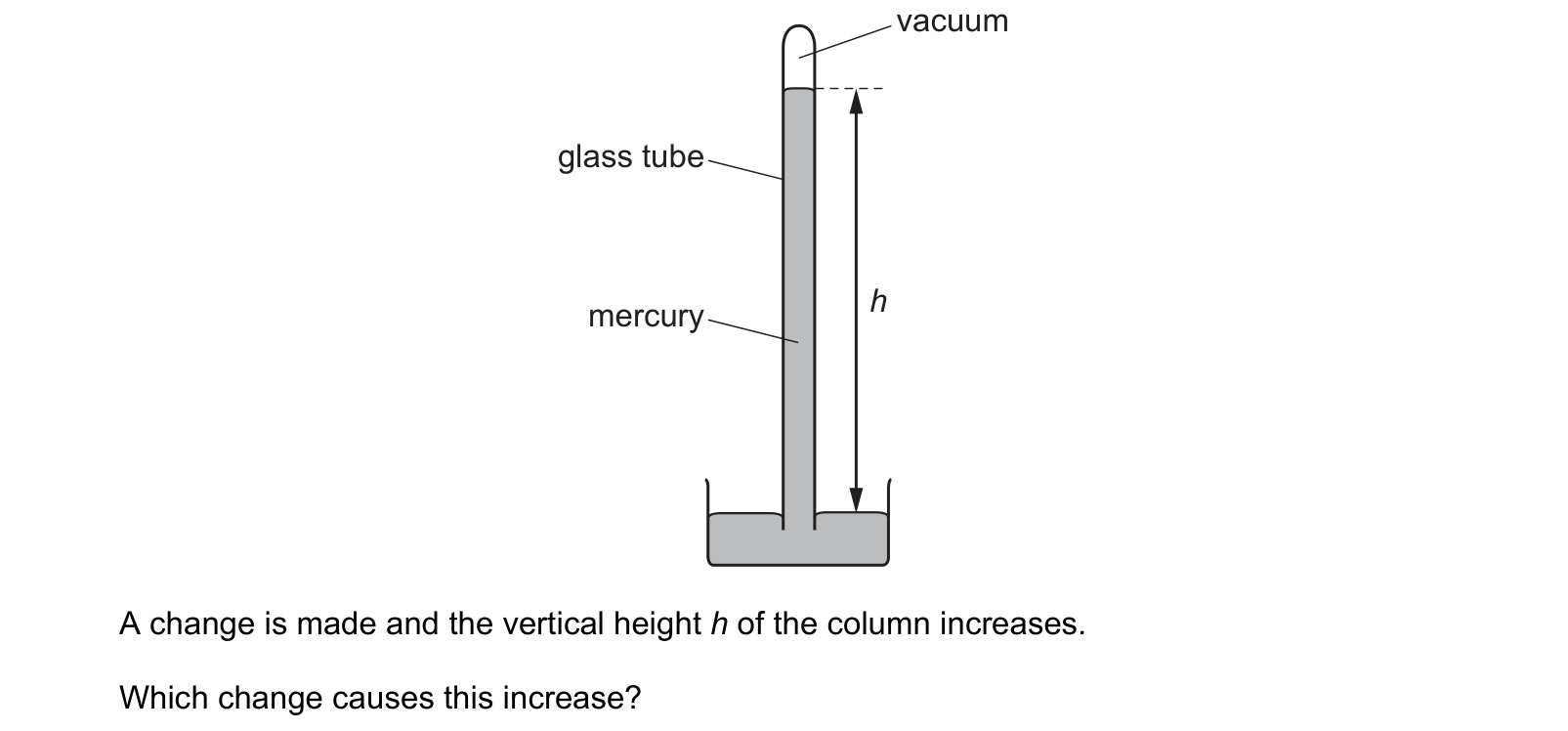
A mercury barometer is a tube closed at the top, filled with mercury and stood in a dish. There is a vacuum above the mercury in the tube.
The atmospheric pressure is measured by the vertical height of mercury above the level in the dish.
Three things are easy to get wrong.
- The distance to the closed top of the tube is too long, because the vacuum above the mercury exerts no pressure.
- The distance down to the bottom end of the tube is too long, because mercury below the dish's surface is supported by the mercury around it, not by the air.
- Tilting the tube does not change the reading. The length of liquid along the tube grows, but h is the vertical height.
Narrowing the tube changes nothing either. A wider tube holds more mercury but spreads its weight over proportionally more area.
Mercury is used because it is dense. A water barometer would need a column over ten metres tall to balance the same atmosphere.
Within the mercury, pressure follows the same rule as any liquid: it is near zero in the vacuum, below atmospheric part way up the column, atmospheric at the surface in the dish, and above atmospheric anywhere below that surface.
Common mistakes
- Putting a mass in kilograms into p = F/A instead of a weight in newtons.
- Choosing the smallest face when asked for the least pressure.
- Using the height of a block rather than the dimensions of its base.
- Leaving a depth in centimetres in p = hρg.
- Thinking a bigger reservoir or a wider container gives a greater pressure at the bottom.
- Reading a single level on a manometer rather than the difference between the two.
- Including the vacuum space when reading a barometer.
- Giving the pressure change rather than the final pressure, or the other way round, without checking which was asked.
Check you have it
Question 1
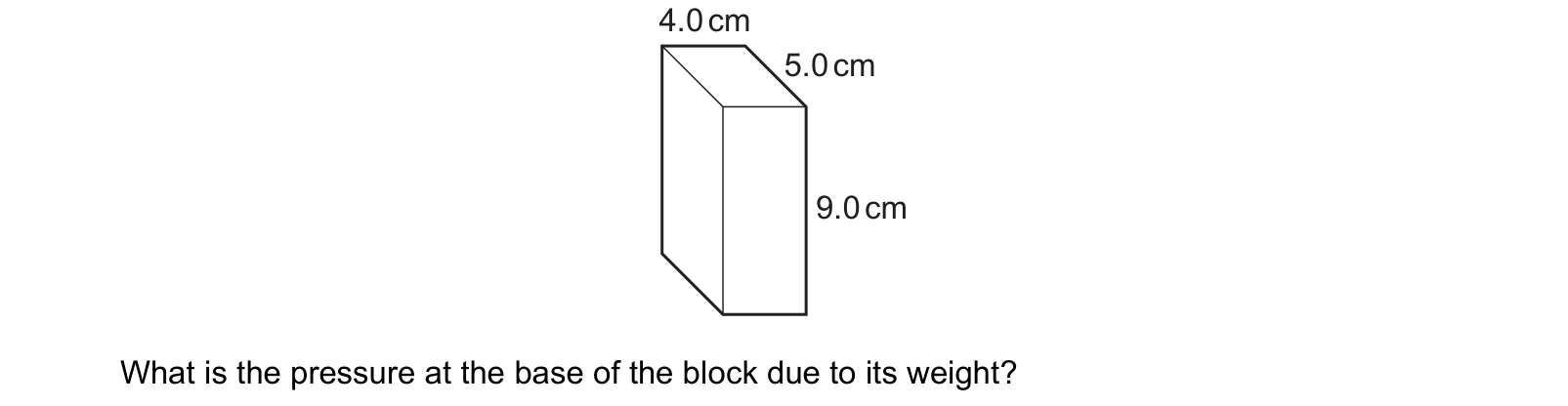
The diagram shows a rectangular block of weight 16 N. It is resting on a flat surface. What is the pressure at the base of the block due to its weight?
Answer: C.
From the diagram the 9.0 cm is the vertical height, so the base is 4.0 cm by 5.0 cm:
area = 4.0 x 5.0 = 20 cm2
p = F / A = 16 / 20 = 0.80 N / cm2, which is C.
B, 0.36 N / cm2, uses 5.0 x 9.0 = 45 cm2, which is one of the side faces. That face is vertical, so nothing rests on it.
A, 0.089 N / cm2, divides by 4.0 x 5.0 x 9.0 = 180, which is the block's volume. Dividing a force by a volume gives no pressure at all, and the units would be wrong.
D, 320, multiplies rather than divides.
Identifying the base is the whole question, and the diagram is drawn tall precisely so that the two smaller dimensions are the ones on the floor. A quick check: the block is standing up, so the face touching the ground must be made from the two horizontal edges.
Question 2
The diagram shows a simple mercury barometer. A change is made and the vertical height h of the column increases.
Which change causes this increase?
Answer: A.
To make h larger you either raise the atmospheric pressure or lower the density of the liquid. Swapping mercury for something less dense increases h, so A.
That is exactly why mercury is used. Water is about fourteen times less dense, so a water barometer would need a column over ten metres tall to do the same job.
B has it backwards: less atmospheric pressure supports a shorter column, not a taller one.
C changes nothing. The height a liquid column reaches does not depend on the width of the tube, because a wider tube holds more liquid but spreads its weight over proportionally more area.
D is the neatest trap. Tilting the tube makes the length of liquid along the tube longer, but h is the vertical height, and that stays exactly the same.
Question 3
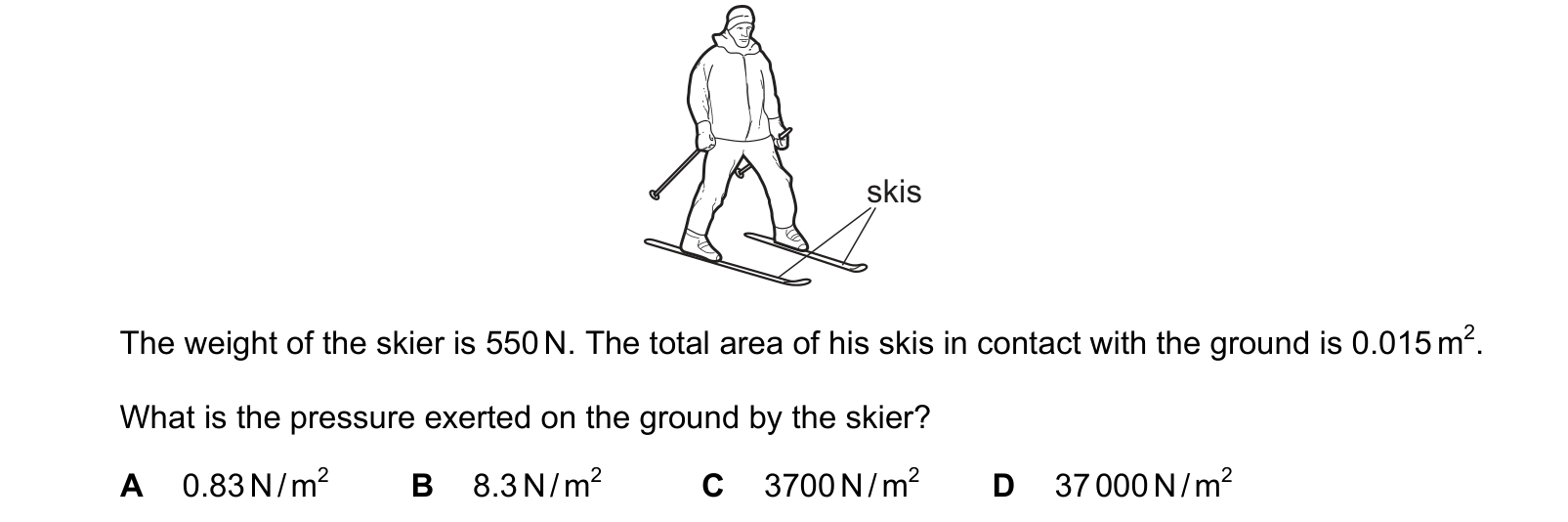
A skier is standing still on a flat area of snow. The weight of the skier is 550 N. The total area of his skis in contact with the ground is 0.015 m². What is the pressure exerted on the ground by the skier?
Answer: D.
p = F / A = 550 / 0.015 = 36 667 N / m2, which rounds to 37 000 N / m2, so D.
C, 3700 N / m2, is out by a factor of ten, which is the easiest slip to make dividing by a number as small as 0.015. It is worth doing the division in two steps to be safe: 550 / 15 = 36.7, and dividing by 0.015 rather than 15 makes it a thousand times bigger.
A and B are tiny, and come from dividing the area by the weight rather than the other way round. A pressure of under 10 N / m2 would be nothing at all.
The physics behind the numbers is worth a moment. Skis exist to make A large so that p is small, which is what stops the skier sinking. Swap them for a pair of stiletto heels, with a contact area perhaps a thousand times smaller, and the same 550 N would produce a pressure high enough to cut straight down into the snow.
What the syllabus asks for on this topicSyllabus points
Syllabus points
- Define pressure as force per unit area and recall p = F/A.
- Describe how pressure varies with force and area, and give everyday examples.
- Recall and use the equation for the pressure due to a column of liquid.
- Describe how a manometer measures the pressure of a gas supply.
- Describe how a mercury barometer measures atmospheric pressure.
Related CIE 0625 Physics topics
Not the topic you were looking for? Describe what you are stuck on in your own words and we will take you to the notes that answer it.