Forces
Contents: 10 sections
What a force can do
A force can change an object's shape, its size and its speed or direction. It cannot change its mass, because pushing on something adds no matter. Questions asking which property cannot be changed are asking exactly that.
Resultant force
Forces along the same line add if they point the same way and subtract if they oppose. The resultant points the way the larger force points.
- Constant speed in a straight line means the resultant is zero, and the forces cancel.
- A non-zero resultant produces acceleration in its direction.
F = ma, where F is the resultant force, never one of the forces acting.
Worked example. A 1200 kg car has a driving force of 4000 N and a total frictional force of 1000 N.
Resultant = 4000 − 1000 = 3000 N. a = 3000 / 1200 = 2.5 m/s².
Using 4000 N alone gives 3.3 m/s², which is on offer as an option. The friction is drawn on the diagram to be used, not admired.
Zero resultant does not mean stationary. It means the velocity is not changing, so something already moving keeps going at the same speed. That is Newton's first law.
Friction and air resistance
Both oppose motion, so both act backwards along the direction of travel.
Air resistance grows with speed. That is why a car reaches a top speed: as it goes faster the resistance rises until it equals the driving force, the resultant becomes zero, and the acceleration becomes zero. The car then holds that speed. The acceleration at top speed is zero, not negative.
A hot-air balloon rising at constant speed, or a sledge pulled at constant speed, is the same idea: everything cancels.
Hooke's law
Within the limit of proportionality, the extension of a spring is directly proportional to the load.
F = kx
where x is the extension, not the length, and k is the spring constant in N/cm or N/m.
extension = stretched length − unstretched length
Any question quoting two lengths is telling you to subtract. Any graph labelled "extension" is not asking for the length.
A load-extension graph obeying Hooke's law is a straight line through the origin. Both conditions matter: a straight line that cuts the axis above zero claims the spring is stretched with nothing on it.
Beyond the limit of proportionality the line curves and the law no longer holds. Where a table of results has one row that breaks the pattern the others follow, that row is past the limit and must not be used to find k. It is put there deliberately, and the value it gives is usually one of the options.
Moments
The moment of a force is its turning effect about a pivot.
moment = force x perpendicular distance from the pivot
Units are N m or N cm. The distance is the perpendicular distance to the line of the force, which is why a force applied at right angles to a lever is more effective than the same force applied at an angle. Changing only the direction of a force, with every distance unchanged, can still reduce the effort needed.
The principle of moments
For an object in equilibrium, the total clockwise moment about any point equals the total anticlockwise moment.
Worked example. A uniform metre rule is pivoted at its 50 cm mark. A 4.0 N weight hangs at the 5 cm mark and a string pulls up at the 30 cm mark. Find the tension.
The rule is uniform, so its weight acts at 50 cm, which is the pivot, and has no moment. Weight: 45 cm from the pivot, so 4.0 x 45 = 180 N cm. String: 20 cm from the pivot, so T x 20 = 180, giving T = 9.0 N.
The string is closer in, so it needs a larger force than the weight it balances. Choosing the pivot as your point removes any force acting through it from the equation, which is usually the point of choosing it.
Equilibrium
An object is in equilibrium when there is no resultant force and no resultant turning effect. Both conditions are needed.
Two equal and opposite forces that are offset from each other have zero resultant force and still rotate the object. That pair is called a couple, and it is the reason equilibrium carries two conditions rather than one. Questions in this topic routinely offer such a case as a wrong answer, and checking only that the forces cancel lets it through.
Centre of gravity
The centre of gravity is the point where the whole weight of an object appears to act.
Hung freely, an object settles with its centre of gravity directly below the point of suspension. That fixes a line, not a point, so one suspension is not enough to locate it. Hang the object from a second point, draw that vertical too, and the centre of gravity is where the two lines cross.
Stability
An object is more stable when its centre of gravity is lower and its base is wider. It topples when its centre of gravity passes outside the base.
Given several objects of the same size and shape, only the height of the centre of gravity can differ, so the question comes down to reading the marked points. This is why a self-righting toy carries a heavy weight in its base.
Circular motion
An object moving in a circle at constant speed is still accelerating, because its direction is changing. The resultant force points towards the centre of the circle.
- For a satellite, that force is gravity, pulling towards the Earth.
- For an object on a string, it is the tension, pulling towards the hand.
The force is not along the direction of motion, which would speed it up, and it is not outwards. Cut the string and the object does not fly outwards: it carries straight on along the tangent.
Common mistakes
- Putting a single force into F = ma instead of the resultant.
- Using the stretched length instead of the extension in Hooke's law.
- Taking the spring constant from a reading past the limit of proportionality.
- Accepting a case as equilibrium when the forces cancel but form a couple.
- Using a distance that is not perpendicular to the force when finding a moment.
- Saying the centre of gravity is at the point of suspension, or halfway down the vertical.
- Drawing the force on an object in circular motion outwards or along the tangent.
- Saying an object at constant speed has no forces acting on it.
Check you have it
Question 1
An irregular plane object is suspended freely from point O.
The object is displaced and then released. It swings a few times, and comes to rest as shown. Where is the centre of gravity of the object?
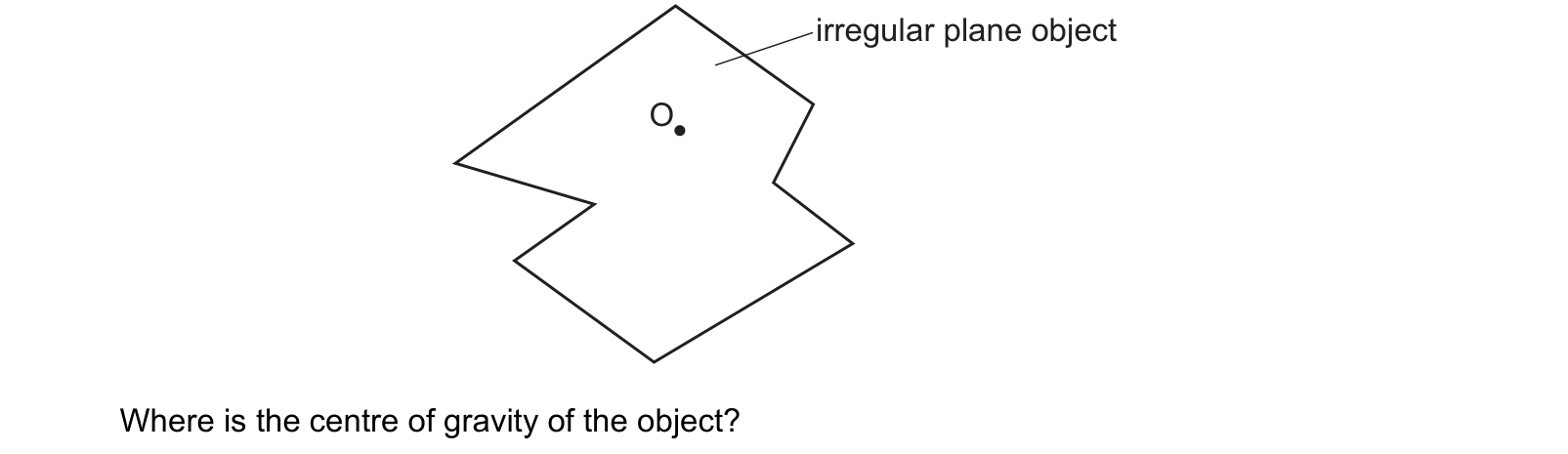
Answer: D.
The reason is moments. If the centre of gravity were off to one side, its weight would act along a line that misses O, producing a turning moment about O, and the object would swing. Only when the weight acts straight down through O is that moment zero, and only then can it be at rest.
A and B place it to one side, which is exactly the unstable arrangement that would keep it swinging.
C places it above O. An object can balance with its centre of gravity above the pivot, but that is unstable equilibrium: the slightest nudge produces a moment that topples it further. A freely suspended object that has swung a few times and settled will always end up in the stable position, hanging below.
This is the basis of the standard laboratory method for finding the centre of gravity of an irregular shape. Hang it from one point and draw a vertical line down from there, hang it from a second point and draw another, and the centre of gravity is where the two lines cross.
Question 2
Two boys are sitting on a see-saw. The see-saw is in equilibrium and remains horizontal. What affects the moment of each boy about the pivot?
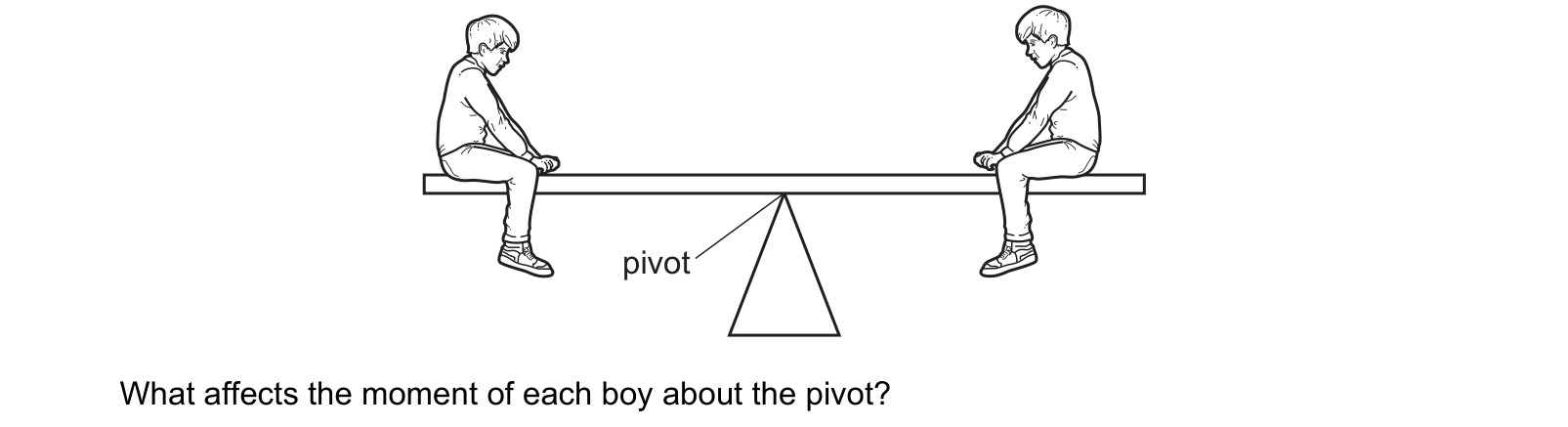
Answer: D.
A gives distance only. A heavy boy and a light boy sitting at the same place produce quite different moments.
C gives weight only. The same boy sitting near the pivot or out at the end produces quite different moments, which is the entire reason a see-saw can be balanced by moving along it.
B offers height above the ground, which is irrelevant. As the see-saw tips, each boy's height changes continuously while the balance condition does not. The distance that counts is measured along the beam from the pivot, not vertically.
That is the practical genius of a see-saw and of levers generally. A small child can balance a much heavier adult by sitting further out, because the product of the two quantities is what has to match rather than the weights themselves.
Question 3
A spring is suspended from a stand. Loads are added and the extensions are measured. Which graph shows the result of plotting extension against load? Use the source image for S19 Paper 11, question 8.
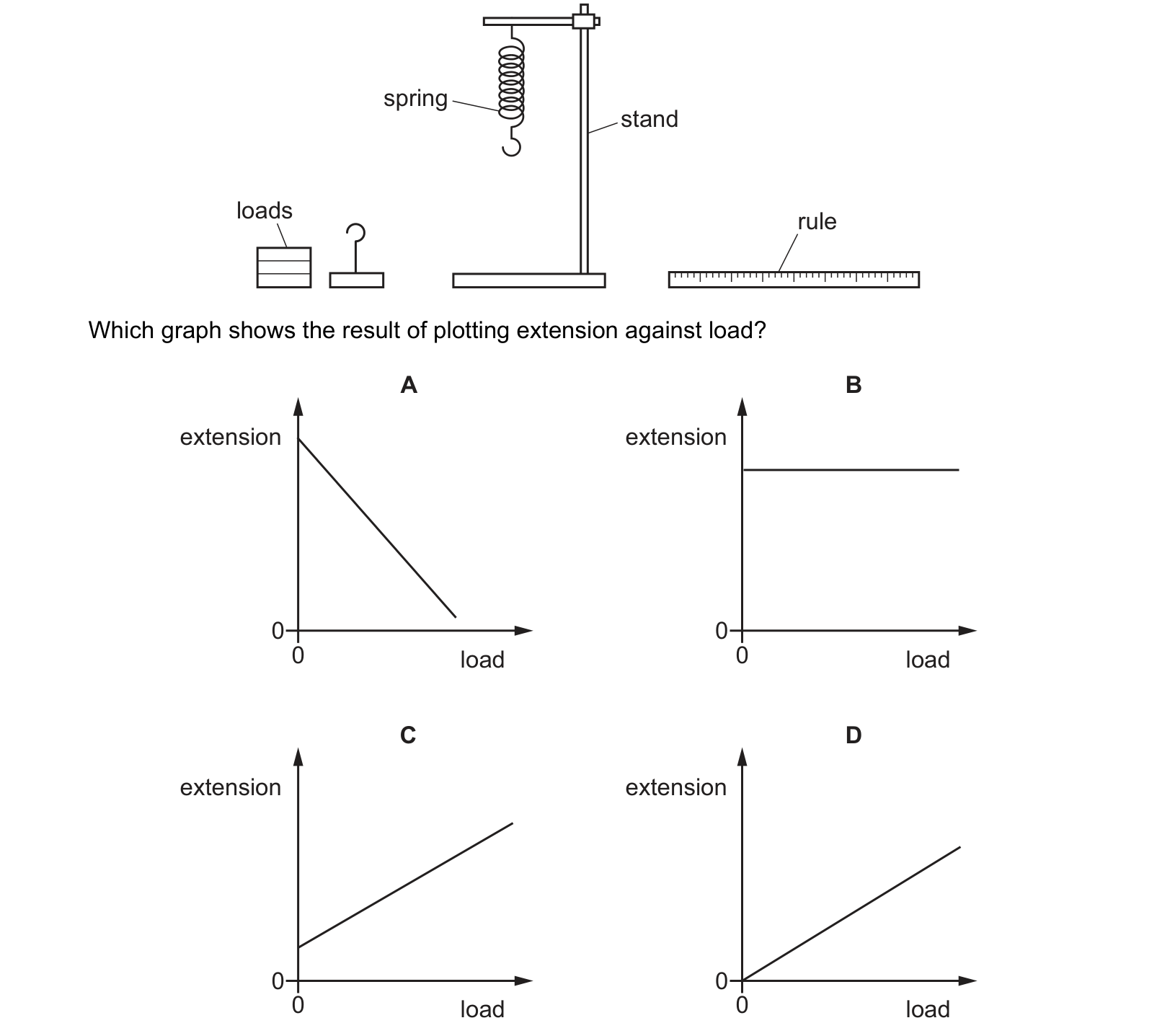
Answer: D.
Only graph D is a straight line through the origin, so D.
C is a straight line with the right slope but it cuts the extension axis above zero, which claims the spring is already stretched when nothing is hanging on it.
B is horizontal, so the extension never changes however much load is added.
A slopes downwards, so the spring would get shorter as load is added.
Direct proportion means both things at once: a straight line, and through the origin. C is there for anyone who checks only the first.
What the syllabus asks for on this topicSyllabus points
Syllabus points
- Describe the effects of forces on shape, size and motion.
- Find the resultant of forces acting along the same line, and use F = ma.
- Describe solid friction and air resistance, and their effect on motion.
- Recall and use Hooke's law, and understand the limit of proportionality.
- Understand the turning effect of a force, calculate moments, and apply the principle of moments.
- Understand centre of gravity and its effect on stability.
- Describe motion in a circle and identify the direction of the resultant force.
Related CIE 0625 Physics topics
Not the topic you were looking for? Describe what you are stuck on in your own words and we will take you to the notes that answer it.