Density
Contents: 9 sections
The equation
density = mass / volume
Rearranged: mass = density x volume, and volume = mass / density.
Units are g/cm³ or kg/m³. The two are not interchangeable and the conversion is a factor of 1000:
1 g/cm³ = 1000 kg/m³
Water is 1.0 g/cm³, which is 1000 kg/m³. Anything you calculate can be checked against that: 8 g/cm³ is about right for iron, 2.7 for aluminium, 1.2 kg/m³ for air. A liquid coming out at 120 000 kg/m³ is denser than any material on Earth and the working is wrong.
Use the units to check the operation. Multiplying g/cm³ by cm³ leaves grams, a mass. Dividing would leave cm⁶/g, which is not a unit of anything.
Regular solids
Measure the sides with a ruler, calculate the volume, weigh it on a balance.
- Cuboid: volume = length x width x height
- Prism or cylinder: volume = cross-sectional area x length
Worked example. A block has a cross-sectional area of 25 cm² and a length of 20 cm, and a mass of 4000 g.
Volume = 25 x 20 = 500 cm³. Density = 4000 / 500 = 8.0 g/cm³, which is about right for steel.
Where dimensions are read from a scale rather than given, each one is the difference between two readings. Rules in these questions are deliberately not started at zero, and every wrong option is usually an endpoint used instead of a difference.
Irregular solids
Use displacement, as in 1.1.
- Read the level in a measuring cylinder.
- Lower the object in until fully submerged.
- Read the new level.
- Volume of the object = the rise, not the final reading.
Weigh the object separately, then divide.
Worked example. A cylinder holds 50 cm³ of water and sits on a balance reading 150 g. An object is lowered in; the level rises to 75 cm³ and the balance reads 210 g.
Volume = 75 − 50 = 25 cm³. Mass = 210 − 150 = 60 g. Density = 60 / 25 = 2.4 g/cm³.
Two subtractions, and skipping either gives one of the offered answers. Both readings are totals, because the cylinder and the water were already there.
Cork and other floating solids need a sinker to hold them under.
Liquids
Weigh an empty container, add the liquid, weigh again, and subtract to get the mass of the liquid alone. Read the volume off the cylinder.
Worked example. An empty flask has a mass of 34 g. With 20 cm³ of liquid added, the total is 50 g.
Mass of liquid = 50 − 34 = 16 g. Density = 16 / 20 = 0.80 g/cm³.
Any question quoting a "total mass" is telling you to subtract the container first.
Comparing densities
Density is a ratio, so neither number decides it alone.
- The heaviest object on a page is not necessarily the densest. A block of 68 g in 40 cm³ is 1.7 g/cm³, and one of 54 g in 20 cm³ is 2.7 g/cm³.
- Two objects with the same mass can have different densities, and two with the same volume can too.
Whenever a question shows several objects, work out every density rather than looking for the biggest mass. The row with the largest number in the mass column is usually there to catch anyone who does not.
Floating and sinking
An object floats in a fluid if its density is less than the fluid's, and sinks if it is greater.
- Ice at about 0.92 g/cm³ floats on water at 1.0.
- Steel at 8 g/cm³ sinks, yet a steel ship floats, because the ship is mostly air and its average density is well below 1.0.
The same rule explains why oil floats on water and why a balloon filled with helium rises through air.
Density and heating
Heating a fluid makes it expand. The same mass now occupies a larger volume, and since density = mass / volume, the density falls.
Less dense fluid surrounded by denser fluid is pushed upwards, so it rises. Cooler, denser fluid sinks to take its place, and the loop that results is convection. Air warmed by a hot kettle becomes less dense and rises; this is the standard question and the reasoning is always the same two steps.
Note what changes and what does not. Squeezing a piece of foam reduces its volume, so its density rises, but its mass and weight are unchanged, because squeezing adds no matter.
Common mistakes
- Using the final level in a measuring cylinder as the volume instead of the rise.
- Forgetting to subtract the mass of the container from a stated total.
- Choosing the object with the greatest mass as the densest.
- Mixing g/cm³ and kg/m³, or missing the factor of 1000 between them.
- Dividing volume by mass instead of mass by volume; check with the units.
- Saying heating increases the density of a gas.
- Saying that compressing something increases its mass.
- Reading dimensions off a scale as endpoints rather than differences.
Check you have it
Question 1
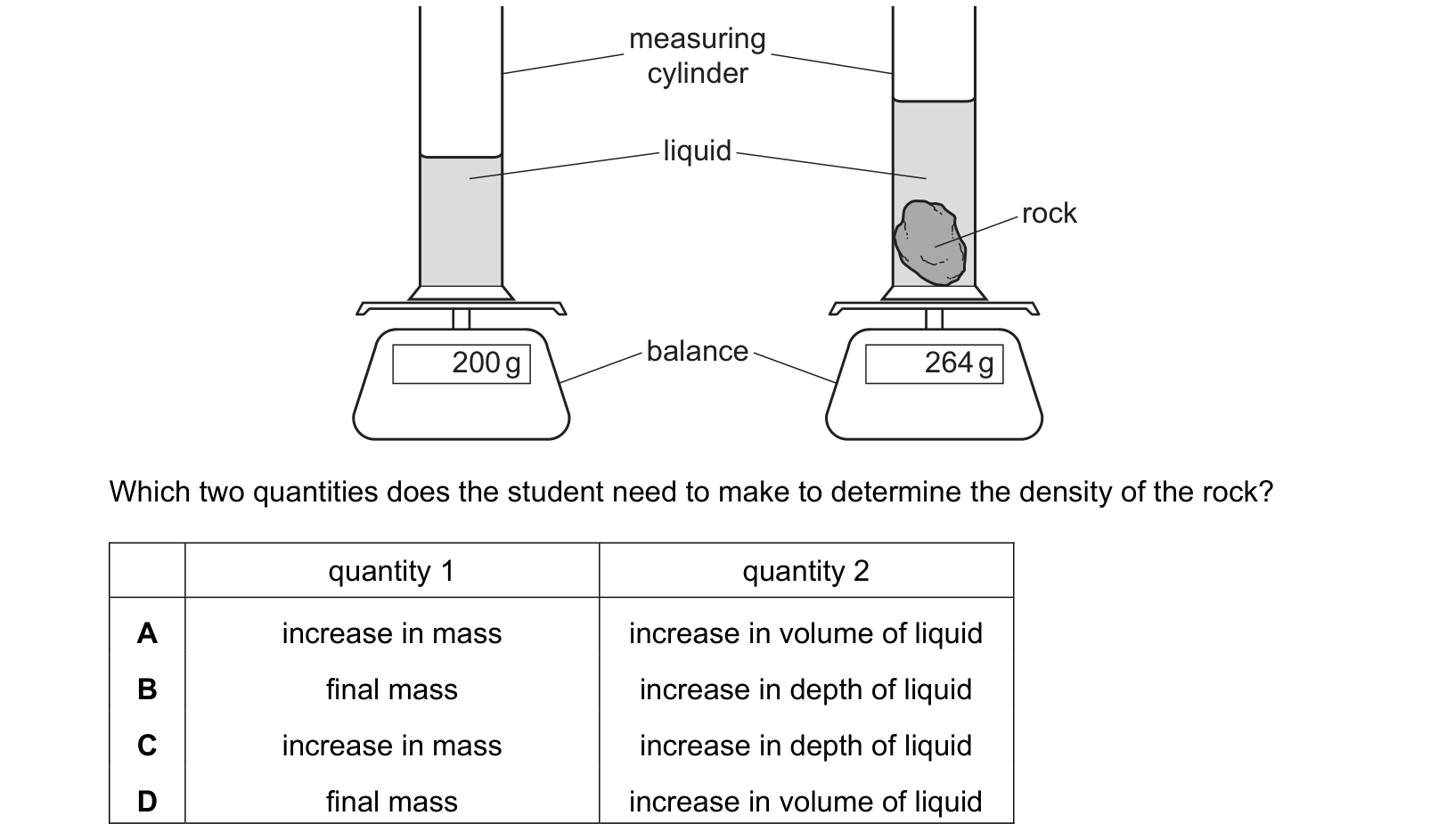
A student carries out an experiment to find the density of a rock. Which two quantities does the student need to make to determine the density of the rock? Each answer gives, in order: quantity 1; quantity 2.
Answer: A.
Mass of the rock: weigh the container of liquid before and after the rock goes in, and the increase is the rock's mass.
Volume of the rock: the rock pushes the liquid aside, so the increase in the liquid's volume is the rock's volume. That is the displacement method, and it works for an awkward shape no formula fits.
Increase in mass and increase in volume of liquid, which is A.
B and D use the final mass, which is the rock plus the liquid plus the container. Dividing that by anything gives no useful density, and it is the error the word "increase" in the other options is there to contrast with.
B and C use the increase in depth, not volume. Depth alone is not a volume: it would only give one if the container's cross-section were known and uniform, and the question offers no such information. Reading a volume scale directly avoids the whole problem, which is why measuring cylinders have one.
Question 2
Two objects are placed on a balance, one on each side, as shown.
Which properties of the objects can be compared using the balance?

Answer: B.
A adds volume. The balance has no way of sensing size. A small dense object and a large light one can balance perfectly, which is the whole reason density is a separate property worth measuring.
C and D involve density, and density needs a volume as well as a mass. The balance supplies only one of the two ingredients, so no density comparison is possible without other apparatus.
The property that makes a beam balance special is that it would give the same result on the Moon. It never measures a weight absolutely; it only asks which side is heavier. Weaken gravity and both pans weaken by the same factor, so the balance point is unmoved. A spring scale, which measures force against its own stiffness, would read quite differently there.
Question 3
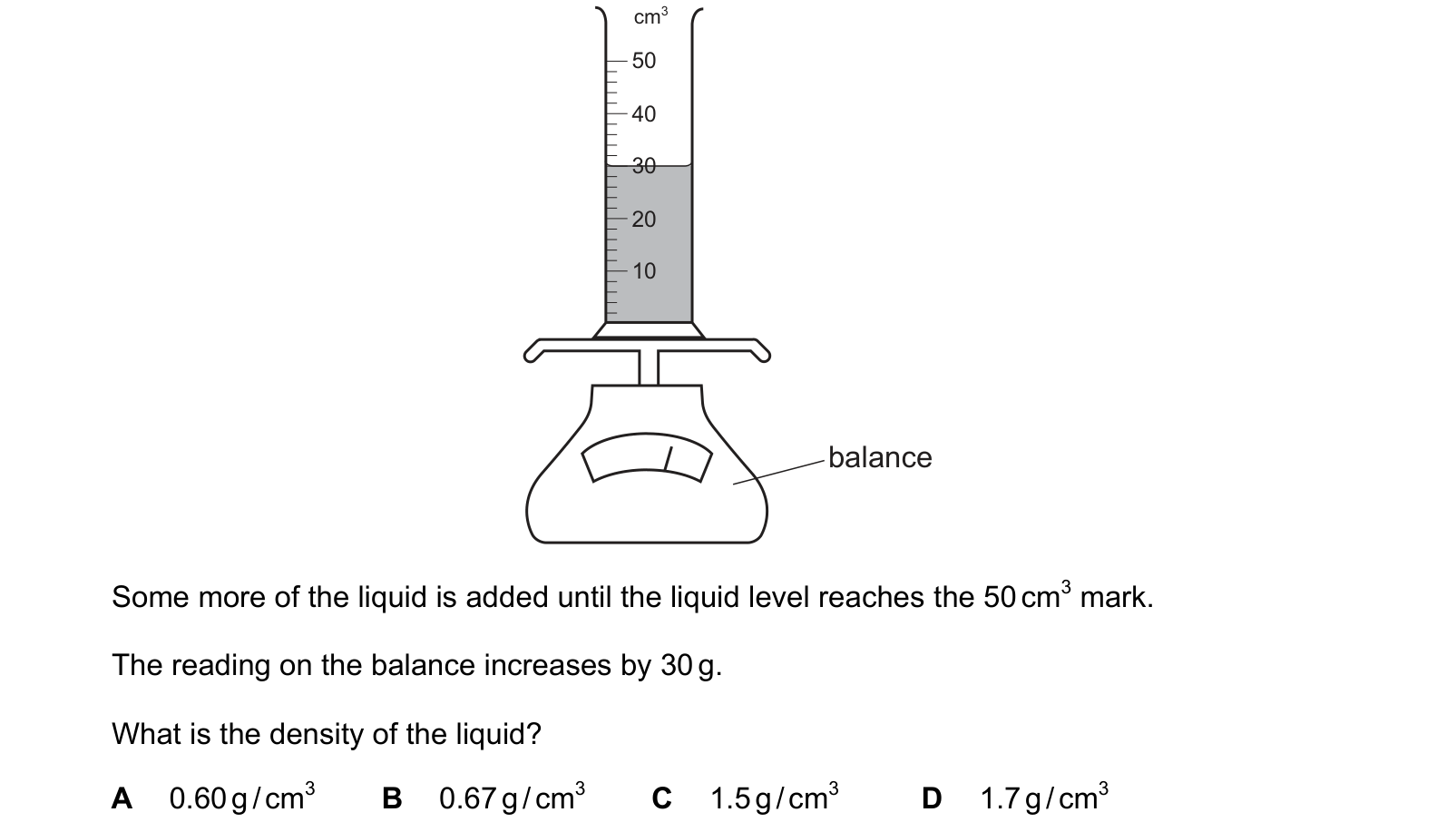
A measuring cylinder contains 30 cm³ of a liquid. Some more of the liquid is added until the liquid level reaches the 50 cm³ mark.
The reading on the balance increases by 30 g.
What is the density of the liquid?
Answer: C.
volume added = 50 - 30 = 20 cm3
mass added = 30 g
density = 30 / 20 = 1.5 g / cm3, which is C.
A, 0.60 g / cm3, divides 30 by 50, using the final level rather than the amount added. The cylinder already held 30 cm3 before anything was poured in, and that liquid's mass was never on the balance reading being quoted.
B, 0.67 g / cm3, is 20 divided by 30, the formula upside down.
D comes from another combination.
Both figures in the question are increases, and pairing them correctly is the whole task. The balance reading increased by 30 g, and the volume increased by 20 cm3, so those two belong together.
A density of 1.5 g / cm3 is half as dense again as water, which is a plausible liquid. Note that the answer does not depend on what was in the cylinder to begin with, which is exactly why the method works.
What the syllabus asks for on this topicSyllabus points
Syllabus points
- Define density as mass per unit volume and recall the equation.
- Determine the density of a regularly shaped solid, an irregularly shaped solid and a liquid.
- Predict whether an object will float or sink by comparing densities.
- Explain why a liquid or gas rises when it is heated, in terms of density.
Related CIE 0625 Physics topics
Not the topic you were looking for? Describe what you are stuck on in your own words and we will take you to the notes that answer it.