Electrical safety
Contents: 8 sections
The three wires
A mains cable carries three wires, each with a job and a colour.
| Wire | Colour | Purpose |
|---|---|---|
| Live | Brown | Carries the alternating supply voltage from the source |
| Neutral | Blue | Completes the circuit, at close to zero volts |
| Earth | Green and yellow stripes | Safety path to the ground, carries no current in normal use |
The live wire is the dangerous one, because it sits at a high voltage relative to the ground. Touching it gives a path to earth through your body.
The hazards
- Damaged insulation exposes bare conductors, so touching the cable can give a shock.
- Overheating cables can melt insulation and start a fire. This happens when too much current flows for the cable's thickness, often because too many appliances are run from one socket.
- Damp conditions are dangerous because water conducts, providing a path from a live part to earth through a person. This is why sockets are not fitted in bathrooms.
- Excess current from a fault or an overload heats the cable and can cause fire.
Fuses
A fuse is a thin wire that melts and breaks the circuit if the current exceeds its rating.
The fuse must be in the live wire. If it were in the neutral, the fuse would blow but the appliance would remain connected to the live supply, so anyone touching it could still get a shock. The same argument applies to the switch: it goes in the live wire so that switching off isolates the appliance from the high voltage.
Choosing a fuse. Work out the normal operating current from P = IV, then pick the next fuse value above it from those available, usually 3 A, 5 A and 13 A.
Worked example. A 1.2 kW appliance on a 230 V supply.
I = P/V = 1200 / 230 = 5.2 A, so a 13 A fuse is chosen, since a 5 A fuse would blow in normal use.
A fuse rated far too high never blows and gives no protection; one rated too low blows constantly. Both errors are offered in questions.
Circuit breakers
A circuit breaker does the same job as a fuse but is a switch that trips rather than a wire that melts.
Compared with a fuse it:
- operates faster
- can be reset rather than replaced
- is more accurate about the current at which it operates
A residual current circuit breaker (RCCB) compares the current in the live and neutral wires. In normal use they are equal. If some current is leaking to earth, perhaps through a person, they differ, and the RCCB cuts the supply within milliseconds. It protects people; an ordinary fuse mainly protects the wiring.
Earthing
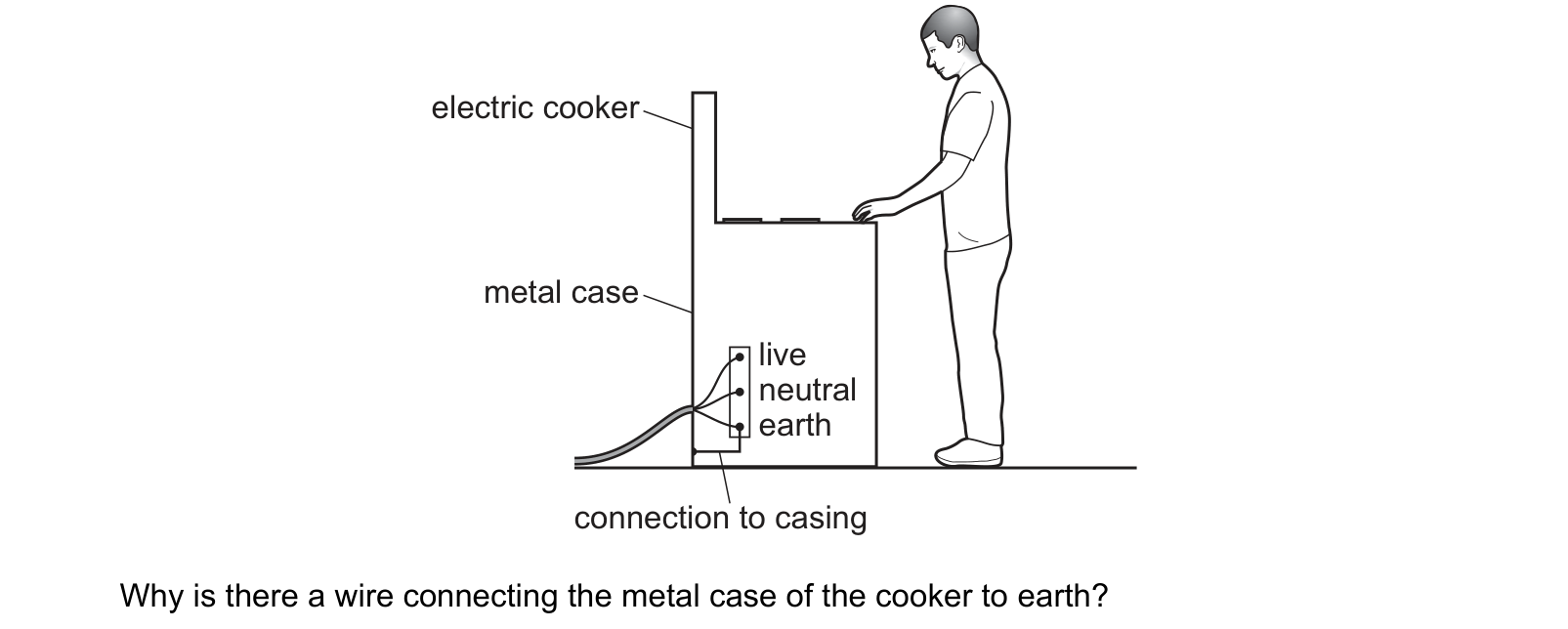
An appliance with a metal case is fitted with an earth wire connected to the case.
If a fault lets the live wire touch the case, the case would otherwise become live and anyone touching it would receive a shock. With earthing, a large current flows from the live wire, through the case, to earth. That surge blows the fuse and disconnects the supply.
The full answer needs both halves: the earth wire carries the current away and the resulting large current blows the fuse. Saying only that the current "goes to earth" leaves out why the appliance stops being dangerous.
Double insulation
An appliance with a plastic case does not need an earth wire. The case cannot become live because plastic is an insulator, so the appliance is safe with only two wires, live and neutral.
Such appliances are marked with a symbol of one square inside another, and are described as double insulated.
Kettles and toasters with metal bodies are earthed; hairdryers and drills with plastic bodies are usually double insulated.
Common mistakes
- Putting the fuse or the switch in the neutral wire.
- Saying the earth wire carries current in normal operation.
- Explaining earthing without mentioning that the large current blows the fuse.
- Choosing a fuse rated below the normal operating current.
- Choosing a 13 A fuse for everything regardless of the calculation.
- Saying a double insulated appliance is safe because it has an earth wire.
- Saying a circuit breaker works by melting.
- Mixing up the wire colours; brown is live and blue is neutral.
Check you have it
Question 1
A simple wiring diagram for an electric cooker is shown. Why is there a wire connecting the metal case of the cooker to earth?
Answer: C.
Question 2
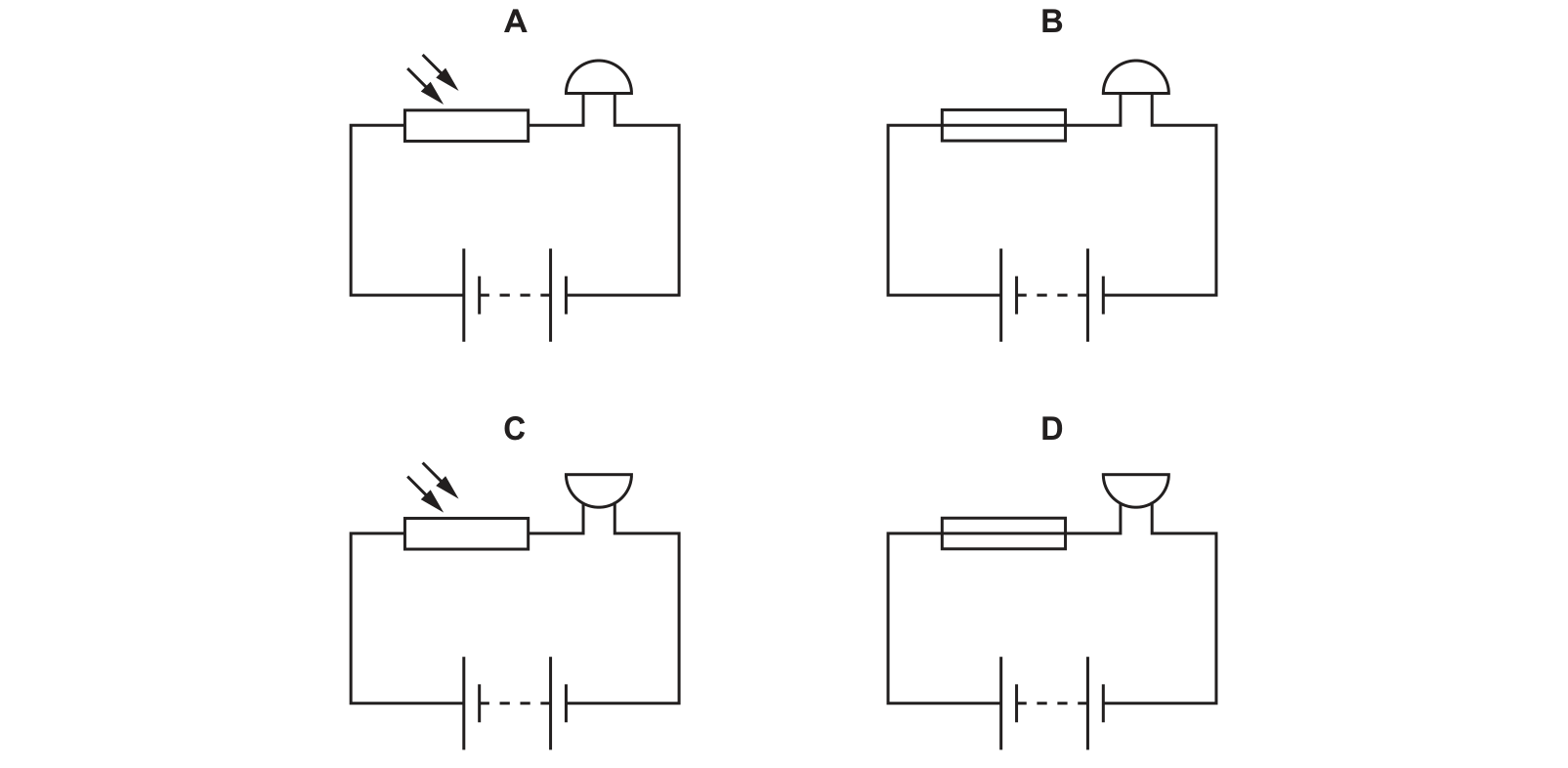
Which diagram shows a circuit containing a battery, a fuse and a buzzer? Use the source image for W22 Paper 11, question 32.
Answer: D.
Question 3
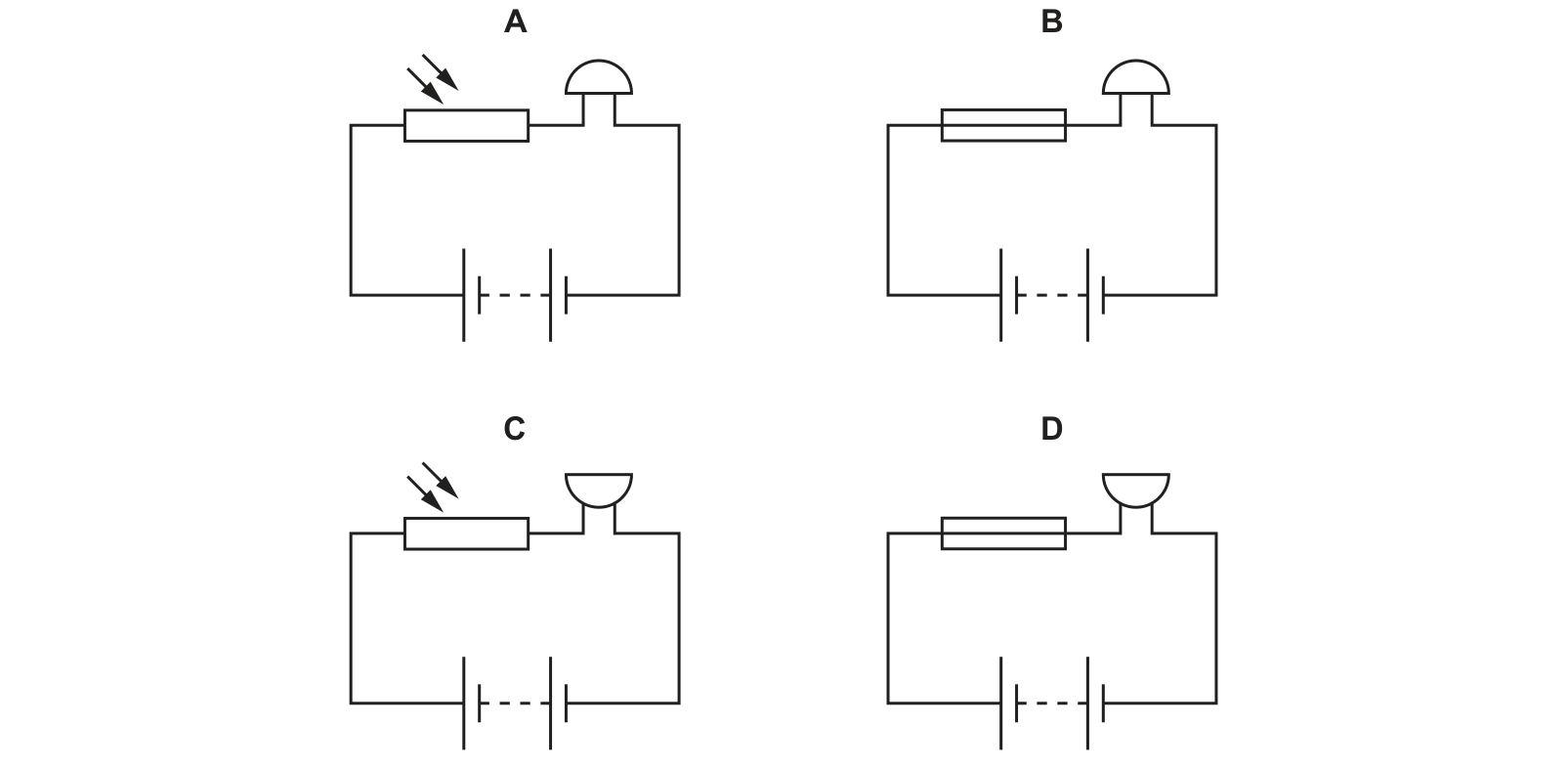
Which diagram shows a circuit containing a battery, a fuse and a buzzer? Use the source image for W22 Paper 21, question 32.
Answer: D.
What the syllabus asks for on this topicSyllabus points
Syllabus points
- State the hazards of damaged insulation, overheating cables, damp conditions and excess current.
- Explain the use and choice of fuses and circuit breakers.
- Explain the use of earthing and of double insulation.
- Explain why switches and fuses are placed in the live wire.
Related CIE 0625 Physics topics
Not the topic you were looking for? Describe what you are stuck on in your own words and we will take you to the notes that answer it.