43 past-paper questions on this unit. Five of them are below. Answer on the page: each one is marked the moment you pick, the correct option is shown whether or not you found it, and the full explanation opens either way.
CIE 0625 PhysicsPaper 1 and Paper 2 MCQsFree account
Electrical safety: five questions to try now
Real past-paper questions, the answer key from the mark scheme, and the explanation that goes with it. No account needed to answer them.
Question 1
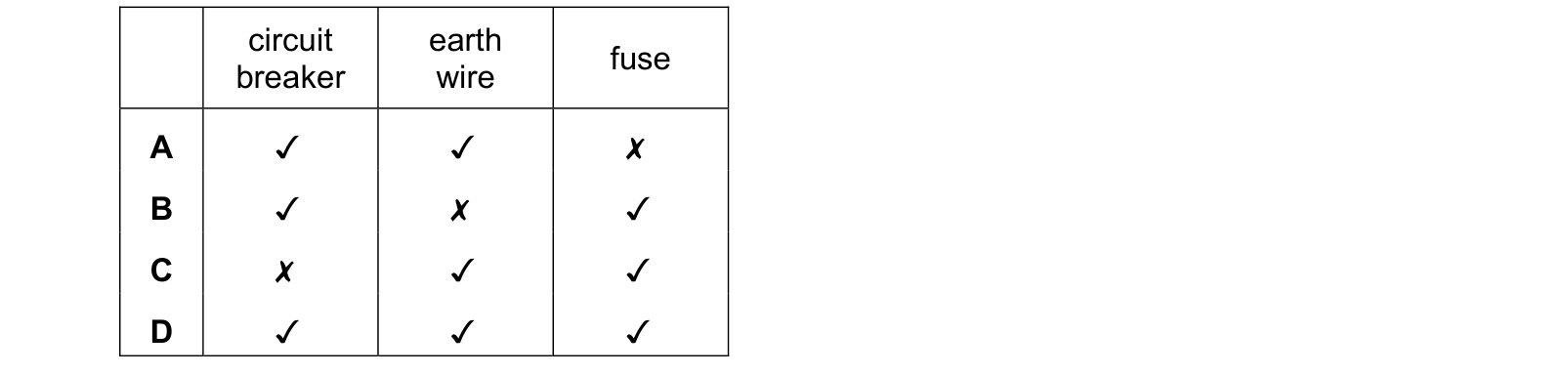
Which components are designed to improve the safe working of a mains electrical supply? circuit earth fuse breaker wire Use the source image for S19 Paper 12, question 35.
Answer: D.
All three of the components listed are safety devices for a mains supply, so the row with a tick in every column is the right one, which is D. A fuse is a thin wire that melts and breaks the live connection if the current becomes too large, which protects the wiring and the appliance from overheating. A circuit breaker does the same job by switching itself off automatically, with the advantage that it can be reset instead of replaced. The earth wire connects the metal case of an appliance to earth so that a live wire touching the case sends a large current to earth, blowing the fuse instead of leaving the case at a dangerous potential. A, B and C each leave one of these three out.
Question 2
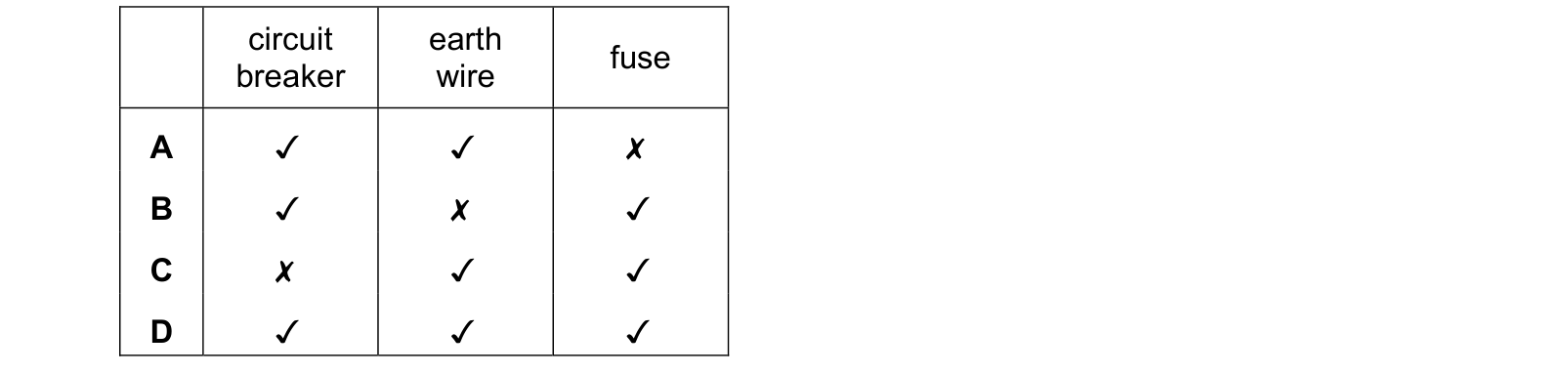
Which components are designed to improve the safe working of a mains electrical supply? circuit earth fuse breaker wire Use the source image for S19 Paper 22, question 35.
Answer: D.
All three of the components listed are safety devices for a mains supply, so the row with a tick in every column is the right one, which is D. A fuse is a thin wire that melts and breaks the live connection if the current becomes too large, which protects the wiring and the appliance from overheating. A circuit breaker does the same job by switching itself off automatically, with the advantage that it can be reset instead of replaced. The earth wire connects the metal case of an appliance to earth so that a live wire touching the case sends a large current to earth, blowing the fuse instead of leaving the case at a dangerous potential. A, B and C each leave one of these three out.
Question 3
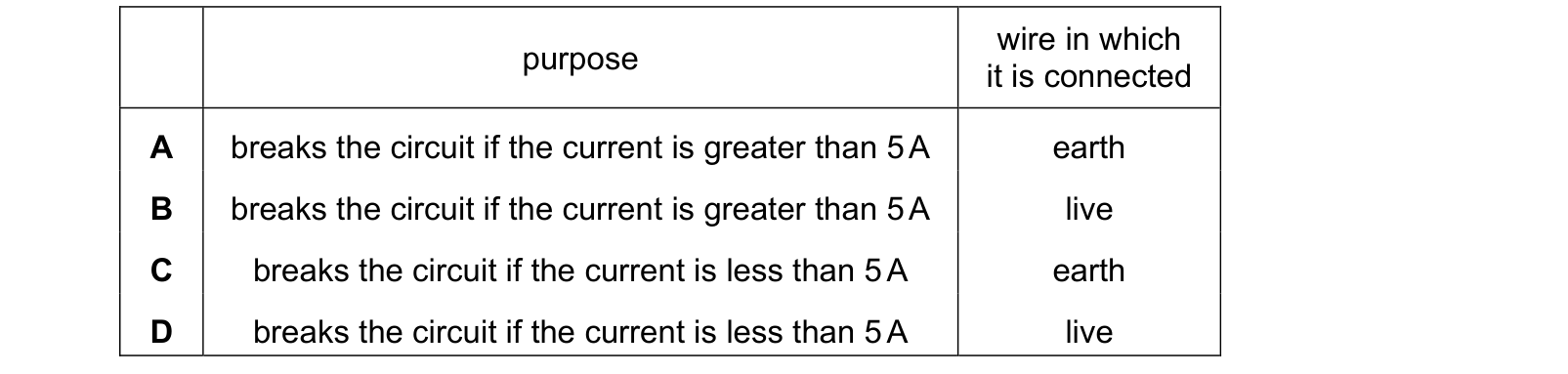
There is a 5 A fuse in the circuit of an appliance. What is the purpose of the fuse and in which wire is it connected? Each answer gives, in order: purpose; wire in which it is connected.
Answer: B.
A fuse is a thin wire that melts and breaks the circuit when the current through it grows too large, so a 5 A fuse is meant to blow above 5 A. That rules out C and D at once, since a fuse that broke at low current would cut the appliance off during normal use. The fuse also has to sit in the live wire, so that when it melts the appliance is disconnected from the dangerous high potential side of the mains. Put it in the earth or neutral wire, as A suggests, and the appliance would still be joined to the live supply after the fuse had blown and could still give a shock. Row B gives both halves correctly.
Question 4
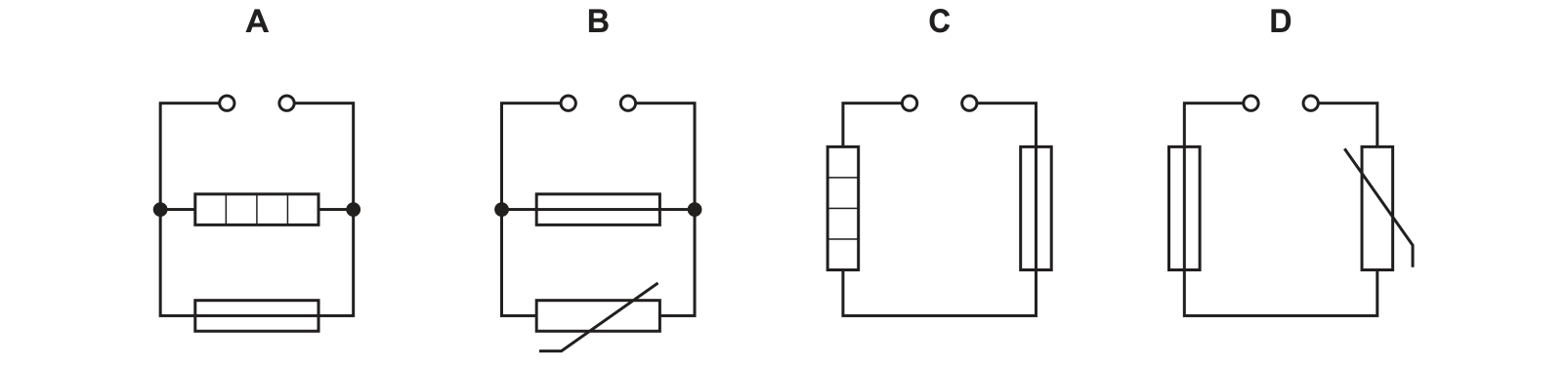
A student sets up four circuits. In which circuit is there a heater in series with a fuse? Use the source image for S19 Paper 11, question 32.
Answer: C.
A heater is drawn as a rectangle divided into small boxes, and a fuse is drawn as a rectangle with the wire running straight through it. Two components are in series when the current has no choice but to pass through both, one after the other round a single loop. C is the only circuit where those two symbols follow one another round the same loop, the segmented heater on one side and the fuse on the other, so C is correct. In A the heater and the fuse are drawn as separate branches between the same pair of junction dots, so they are in parallel and current could bypass the fuse completely. B also has its two components in parallel, and in both B and D the second component is a rectangle with a diagonal line through it, which is a thermistor and not a heater.
Question 5
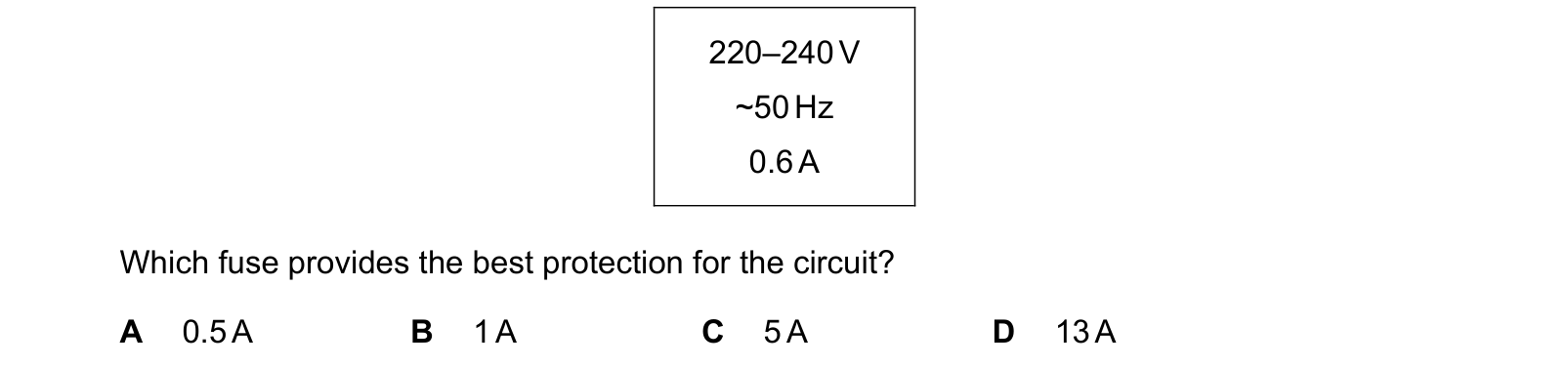
The information on the back of a television is shown. 220–240 V ~50 Hz 0.6 A Which fuse provides the best protection for the circuit?
Answer: B.
A fuse has to be rated a little above the normal working current of the appliance, so that it carries that current safely but melts quickly if a fault makes the current rise. The label gives the television's normal current as 0.6 A, so the smallest fuse rating above that is the sensible choice, and 1 A is the best fit, which is B. A 0.5 A fuse is below the working current, so it would blow every time the television was switched on. The 5 A and 13 A fuses would carry the normal 0.6 A happily, but a fault current of several amps would flow for a long time before either of them melted, so they give far poorer protection.
These questions are drawn from past CIE 0625 Physics papers and filtered to electrical safety. You answer, you find out immediately whether you were right, and you get the reasoning for the correct option and for each distractor. Wrong answers go to a mistakes locker so you can come back to exactly those.
Practice is free. You need an account only so your progress and your mistakes are still there next time.
These are the errors that cost marks on electrical safety, taken from our own topic notes. Read them before you practise and you will recognise the traps in the questions.
Putting the fuse or the switch in the neutral wire.
Saying the earth wire carries current in normal operation.
Explaining earthing without mentioning that the large current blows the fuse.
Choosing a fuse rated below the normal operating current.
Choosing a 13 A fuse for everything regardless of the calculation.
Saying a double insulated appliance is safe because it has an earth wire.
Saying a circuit breaker works by melting.
Mixing up the wire colours; brown is live and blue is neutral.