Electromagnetic effects
Contents: 8 sections
Electromagnetic induction
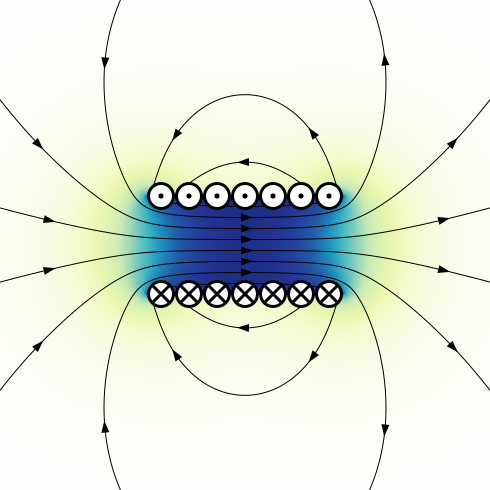
When a conductor cuts magnetic field lines, an e.m.f. is induced across it. If the conductor is part of a complete circuit, a current flows.
Relative movement is essential. A magnet held still inside a coil induces nothing, however strong it is.
The induced e.m.f. is larger when:
- the magnet or coil moves faster
- the magnetic field is stronger
- the coil has more turns
Reversing the direction of motion, or reversing the magnet, reverses the direction of the induced current.
Lenz's law in words: the induced current always opposes the change producing it. Pushing a north pole into a coil induces a current that makes the near face a north pole, which repels the magnet, so work has to be done to push it in. That work is where the electrical energy comes from, and it is why induction does not create energy from nothing.
The a.c. generator
A coil rotates in a magnetic field between the poles of a magnet. As it turns, the sides cut field lines and an e.m.f. is induced. Slip rings and brushes connect the rotating coil to the external circuit.
The output is alternating: a sine curve that reverses every half turn.
- The e.m.f. is greatest when the coil is parallel to the field, because the sides are then cutting field lines fastest.
- The e.m.f. is zero when the coil is perpendicular to the field, because the sides are momentarily moving along the field lines and cutting none.
That pairing feels backwards and is examined often. Turning the coil faster increases both the frequency and the peak e.m.f.
Transformers
A transformer has a primary coil and a secondary coil wound on a soft iron core.
An alternating current in the primary produces a changing magnetic field in the core. The core carries that changing field to the secondary, where it induces an alternating e.m.f.
A transformer only works with alternating current. With d.c. the field is steady, nothing changes, and no e.m.f. is induced. This is the single most common transformer question.
Soft iron is used because it magnetises and demagnetises easily, following the rapidly changing field.
The equations
Vp / Vs = Np / Ns
For an ideal (100% efficient) transformer, power in equals power out:
Ip Vp = Is Vs
A step-up transformer has more turns on the secondary and raises the voltage, which lowers the current. A step-down transformer does the reverse.
Worked example. A transformer has 200 primary turns and 1000 secondary turns, with 12 V across the primary.
Vs = 12 x 1000/200 = 60 V. Voltage up by five, so current down by five.
Voltage and current always move in opposite directions. A transformer cannot increase both, because that would increase the power.
High-voltage transmission
Power is sent across the country at very high voltage and correspondingly low current.
The reason is the heating loss in the cables, which is P = I²R. Because the loss depends on the square of the current, reducing the current to a tenth cuts the loss to a hundredth.
Step-up transformers raise the voltage at the power station; step-down transformers lower it again for safe use in homes.
Magnetic effect of a current
A current-carrying wire produces a magnetic field around it.
- Around a straight wire the field lines are concentric circles, closer together near the wire where the field is stronger. The right-hand grip rule gives the direction: point the right thumb along the conventional current and the fingers curl the way the field goes.
- A solenoid produces a field like that of a bar magnet, with a strong, uniform field inside. Its strength is increased by more turns, a larger current, or a soft iron core.
Reversing the current reverses the field.
The motor effect
A current-carrying conductor placed in a magnetic field experiences a force, provided the current is not parallel to the field.
Fleming's left-hand rule gives the direction: first finger for Field (north to south), second finger for Current (conventional), thumb for Motion.
The force is larger with a stronger field or a larger current, and reverses if either the current or the field reverses. Reversing both leaves the direction unchanged.
The d.c. motor
A coil carrying current in a magnetic field has forces on its two sides in opposite directions, so it turns.
The split-ring commutator reverses the current in the coil every half turn. Without it the coil would turn half a revolution and stop, because the forces would then oppose the rotation. The commutator is what keeps the motor turning continuously, and explaining that is the standard question.
The turning effect is increased by a larger current, a stronger field, more turns on the coil, or a larger coil area.
Common mistakes
- Saying a transformer works on direct current.
- Saying a stationary magnet inside a coil induces a current.
- Placing the peak generator output when the coil is perpendicular to the field.
- Saying a step-up transformer increases both voltage and current.
- Explaining high-voltage transmission by saying the voltage reduces the resistance.
- Using the left-hand rule for induction, or the right-hand grip rule for the motor effect.
- Saying the commutator makes the coil spin faster rather than keeping it turning one way.
- Forgetting that reversing both the current and the field leaves the force unchanged.
Check you have it
Question 1
The diagram shows part of a long current-carrying conductor. At which point is the magnetic field strongest? Use the source image for W20 Paper 21, question 36.

Answer: C.
Question 2
The diagram shows an a.c. generator rotating in a clockwise direction. What are the names of parts 1 and 2? Use the source image for W22 Paper 22, question 36.
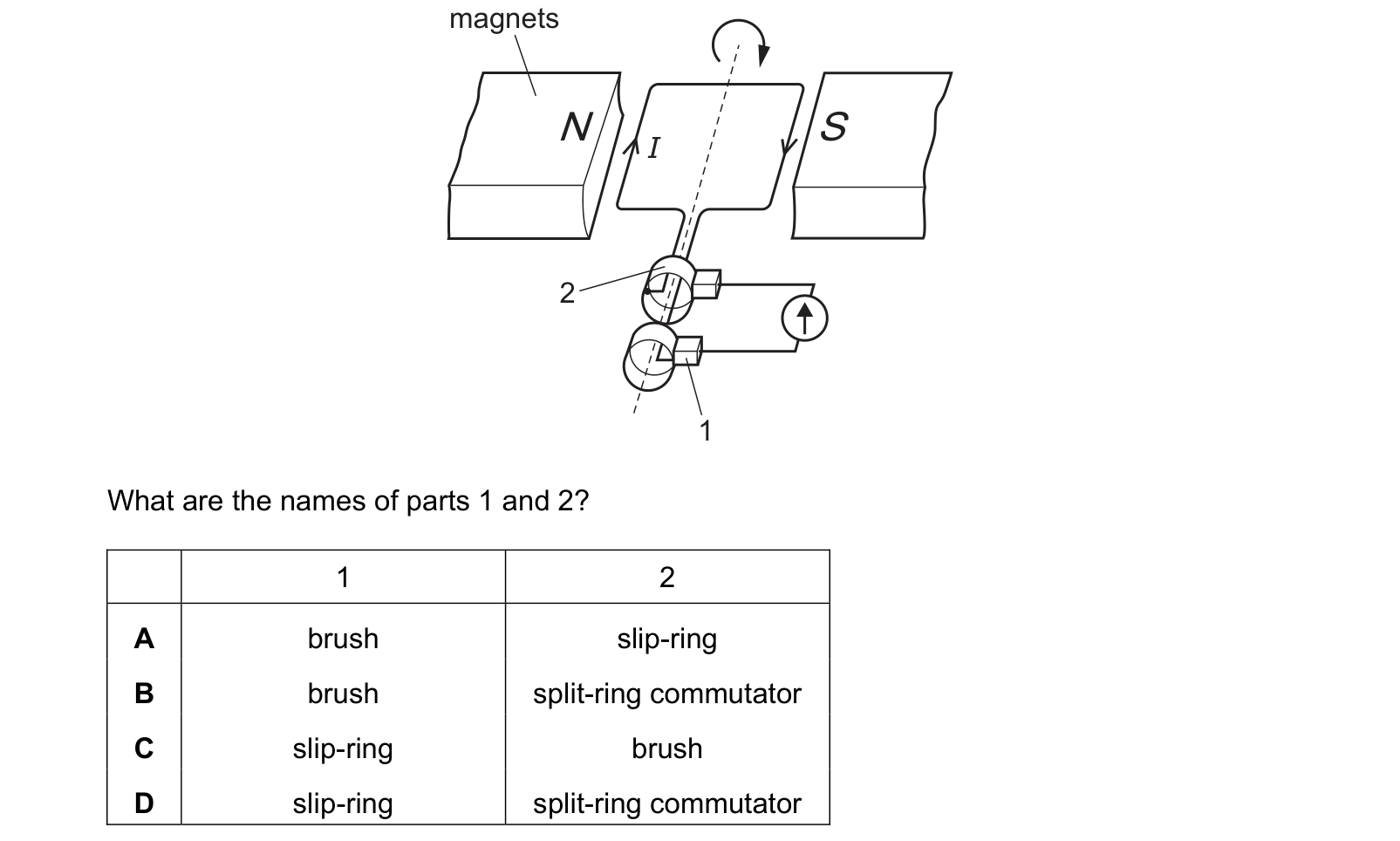
Answer: A.
Question 3
The diagram shows the magnetic field around a conductor which is carrying a current. Where is the strength of the field greatest? Use the source image for W24 Paper 22, question 24.
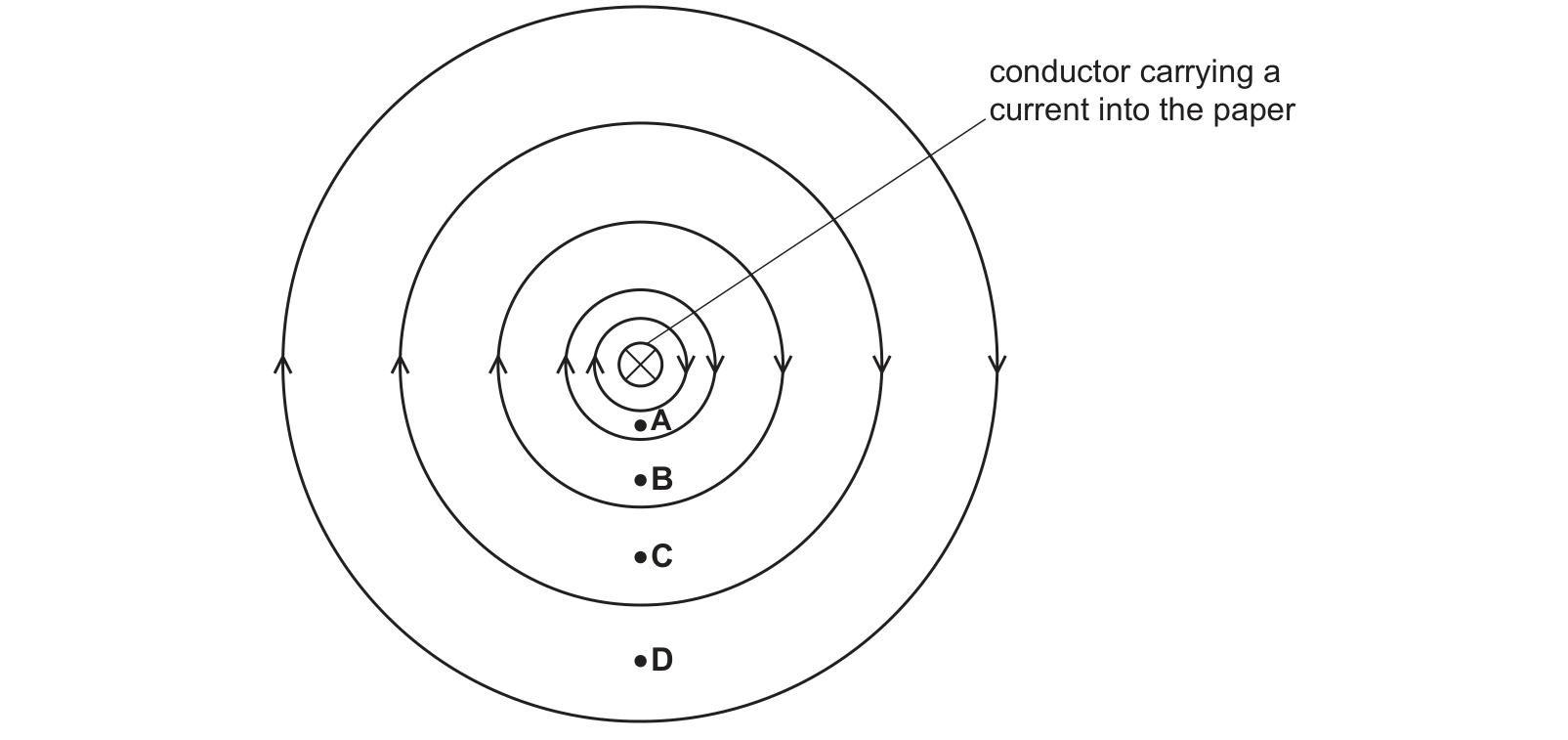
Answer: A.
What the syllabus asks for on this topicSyllabus points
Syllabus points
- Describe electromagnetic induction, and the factors affecting the induced e.m.f.
- Describe a simple a.c. generator and sketch its output.
- Describe the structure and action of a transformer, and recall the turns and current equations.
- Explain why power is transmitted at high voltage.
- Describe the magnetic field of a current-carrying conductor and of a solenoid.
- Describe the force on a current-carrying conductor in a magnetic field, and the action of a d.c. motor.
Related CIE 0625 Physics topics
Not the topic you were looking for? Describe what you are stuck on in your own words and we will take you to the notes that answer it.