131 past-paper questions on this unit. Five of them are below. Answer on the page: each one is marked the moment you pick, the correct option is shown whether or not you found it, and the full explanation opens either way.
CIE 0625 PhysicsPaper 1 and Paper 2 MCQsFree account
Electromagnetic effects: five questions to try now
Real past-paper questions, the answer key from the mark scheme, and the explanation that goes with it. No account needed to answer them.
Question 1
A conductor carrying a current is placed in a magnetic field. In which direction does the force on the conductor act? Use the source image for S19 Paper 23, question 37.
Answer: A.
The N pole is on the left and the S pole is on the right, so in the gap the field runs from the N face across to the S face, that is from left to right. The arrowhead on the wire points down towards the near, lower-left end, so the current is coming out towards the reader along a wire that lies at right angles to the field. Fleming's left hand rule, with the first finger along the field and the second finger along the current, puts the thumb up the page, so the force is arrow A. C is the answer for the current running the other way along the wire, and B and D point along the field itself, but the force on a current-carrying wire can never act along the field direction.
Question 2
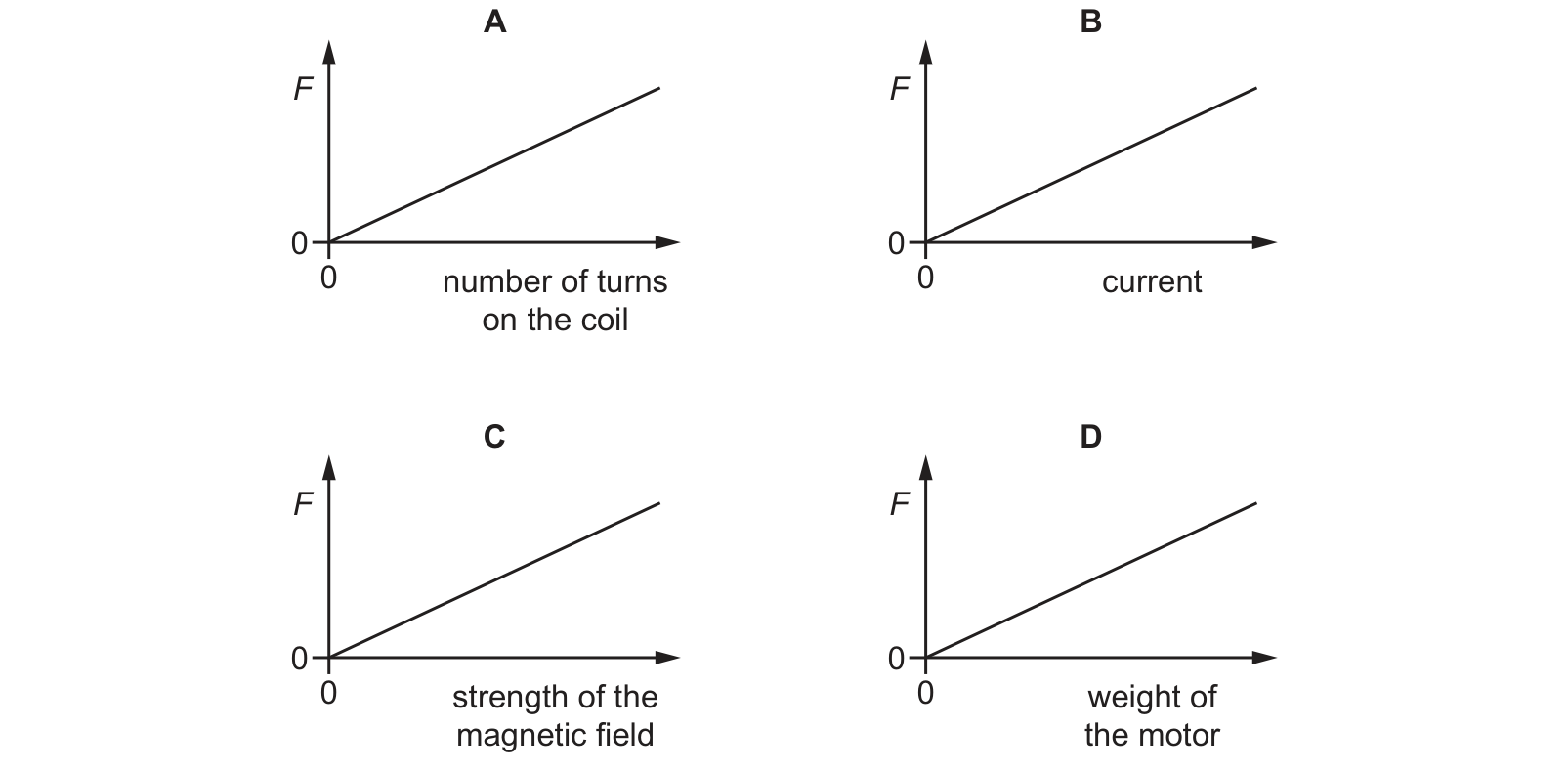
Which graph does not show the correct trend for the force F causing the turning effect on the coil in a d.c. motor? Use the source image for S24 Paper 12, question 31.
Answer: D.
The turning effect in a motor comes from F = BIL acting on the sides of the coil, and every extra turn adds another pair of sides, so F rises in proportion to the number of turns, the current and the field strength. A, B and C all show that straight line through the origin, so all three are correct trends. The weight of the motor appears nowhere in that relationship, and a heavier casing does not push harder on the coil, so the straight line in D is the one that does not belong. The question asks which graph is not correct, so the odd one out is the answer rather than the three that agree.
Question 3
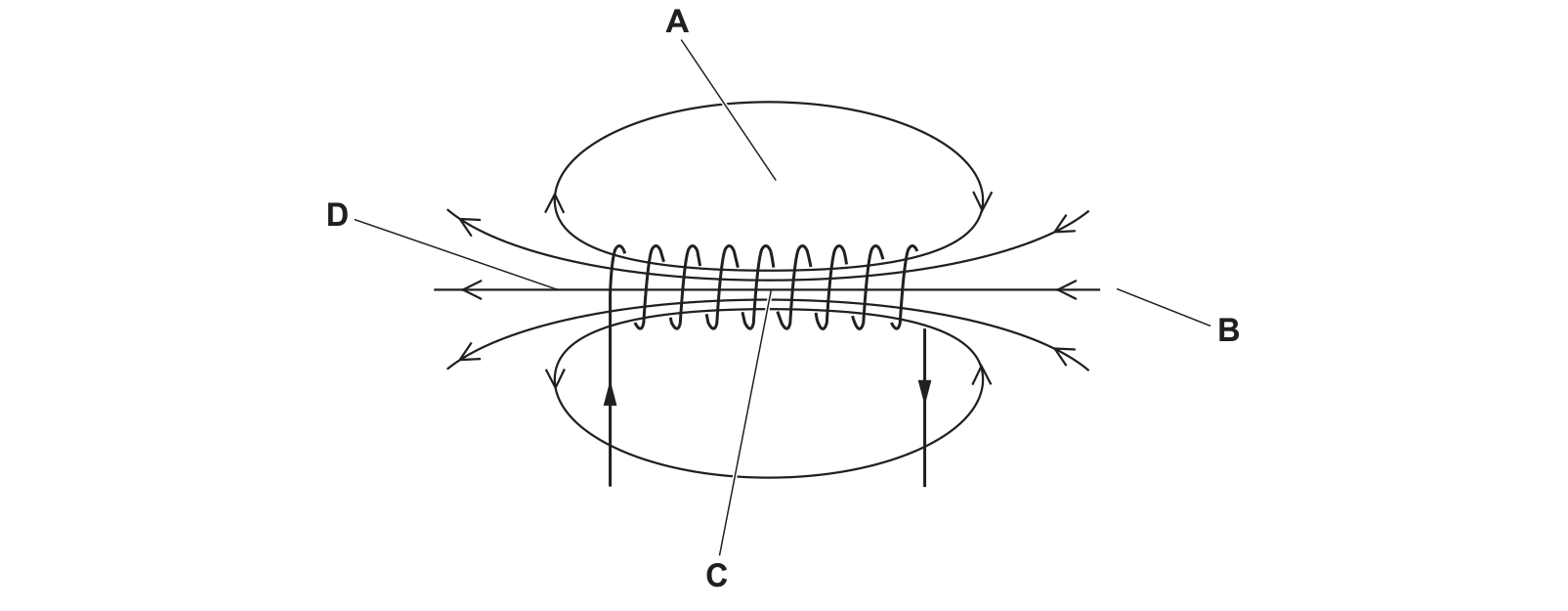
The diagram shows the magnetic field due to a current in a solenoid. Where is the magnetic field the strongest? Use the source image for S20 Paper 22, question 35.
Answer: C.
The strength of a magnetic field is shown by how closely the field lines are packed together. Inside the solenoid the lines are squeezed into the narrow space along the axis and run parallel and evenly spaced, which is the most crowded region on the whole diagram, so the field is strongest there and C is correct. A points to one of the wide return loops well above the coil, where the same lines have spread out over a much larger area and the field is weak. B and D point to the field beyond the ends of the solenoid, where the lines are already fanning outwards on their way round, so the field there is weaker than inside.
Question 4
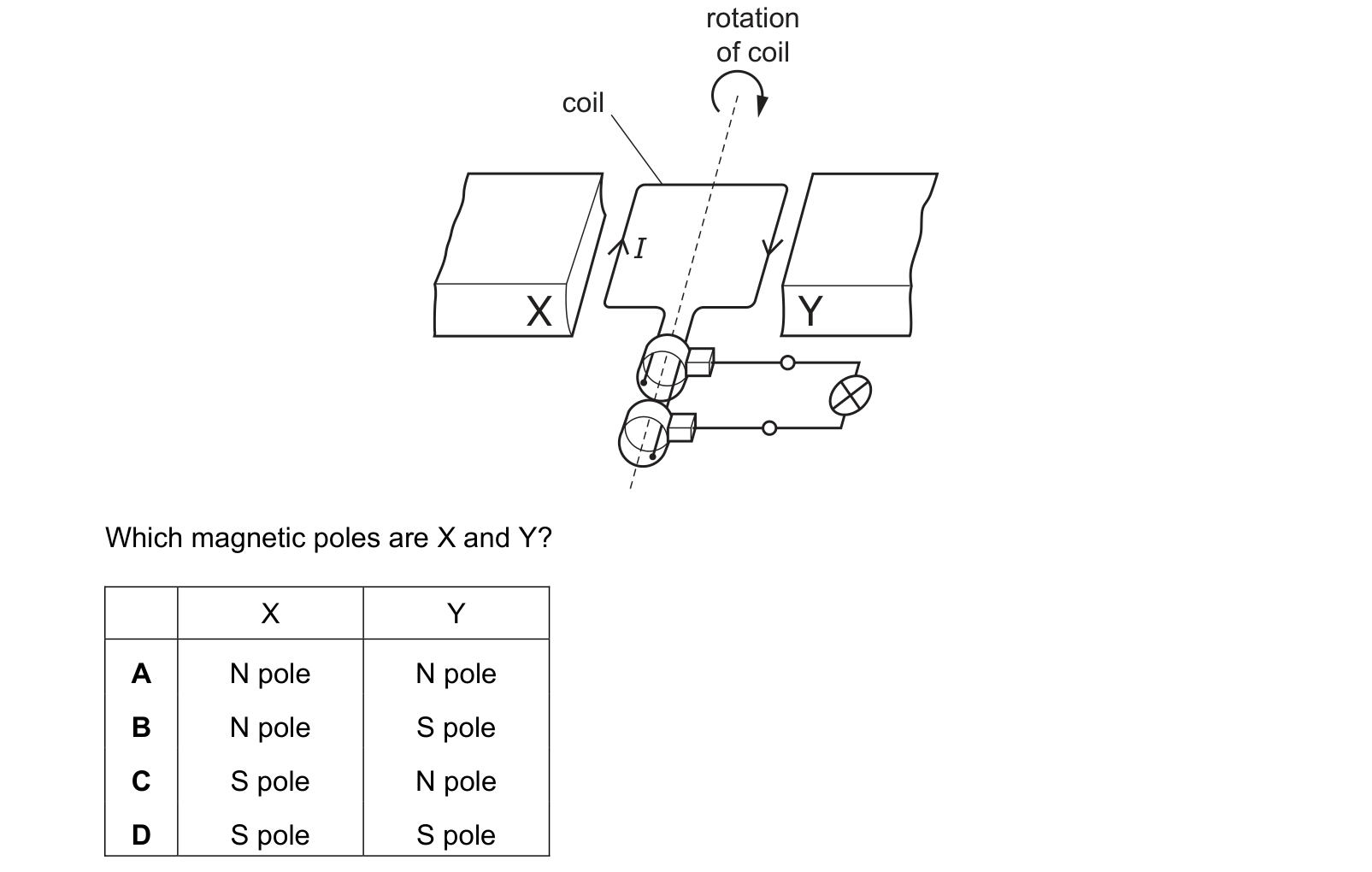
The diagram shows an a.c. generator used to power a lamp. The coil rotates in a clockwise direction. rotation Which magnetic poles are X and Y? Each answer gives, in order: X; Y.
Answer: B.
Work on one side of the coil at a time. The arrow shows the current running up the left-hand side of the coil, and that side is being carried round by the rotation shown at the top of the diagram. Fleming's right-hand rule for a generator ties those together: with that motion and that current, the field has to run across the gap from left to right. Field lines leave a north pole and enter a south pole, so X on the left is the N pole and Y on the right is the S pole, giving B. C is the answer if the coil were turning the other way, or equivalently if the current arrows were reversed, and A and D put like poles facing each other, which would not give the straight field across the gap that a generator needs.
Question 5
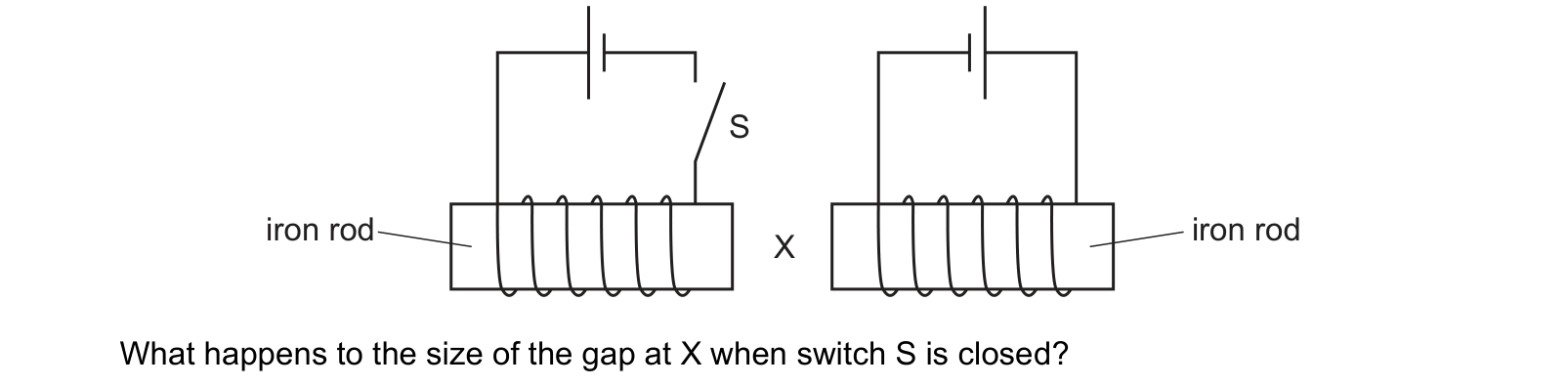
Two circuits are set up as shown. The iron rods are placed close together and are able to move. What happens to the size of the gap at X when switch S is closed?
Answer: C.
Both coils are wound the same way round their iron rods, so the difference lies in the cells. The long plate of the left-hand cell is on its left, while the long plate of the right-hand cell is on its right, which sends current along the two rods in opposite directions. Identical windings carrying current in opposite directions give fields pointing opposite ways inside their cores, so the two ends that face each other across the gap end up as the same kind of pole. Like poles repel, so closing S pushes the rods apart and the gap at X increases, which is C. A is what would happen if the two cells were connected the same way round so that unlike poles met at the gap, D forgets that closing S turns the left-hand rod into a magnet at all, and B would need something in the circuit to change part way through, which nothing does.
These questions are drawn from past CIE 0625 Physics papers and filtered to electromagnetic effects. You answer, you find out immediately whether you were right, and you get the reasoning for the correct option and for each distractor. Wrong answers go to a mistakes locker so you can come back to exactly those.
Practice is free. You need an account only so your progress and your mistakes are still there next time.
These are the errors that cost marks on electromagnetic effects, taken from our own topic notes. Read them before you practise and you will recognise the traps in the questions.
Saying a transformer works on direct current.
Saying a stationary magnet inside a coil induces a current.
Placing the peak generator output when the coil is perpendicular to the field.
Saying a step-up transformer increases both voltage and current.
Explaining high-voltage transmission by saying the voltage reduces the resistance.
Using the left-hand rule for induction, or the right-hand grip rule for the motor effect.
Saying the commutator makes the coil spin faster rather than keeping it turning one way.
Forgetting that reversing both the current and the field leaves the force unchanged.