Simple phenomena of magnetism
Contents: 9 sections
Poles and forces
Every magnet has a north-seeking pole and a south-seeking pole, usually shortened to north and south. They cannot be separated: cutting a magnet in half gives two smaller magnets, each with both poles.
Like poles repel; unlike poles attract.
Repulsion is the only reliable test for a magnet. A magnet attracts an unmagnetised magnetic material, and an unmagnetised magnetic material attracts a magnet, so attraction proves nothing about which object is magnetised. Only two magnets repel. This is a favourite question and the answer is always repulsion.
Magnetic materials
Only a few materials are magnetic: iron, steel, cobalt, nickel and some alloys.
Copper, aluminium, brass, plastic, wood and glass are not magnetic, even though several of them conduct electricity well. Being a metal and being magnetic are separate properties, and questions exploit the assumption that all metals are magnetic.
Induced magnetism
A magnetic material placed in a magnetic field becomes a magnet itself for as long as it stays there. This is induced magnetism.
The end nearest the magnet develops the opposite pole, so the two attract. That is why a magnet picks up a paper clip, and why a chain of paper clips can hang from a magnet with each one magnetising the next.
Magnetising and demagnetising
To magnetise:
- Stroke the material repeatedly in one direction with one pole of a permanent magnet.
- Place it inside a solenoid carrying a direct current.
- Hammer it while it is aligned with the Earth's field.
To demagnetise:
- Place it inside a solenoid carrying an alternating current and slowly withdraw it.
- Heat it strongly and let it cool while lying east to west.
- Hammer it while lying east to west.
The pattern is worth noting: direct current and alignment magnetise, alternating current and disorder demagnetise.
Magnetic fields
A magnetic field is a region where a magnetic material experiences a force.
Field lines:
- run from north to south outside the magnet
- never cross
- are closer together where the field is stronger, which is at the poles
The field of a bar magnet loops from the north pole round to the south. Between two unlike poles facing each other the lines run straight across from one to the other. Between two like poles they curve away, leaving a neutral point between them where the fields cancel and the resultant is zero.
Fields are plotted with iron filings, which line up along the lines, or with a plotting compass, which gives the direction as well as the shape. A compass needle always points along the field line at its position.
The Earth's field
The Earth behaves as though it contains a bar magnet, which is why a compass works.
The geographic North Pole is close to a magnetic south pole, because the north-seeking end of a compass is attracted to it. Unlike poles attract, so the pole in the Arctic must be a magnetic south. Questions ask this and the reasoning is the whole answer.
Temporary and permanent magnets
| Soft iron | Steel | |
|---|---|---|
| Magnetises | Easily | With difficulty |
| Retains magnetism | Poorly | Well |
| Type | Temporary | Permanent |
| Used for | Electromagnet cores, transformer cores, relays | Compass needles, loudspeaker magnets, fridge magnets |
Soft and hard here describe magnetic behaviour, not physical hardness.
A temporary magnet is wanted wherever the magnetism must be switched off: an electromagnet in a scrapyard crane picks up a car and drops it when the current stops. A soft iron core is used because it loses its magnetism as soon as the current does.
A permanent magnet is wanted wherever the field must persist without a current.
Common mistakes
- Saying attraction proves an object is a magnet; only repulsion does.
- Assuming all metals are magnetic, especially copper and aluminium.
- Drawing field lines from south to north outside the magnet, or letting them cross.
- Saying the Earth's magnetic pole in the Arctic is a magnetic north.
- Using steel for an electromagnet core, or soft iron for a permanent magnet.
- Saying a cut magnet gives one north piece and one south piece.
- Confusing "magnetically soft" with physically soft.
Check you have it
Question 1
Which metal could be used for a permanent magnet and which metal could be used for the core of an electromagnet? Each answer gives, in order: permanent magnet; core of electromagnet.
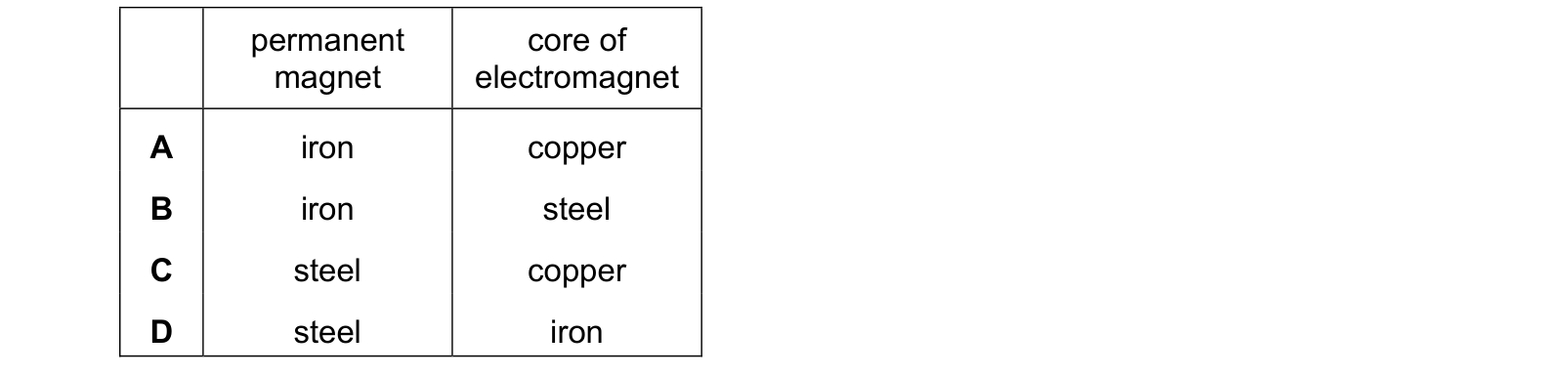
Answer: D.
Question 2
The diagrams show two bar magnets which are attracting each other. Which diagram shows the magnetic field pattern between the poles? Use the source image for S20 Paper 12, question 27.
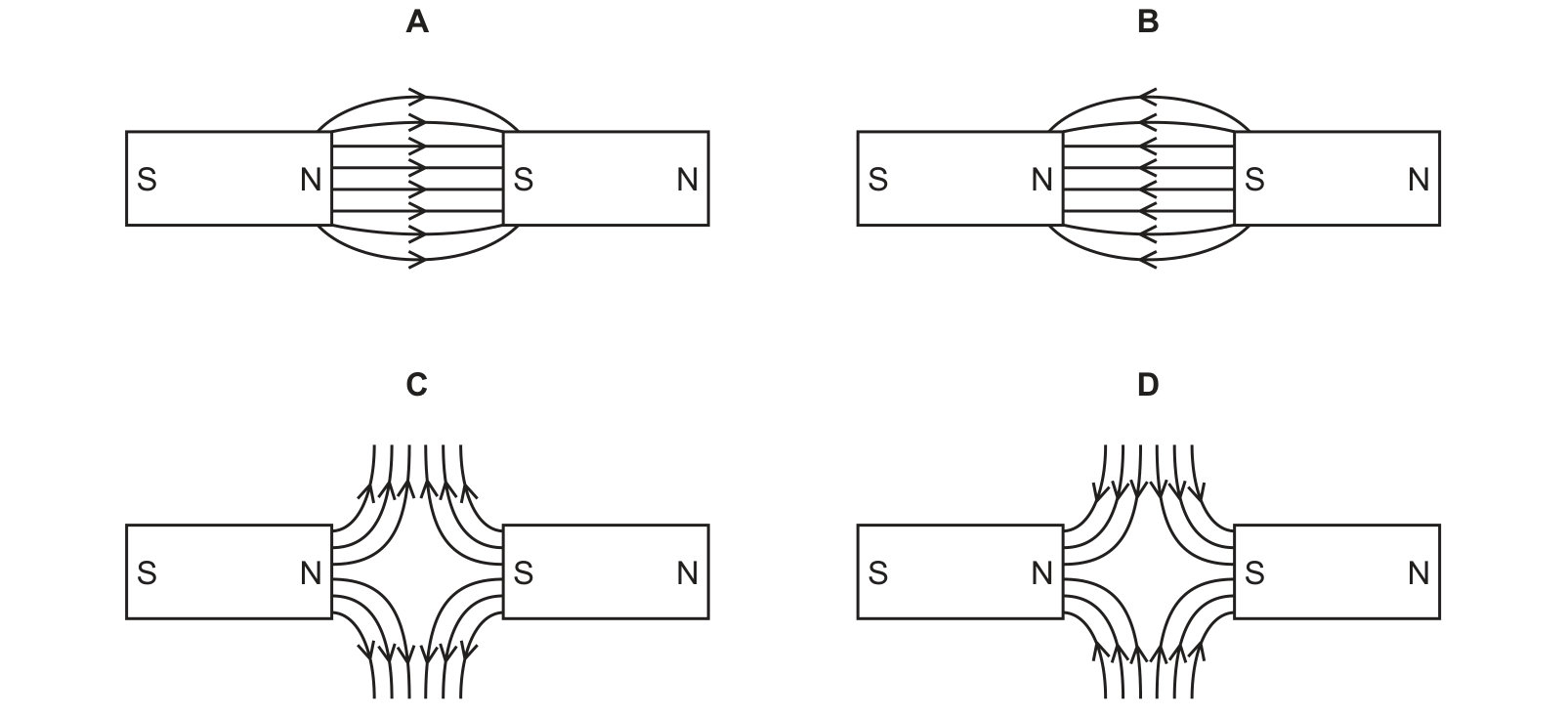
Answer: A.
Question 3
The diagram shows part of the magnetic field around a strong magnet. In which position does a magnetic pole experience the strongest force? Use the source image for W24 Paper 21, question 24.

Answer: A.
What the syllabus asks for on this topicSyllabus points
Syllabus points
- Describe the forces between magnetic poles and between magnets and magnetic materials.
- Distinguish magnetic from non-magnetic materials.
- Describe induced magnetism.
- Describe methods of magnetising and demagnetising.
- Draw and describe magnetic field patterns, including the field of a bar magnet and the Earth's field.
- Distinguish the properties and uses of temporary and permanent magnets.
Related CIE 0625 Physics topics
Not the topic you were looking for? Describe what you are stuck on in your own words and we will take you to the notes that answer it.