Sound
Contents: 7 sections
What sound is
Sound is produced by a vibrating source: a loudspeaker cone, a string, a drum skin, vocal cords.
Sound is a longitudinal wave. The particles of the medium oscillate backwards and forwards along the direction the wave travels, producing compressions where the particles are pushed together and rarefactions where they are spread apart.
Sound cannot travel through a vacuum, because it needs particles to pass the vibration along. The standard demonstration is a ringing bell in a bell jar: as the air is pumped out the sound fades to nothing while the bell can still be seen vibrating.
Loudness and pitch
- Loudness depends on amplitude. A larger amplitude means a louder sound.
- Pitch depends on frequency. A higher frequency means a higher pitch.
On an oscilloscope trace, a louder note is taller and a higher note has its peaks closer together. Questions often show two traces and ask which is louder or higher; read height for loudness and spacing for pitch.
The range of human hearing is about 20 Hz to 20 000 Hz. This narrows with age, from the top end downwards.
Speed of sound
In air at room temperature the speed of sound is about 330 to 350 m/s. Most questions use 330 or 340 m/s.
Sound travels fastest in solids, slower in liquids, slowest in gases. The reason is the spacing of the particles: in a solid they are close together and strongly bonded, so a vibration is passed on quickly. In a gas they are far apart and must travel some distance before colliding.
This is the opposite of light, which travels fastest in a vacuum and slows in a medium. Mixing the two up is easy and costly.
Measuring it
A simple method uses a starting pistol and a measured distance. One student fires the pistol; another, a known distance away, starts a stopwatch on seeing the smoke and stops it on hearing the bang.
Light covers the distance so quickly that the seeing is effectively instantaneous, so the time measured is the travel time of the sound.
speed = distance / time
Worked example. A pistol is fired 450 m away and the bang is heard 1.5 s after the smoke is seen.
speed = 450 / 1.5 = 300 m/s.
Repeating and averaging improves the result, since reaction time is the main source of error. It is normal for a school experiment to give 300 rather than 330; do not "correct" the calculation towards the textbook value, because the question asks for the speed calculated from the observation.
The same physics explains why you see lightning before you hear thunder.
Echoes
An echo is sound reflected from a hard surface. Soft, uneven surfaces absorb sound instead, which is why a bare hall echoes and a carpeted room does not.
For an echo, the sound travels to the surface and back, so the distance is twice the distance to the wall.
Worked example. Two students stand 170 m apart in front of a wall, with each of them 170 m from the wall as well. The second hears the shot directly and again by reflection.
Direct path = 170 m. Reflected path = 170 + 170 = 340 m. Extra distance = 340 − 170 = 170 m. Time interval = 170 / 340 = 0.50 s.
The question asks for the gap between the two sounds, so the direct path must be subtracted. Using the whole reflected path gives the time after the shot, which is a different quantity and is usually offered as an option.
Ultrasound
Ultrasound is sound with a frequency above 20 000 Hz, too high for humans to hear.
Uses:
- Medical scanning, including imaging a foetus. Ultrasound is reflected at boundaries between different tissues, and the reflections build an image. It is preferred to X-rays here because it is not ionising and does not damage cells.
- Sonar and echo sounding, finding the depth of water or locating shoals of fish and submarines.
- Cleaning delicate objects, where the vibrations dislodge dirt without contact.
- Checking for cracks inside metal castings, where a flaw reflects the pulse early.
All of these work the same way: send a pulse, time the reflection, and use distance = speed x time, remembering to halve it because the pulse travels there and back.
Worked example. A sonar pulse returns after 0.30 s in water where sound travels at 1500 m/s.
Total distance = 1500 x 0.30 = 450 m. Depth = 450 / 2 = 225 m.
Common mistakes
- Calling sound a transverse wave.
- Saying sound can travel through a vacuum.
- Saying sound travels fastest in gases, by analogy with light.
- Swapping loudness and pitch, or amplitude and frequency.
- Forgetting to halve the distance in an echo or sonar calculation.
- Using the whole reflected path when the question asks for the gap between two sounds.
- Quoting the range of hearing as 20 Hz to 20 kHz and then calling 15 kHz ultrasound.
- Adjusting an experimental speed towards the textbook value rather than reporting what the measurement gives.
Check you have it
Question 1
The diagram shows air particles in a sound wave. V W X Y Z Which row correctly identifies the position of a compression and position of a rarefaction? Each answer gives, in order: compression; rarefaction.
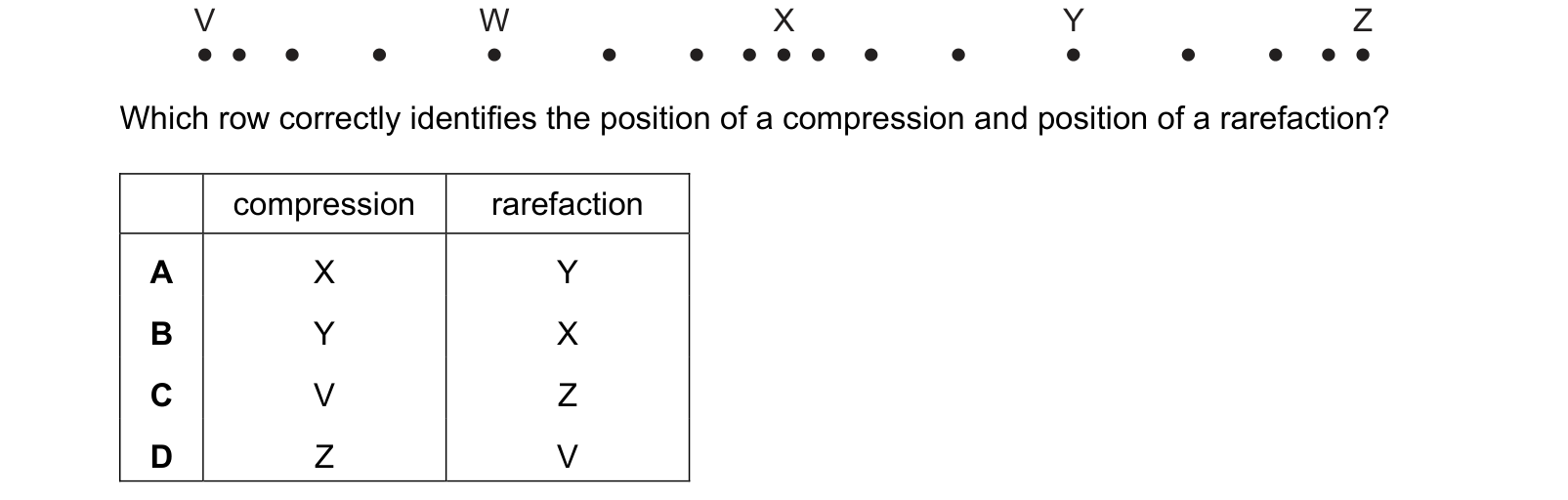
Answer: A.
Around X the dots are packed closer than anywhere else on the row, and around Y they are spread furthest apart, so A names the compression and the rarefaction correctly. B simply swaps them. C and D use V and Z, and both of those sit in crowded patches, so calling either one a rarefaction is wrong.
Since the pattern of a sound wave repeats, more than one place along the row is a compression, and V and Z are two of them. What decides the answer is finding a labelled point in a genuine gap, and Y is the only one.
Question 2
The diagram shows the air molecules in part of a sound wave at a particular moment in time. Which statement is not correct?

Answer: D.
C says the same thing correctly and can be ruled out for that reason. X sits in one of the sparse gaps, so it is currently a rarefaction, and since the pattern moves along, a compression must have passed through X a moment earlier, making A correct.
B is also correct, because the pattern repeats and a rarefaction will arrive at X again one cycle later. Reading which way the bands line up is what fixes the direction of travel.
Question 3
The graphs show the displacement of particles in sound waves from three sources X, Y and Z. The scales on the graphs are all identical. displacement displacement Which sources are producing sound waves with the same pitch?
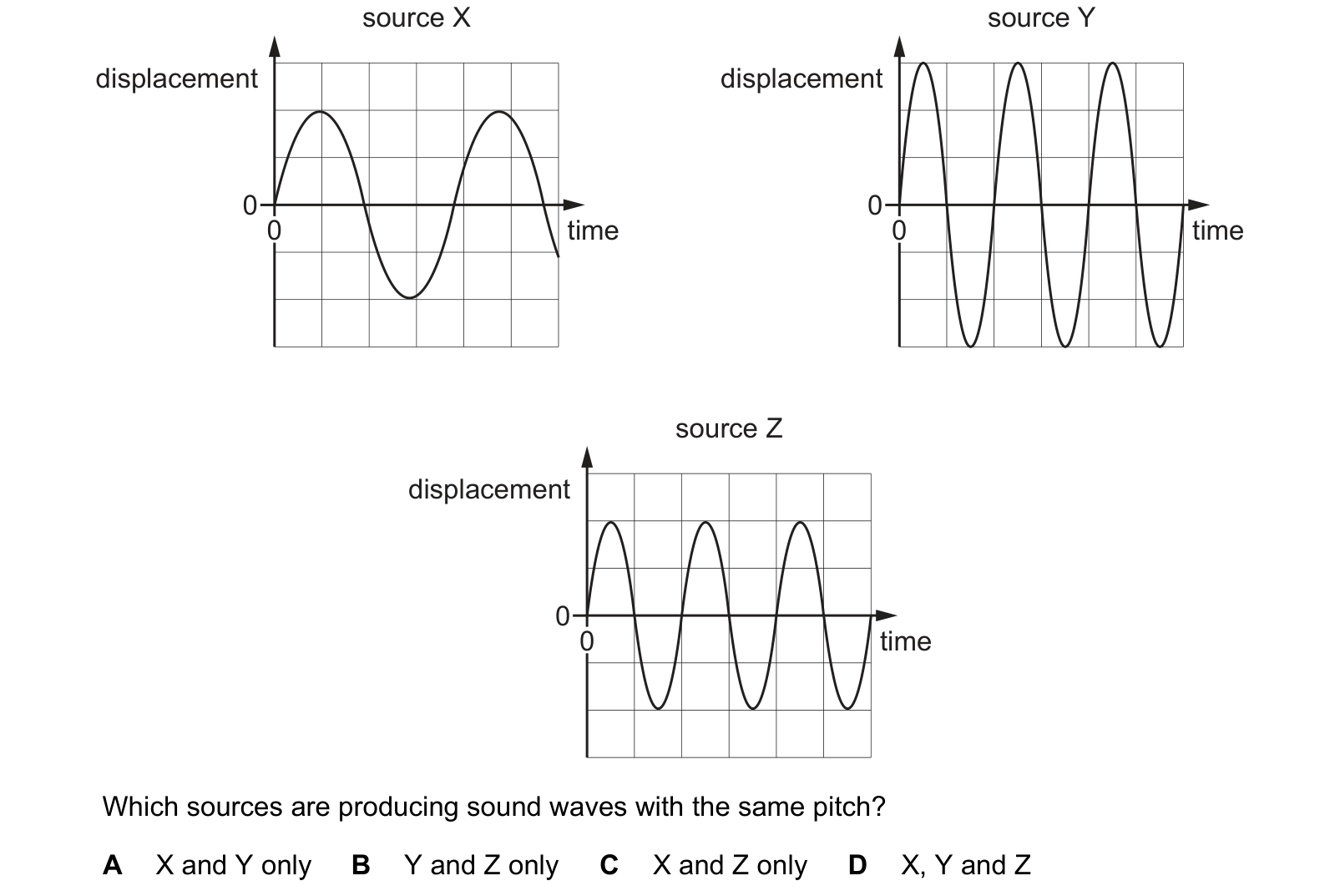
Answer: B.
Y and Z both complete three cycles across the grid, so they have equal periods and equal frequencies and therefore the same pitch, which is B. X manages only about one and a half cycles in the same width, so its period is longer and its pitch is lower.
Y is drawn much taller than Z, which is the trap in this question, but a bigger amplitude means a louder sound, not a higher one. A and D include X, whose spacing between crests is visibly wider, and C pairs X with Z, which are the two graphs that differ most in frequency.
What the syllabus asks for on this topicSyllabus points
Syllabus points
- Describe the production of sound by vibrating sources and its longitudinal nature.
- State the approximate range of human hearing.
- Describe a method for measuring the speed of sound in air.
- Relate loudness to amplitude and pitch to frequency.
- Describe how sound travels through solids, liquids and gases, and explain the differences in speed.
- Describe an echo, and describe ultrasound and its uses.
Related CIE 0625 Physics topics
Not the topic you were looking for? Describe what you are stuck on in your own words and we will take you to the notes that answer it.