Light
Contents: 7 sections
Reflection at a plane mirror
The angle of incidence equals the angle of reflection, both measured from the normal, which is the line drawn at right angles to the surface at the point where the ray strikes.
Angles in optics are always measured from the normal, never from the surface. Getting that wrong turns 30 degrees into 60.
The image in a plane mirror is:
- the same size as the object
- the same distance behind the mirror as the object is in front
- upright
- laterally inverted, so left and right are swapped
- virtual, meaning the rays only appear to come from it and it cannot be caught on a screen
Refraction
Light changes speed when it crosses into a different medium, and if it arrives at an angle it changes direction.
- Entering a denser medium (air into glass) light slows and bends towards the normal.
- Entering a less dense medium (glass into air) light speeds up and bends away from the normal.
- A ray arriving along the normal changes speed but not direction.
Refractive index
n = sin i / sin r
where i is the angle in air (or vacuum) and r the angle in the medium.
It is also the ratio of the speeds:
n = speed of light in a vacuum / speed of light in the medium
Worked example. Light strikes glass at 55 degrees to the normal and refracts to 33 degrees.
n = sin 55 / sin 33 = 0.819 / 0.545 = 1.50. Speed in the glass = 3.0 x 10⁸ / 1.50 = 2.0 x 10⁸ m/s.
Two checks worth doing every time. The angles do not divide; only their sines do, so 55/33 is not the refractive index. And light never travels faster in a medium than in a vacuum, so any answer above 3.0 x 10⁸ m/s can be struck out before you calculate.
Total internal reflection
When light travels from a denser medium towards a less dense one, increasing the angle of incidence increases the angle of refraction. At the critical angle the refracted ray grazes along the boundary at 90 degrees.
Beyond the critical angle no light escapes: it is all reflected back inside. This is total internal reflection.
Two conditions, both needed:
- The light must be going from a denser to a less dense medium.
- The angle of incidence must be greater than the critical angle.
The critical angle is linked to the refractive index by:
n = 1 / sin C
so a larger refractive index gives a smaller critical angle. For glass, n is about 1.5 and C is about 42 degrees.
Uses. Optical fibres carry light along a curved path by repeated total internal reflection, for telephone and internet signals and for endoscopes that look inside the body. Periscopes and binoculars use 45 degree prisms rather than mirrors, because a prism reflects nearly all the light and does not tarnish.
Thin converging lenses
A converging (convex) lens brings parallel rays to a focus at the principal focus, a distance f from the lens called the focal length.
Two rays locate any image:
- A ray parallel to the principal axis refracts through the principal focus.
- A ray through the centre of the lens carries straight on.
Where they cross is the image.
| Object position | Image |
|---|---|
| Beyond 2f | Between f and 2f, real, inverted, smaller |
| At 2f | At 2f, real, inverted, same size |
| Between f and 2f | Beyond 2f, real, inverted, larger |
| At f | No image formed (rays emerge parallel) |
| Inside f | Same side as object, virtual, upright, larger |
A real image can be caught on a screen because the rays actually meet there. A virtual image cannot, because the rays only appear to come from it.
The last row is the magnifying glass, and it is the only arrangement giving an upright image.
Dispersion
White light passing through a prism separates into a spectrum: red, orange, yellow, green, blue, indigo, violet.
This happens because the refractive index of glass is slightly different for each colour. Violet slows most and is refracted most; red slows least and is refracted least. So red emerges at the top of the spectrum and violet at the bottom, taking the usual diagram.
Red has the longest wavelength of visible light and violet the shortest.
A rainbow is the same effect in water droplets.
Common mistakes
- Measuring angles from the surface instead of from the normal.
- Dividing the angles rather than their sines when finding a refractive index.
- Giving a speed of light in a medium greater than its speed in a vacuum.
- Saying total internal reflection can happen going from less dense to more dense.
- Forgetting that a larger refractive index means a smaller critical angle.
- Calling the image in a plane mirror real.
- Drawing a ray through the centre of a lens as if it bends.
- Saying red is refracted most in a prism.
Check you have it
Question 1
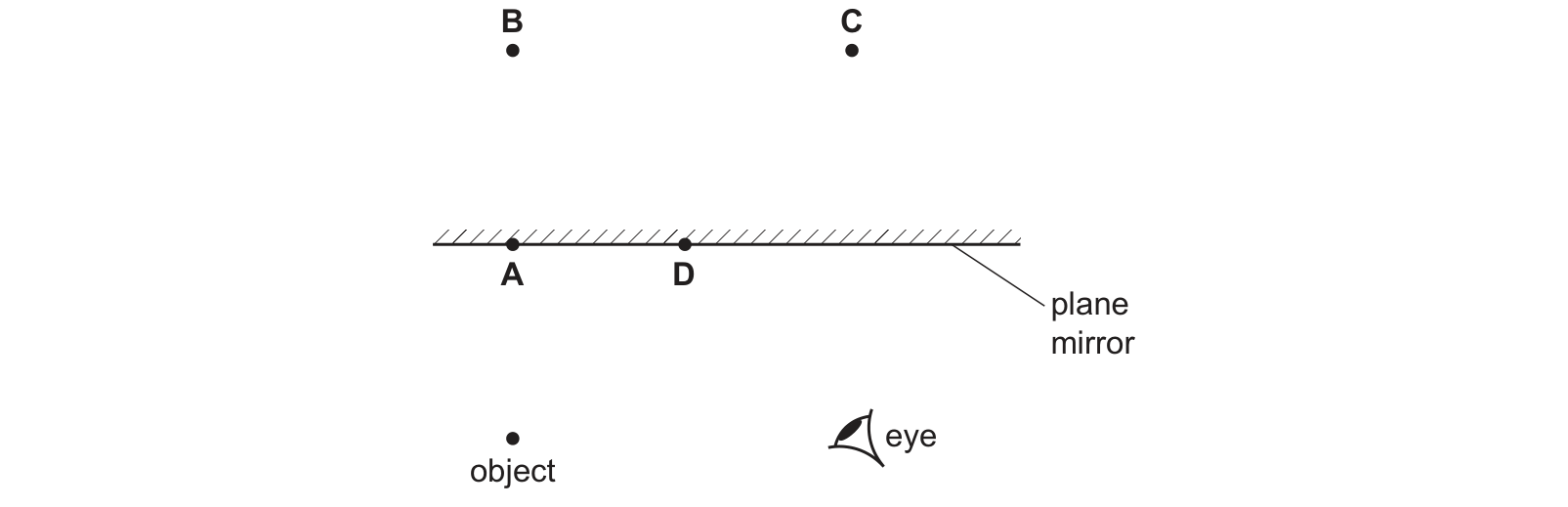
The diagram shows an object in front of a plane mirror. At which labelled position is the image of the object formed? Use the source image for W22 Paper 23, question 20.
Answer: B.
The object sits below the mirror and directly beneath the point marked A, so the image must lie on that same vertical line, an equal distance on the far side, which is position B.
C is the right distance behind the mirror but off to one side, so it is not on the perpendicular through the object. A and D lie on the mirror surface itself, where the light is reflected rather than where it appears to come from. The eye is drawn to tempt you into moving the image towards it, but the image position does not depend on where you stand.
Question 2
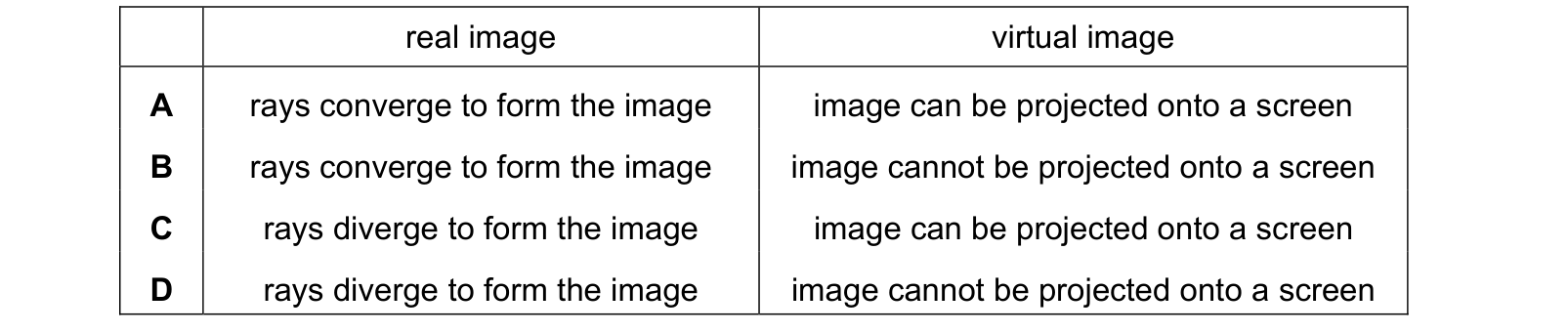
A thin converging lens can produce both real and virtual images. Which row describes a real and a virtual image? Each answer gives, in order: real image; virtual image.
Answer: B.
B is the only row that gets both halves right: converging rays for the real image and no projection possible for the virtual one. A describes the real image correctly but then says a virtual image can be projected, which is the definition of a real image.
C and D both say rays diverge to form a real image, which contradicts the meaning of real. A quick test is to imagine holding paper at the image position: if a picture appears, the image is real.
Question 3
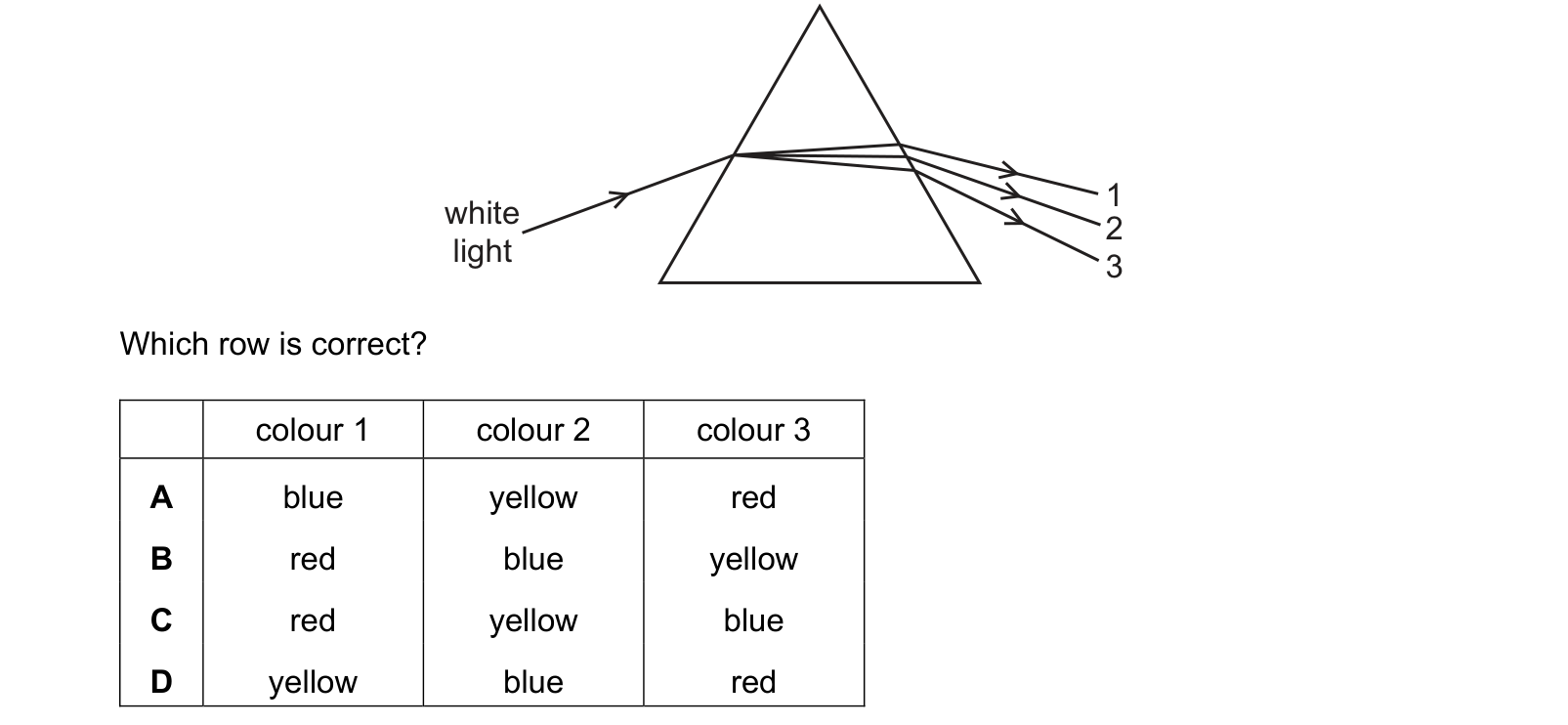
A narrow beam of white light passes through a prism and is dispersed into a spectrum. Which row is correct? Each answer gives, in order: colour 1; colour 2; colour 3.
Answer: C.
Ray 1 leaves highest on the page, so it has been turned least and must be red, and ray 3 leaves lowest, so it has been turned most and must be blue, leaving yellow in the middle as ray 2. That is C.
A and D put blue or yellow at the top, which would mean the shorter wavelengths bending least. B keeps red at the top correctly but then swaps blue and yellow, and blue is further from red in the spectrum than yellow is, so blue has to be the outermost of the two.
The order of the visible spectrum by increasing deviation is red, orange, yellow, green, blue, violet, and the emerging fan follows that order from the least bent ray downwards.
What the syllabus asks for on this topicSyllabus points
Syllabus points
- Describe reflection at a plane mirror and the properties of the image formed.
- Describe refraction at a boundary, and recall and use the refractive index.
- Define critical angle and describe total internal reflection, including optical fibres.
- Describe the action of a thin converging lens and draw ray diagrams.
- Describe dispersion of white light by a prism.
Related CIE 0625 Physics topics
Not the topic you were looking for? Describe what you are stuck on in your own words and we will take you to the notes that answer it.