Motion
Contents: 9 sections
The three quantities
- Speed is distance travelled per unit time. A scalar.
- Velocity is speed in a stated direction. A vector.
- Acceleration is the rate of change of velocity. A vector.
The two equations that follow from those definitions are:
speed = distance / time, and acceleration = change in velocity / time taken.
Acceleration is about how fast the speed is changing, not how large it is. An object can be moving very fast with zero acceleration, and moving slowly with a large one.
Deceleration is simply negative acceleration. Uniform deceleration means the speed falls by the same amount every second, so the rate of change is constant, not shrinking.
Average speed
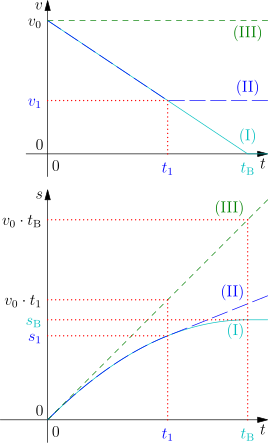
Average speed is total distance divided by total time, and nothing else.
average speed = total distance / total time
Two traps live here.
Do not average the speeds. A cyclist who rides 300 m up a slope in 50 s and back down in 25 s has covered 600 m in 75 s, so 8.0 m/s. Averaging 6.0 and 12 gives 9.0 m/s, which is wrong, because she spends twice as long going up as coming down. Averaging speeds only works when the times are equal.
Do not leave out the stops. If a journey includes 30 minutes stationary, that time still counts. The stop is part of the journey.
Units
Convert before you divide, not after.
- 1 km = 1000 m
- 1 hour = 3600 s, 1 minute = 60 s
A train covering 60 km in 20 minutes is doing 60 000 / 1200 = 50 m/s.
You do not always have to reach SI units. A speed in km/h with a time in hours is perfectly consistent and involves fewer conversions, so fewer chances to slip.
Distance-time graphs
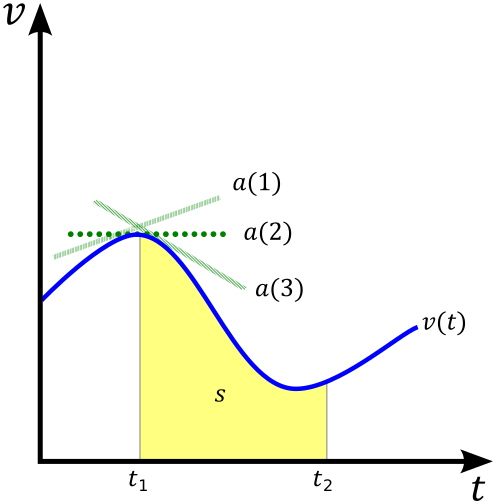
The gradient is the speed.
| Shape | Meaning |
|---|---|
| Horizontal | Stationary |
| Straight, sloping | Constant speed |
| Curve getting steeper | Speeding up |
| Curve flattening | Slowing down |
Average speed between two points is the change in distance divided by the change in time, so both must be subtracted. Reading a single value off either axis is the standard error, and questions usually offer every half-method as an option.
Speed-time graphs
Two features, two meanings, and keeping them apart is most of this topic.
- The gradient is the acceleration.
- The area underneath is the distance travelled.
The units confirm both: a gradient of (m/s) per s is m/s², and an area of m/s multiplied by s is m.
| Shape | Meaning |
|---|---|
| Horizontal on the axis | At rest |
| Horizontal above the axis | Constant speed |
| Straight, sloping up | Constant acceleration |
| Straight, sloping down | Constant deceleration |
| Curve | Changing acceleration |
The line being flat on a speed-time graph means constant speed, not stopped. The object is at rest only where the line touches the time axis. On a distance-time graph flat does mean stationary, so check the vertical axis before deciding what flat means.
Worked example. A car's speed rises steadily from 5 m/s to 15 m/s over 20 s. Find the acceleration and the distance.
Acceleration = (15 − 5) / 20 = 0.5 m/s². Distance = area of the trapezium = ½ × (5 + 15) × 20 = 200 m.
Note that a straight line means the acceleration is constant. What increases at a constant rate is the speed. Saying the acceleration is increasing describes a curve.
Falling bodies
With air resistance ignored, every object accelerates at the same rate, about 9.8 m/s², whatever its mass. Writing it out: acceleration = force / mass and the force is the weight, mg, so acceleration = mg / m = g, and the mass cancels. A heavier object is pulled harder and has proportionally more to shift.
This is why questions strip out air resistance: it makes the result clean, and it is the reason a hammer and a feather land together on the Moon.
Terminal velocity
With air resistance included, a falling object goes through three stages.
- At release the object is at rest, so there is no air resistance and the acceleration is the full g.
- As it speeds up the air resistance grows, the resultant force shrinks, and the acceleration falls.
- When air resistance equals the weight the resultant force is zero, the acceleration is zero, and the object falls at a constant terminal velocity.
At terminal velocity the object is not stationary. It is moving at its fastest. It is the acceleration that has become zero.
The speed-time graph is a curve that is steep at first and flattens towards a horizontal line.
A ball thrown upwards through air is the mirror image and appears often. Going up, gravity and air resistance both act downwards, so the deceleration is greatest at launch when the speed is highest, and eases as the ball slows. Coming down, air resistance acts upwards, so the acceleration starts at g and falls away. The ball returns more slowly than it was thrown, because energy has been lost to the air.
Common mistakes
- Averaging two speeds when the times spent at each are different.
- Excluding a stationary period from a total journey time.
- Reading a value off one axis instead of subtracting between two points.
- Treating a horizontal line on a speed-time graph as stationary.
- Confusing gradient with area, so acceleration is read off as an area.
- Saying a heavier object falls faster when air resistance has been ruled out.
- Saying an object at terminal velocity has stopped, or is still accelerating.
- Describing a straight speed-time line as increasing acceleration.
Check you have it
Question 1
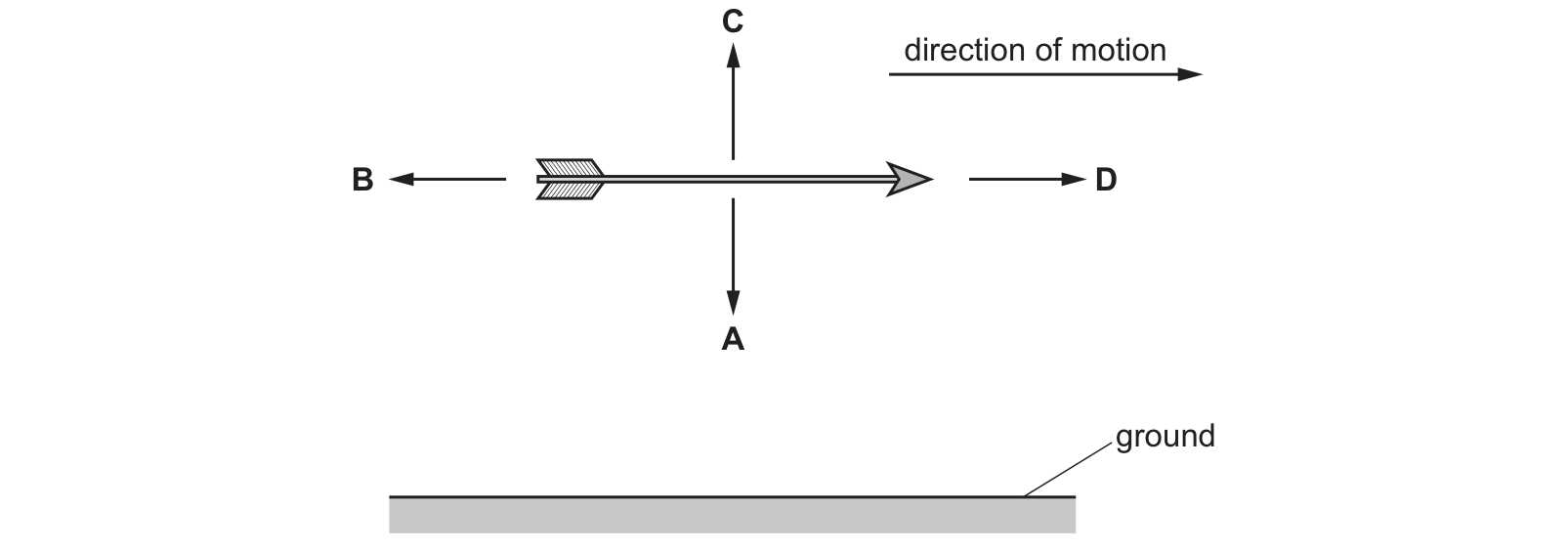
An arrow travels horizontally in a straight line at constant speed. In which direction does the weight act? Use the source image for S19 Paper 11, question 4.
Answer: A.
On the diagram the arrow pointing down towards the ground is labelled A, so the answer is A.
C points vertically up, which is the wrong way for a gravitational pull.
D points along the direction of motion. Nothing is pushing the arrow forwards once it has left the bow; it keeps moving because of its momentum, not because a forward force acts.
B points backwards, which is the direction of air resistance, a real force here but not the weight.
Weight does not care which way the object is travelling. It points down whether the arrow is rising, falling or flying level.
Question 2
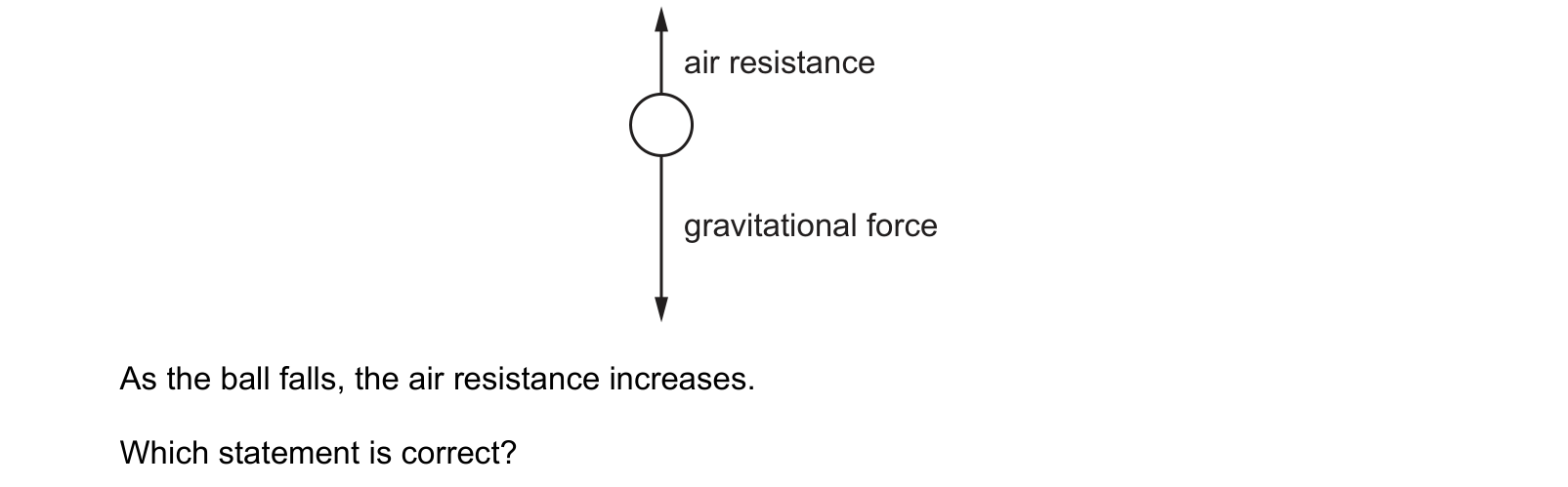
A ball falls from rest through the air towards the ground. The diagram shows two forces acting on the ball. As the ball falls, the air resistance increases.
Which statement is correct?
Answer: A.
Falling: weight acts down and is constant, air resistance acts up and is growing. So the resultant, weight minus air resistance, is shrinking. A shrinking resultant on a constant mass means a shrinking acceleration, which is A.
C is the tempting one and it is worth being clear about. The acceleration is falling, but it is still positive, so the ball is still speeding up, just less eagerly each second. Speed decreasing would need the air resistance to exceed the weight, and drag cannot overshoot: it grows with speed and stops growing the moment the two balance.
D says the gravitational force decreases. The weight depends on mass and g, and neither changes over a fall of a few metres.
B has the acceleration growing, which is what would happen if air resistance were falling.
Follow it to the end and the drag reaches the weight exactly, the resultant becomes zero, and the ball falls at constant speed. That is terminal velocity, and this question is the step before it.
Question 3
A ball is thrown vertically upwards through the air. Air resistance acts on the ball. Which graph shows how its speed varies with time? Use the source image for S21 Paper 22, question 3.
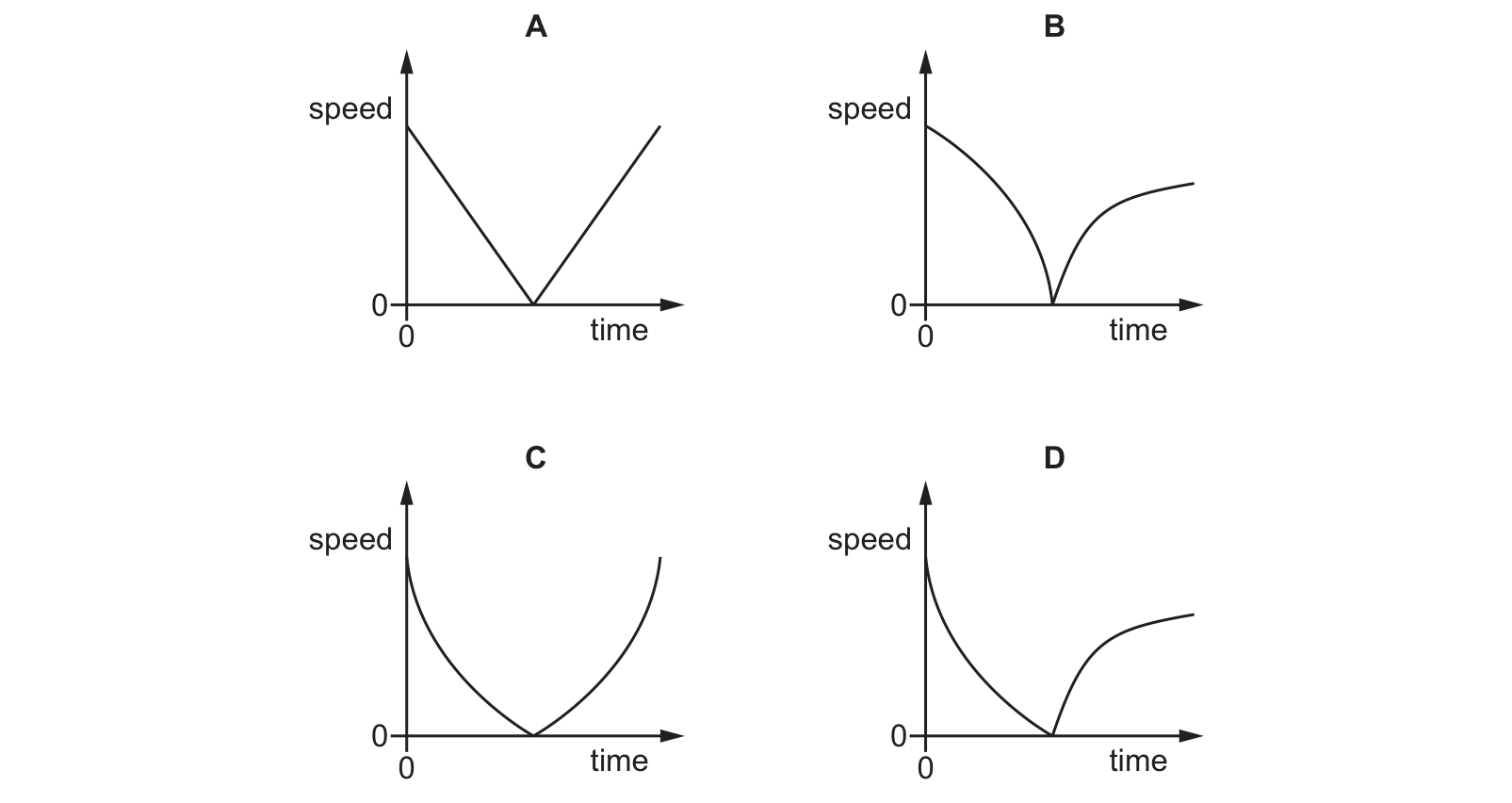
Answer: D.
Going up, gravity pulls down and air resistance also acts down, because it opposes the motion. The ball starts fastest, so the air resistance is largest at the start and the deceleration is greatest there. As the ball slows, the air resistance shrinks. So the speed falls steeply at first and then more gently as it approaches zero.
Coming down, gravity pulls down but air resistance now acts up. The ball starts from rest, so there is no air resistance to begin with and the acceleration is at its greatest. As it speeds up, the air resistance grows and the acceleration falls away, so the curve flattens towards a steady terminal speed.
D is the only graph with both: steep then gentle on the way up, steep then flattening on the way down.
B has the upward half backwards, losing speed slowly at first and then suddenly. C accelerates harder and harder on the way down, which is what would happen if air resistance grew smaller with speed. A is two straight lines, which is the no-air-resistance case.
One more check that separates the graphs from the physics: the ball comes back down slower than it went up, because energy has been lost to the air. Any graph returning to its starting speed would be wrong.
What the syllabus asks for on this topicSyllabus points
Syllabus points
- Define speed, velocity and acceleration, and calculate each.
- Distinguish speed from velocity, and distance from displacement.
- Plot and interpret distance-time and speed-time graphs.
- Find distance travelled from the area under a speed-time graph, and acceleration from its gradient.
- Describe the motion of a body falling with and without air resistance, and explain terminal velocity.
Related CIE 0625 Physics topics
Not the topic you were looking for? Describe what you are stuck on in your own words and we will take you to the notes that answer it.