Kinetic particle model of matter
Contents: 7 sections
The three states
| Solid | Liquid | Gas | |
|---|---|---|---|
| Arrangement | Regular, close-packed | Close but irregular | Far apart, random |
| Separation | Very small | Small | Large, about ten times the diameter |
| Motion | Vibrate about fixed positions | Slide past one another | Move rapidly in all directions |
| Forces between | Strong | Moderate | Negligible |
| Shape | Fixed | Takes the container's | Fills the container |
| Volume | Fixed | Fixed | Fills the container |
| Compressible? | Almost not at all | Almost not at all | Easily |
Every property in the bottom half of that table follows from the top half, and questions expect you to make the link rather than recite it.
A gas is compressible because there is empty space between its particles. A solid and a liquid are not, because their particles are already touching.
A liquid takes the shape of its container because its particles can slide past one another, but keeps a fixed volume because they stay in contact.
Temperature and particle motion
Raising the temperature increases the average kinetic energy of the particles, so they move faster. Cooling slows them down.
At absolute zero, −273 °C or 0 K, particle motion is at a minimum. Nothing can be colder, which is why the Kelvin scale starts there.
To convert: K = °C + 273.
Changes of state
- Melting: solid to liquid, at the melting point.
- Boiling: liquid to gas, at the boiling point, throughout the liquid.
- Evaporation: liquid to gas, at any temperature, from the surface only.
- Condensation: gas to liquid.
- Solidification (freezing): liquid to solid.
Energy supplied during a change of state goes into breaking the forces between particles, not into raising the temperature. That is why the temperature stays constant while ice melts or water boils, even though heating continues.
Evaporation
Only the fastest-moving particles at the surface escape. That leaves the slower ones behind, so the average kinetic energy of what remains falls, and the liquid cools. This is why sweating cools you and why a wet cloth feels cold.
Evaporation is faster when the temperature is higher, the surface area is larger, or there is a draught over the surface.
Gas pressure
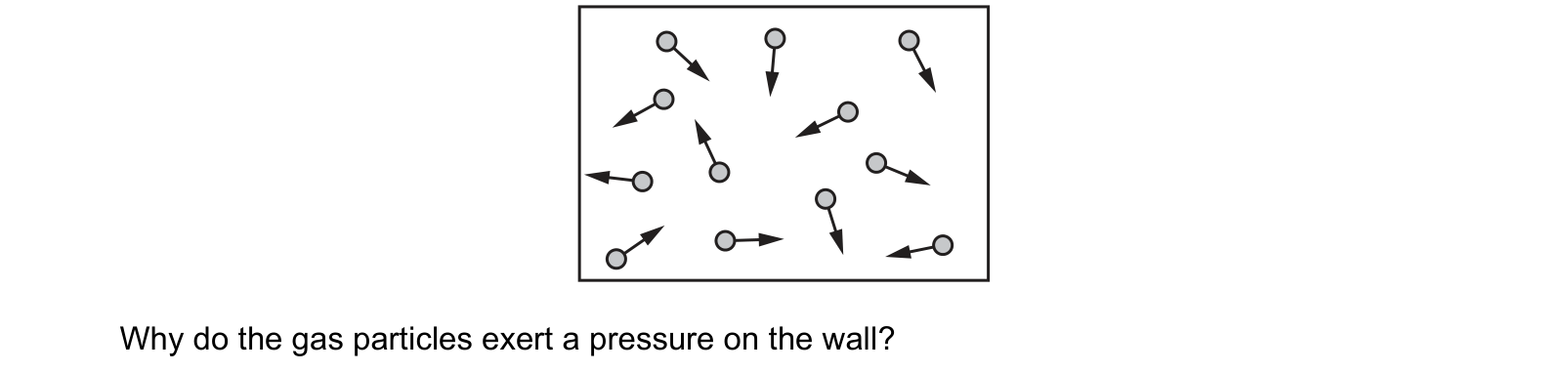
Gas particles move rapidly in all directions and collide with the container walls. Each collision exerts a small force; the pressure is the total force from all those collisions divided by the wall area.
So the pressure rises whenever the particles hit the walls more often or harder.
Changing the temperature at constant volume
Heating makes the particles move faster. They hit the walls more often and with greater force, so the pressure rises.
A sealed rigid container is the standard question. The container cannot change size, so the number of particles and the volume are both fixed, which means the average separation cannot change. Cooling such a container slows the particles and lowers the pressure; it does not bring them closer together. That distinction is what the question is testing.
Changing the volume at constant temperature
Squeezing a gas into a smaller volume means the particles have less distance to travel between collisions, so they hit the walls more often and the pressure rises.
For a fixed mass of gas at constant temperature:
p₁V₁ = p₂V₂
Halve the volume and you double the pressure.
Brownian motion
Smoke particles viewed under a microscope are seen to move in a jerky, random way.
The explanation is that the smoke particles are being bombarded unevenly by much smaller, faster-moving air molecules that cannot themselves be seen. At any instant more molecules strike one side than the other, and the visible particle jolts.
Two points are needed for full marks: the air molecules are smaller and faster than the smoke particles, and the motion is random because the bombardment is uneven.
Brownian motion is the direct evidence that matter is made of moving particles.
Common mistakes
- Saying particles in a solid do not move; they vibrate about fixed positions.
- Saying that cooling a sealed rigid container brings the particles closer together.
- Saying the temperature rises while a substance is melting or boiling.
- Confusing evaporation with boiling: evaporation happens at any temperature and only at the surface.
- Explaining Brownian motion by saying the smoke particles collide with each other.
- Saying the air molecules are visible under the microscope.
- Forgetting to add 273 when converting to kelvin.
- Explaining a pressure rise by saying the particles "expand"; particles do not change size.
Check you have it
Question 1
Gases, liquids and solids are made up of small particles. Which row gives the relative separation of the particles? gas liquid solid Use the source image for S23 Paper 11, question 14.
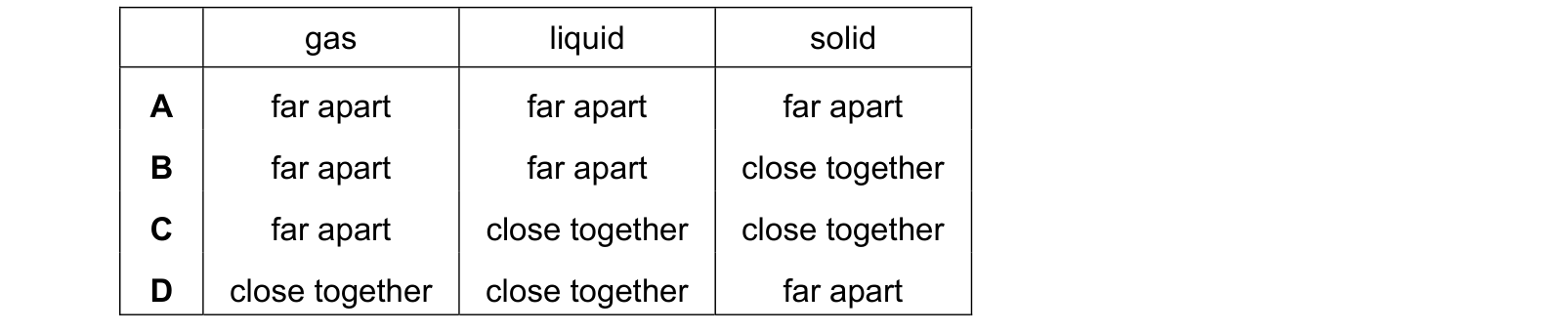
Answer: C.
Question 2
The diagram shows gas particles hitting the wall of a container. The system is at room temperature.
Why do the gas particles exert a pressure on the wall?
Answer: A.
Question 3
Which graph shows the relationship between the pressure p of a fixed mass of gas and its volume V at a constant temperature? Use the source image for W23 Paper 13, question 13.
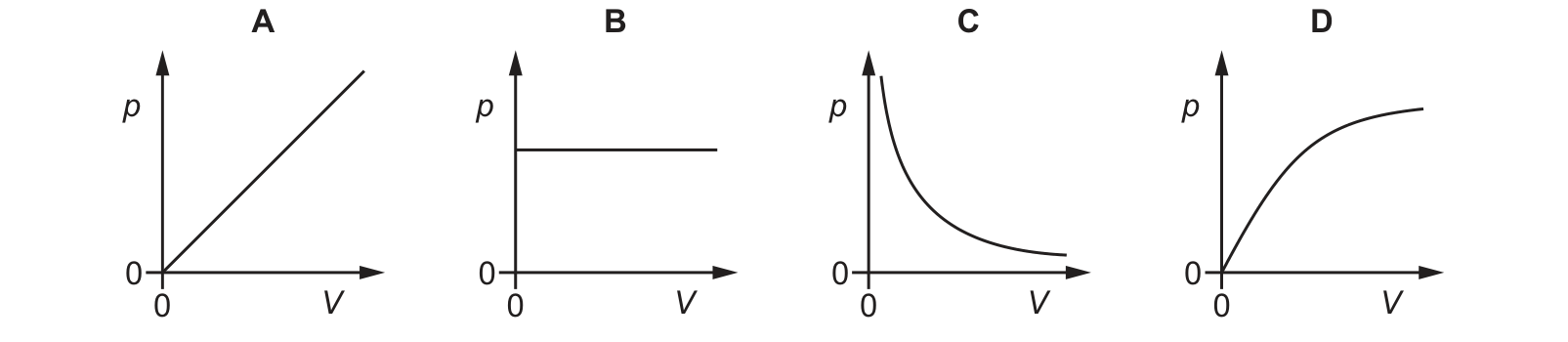
Answer: C.
What the syllabus asks for on this topicSyllabus points
Syllabus points
- Describe the particle arrangement, separation and motion in solids, liquids and gases.
- Explain the physical properties of the three states in terms of that model.
- Describe changes of state and relate them to the forces between particles.
- Explain gas pressure in terms of particle collisions with the container walls.
- Describe the effect of changing temperature or volume on the pressure of a fixed mass of gas.
- Describe and explain Brownian motion.
Related CIE 0625 Physics topics
Not the topic you were looking for? Describe what you are stuck on in your own words and we will take you to the notes that answer it.