Energy, work and power
Contents: 9 sections
Stores of energy
Energy is held in stores and moved between them. The ones this syllabus names are:
- Kinetic, held by anything moving.
- Gravitational potential, held by anything raised up.
- Elastic (strain), held by anything stretched or squashed.
- Chemical, held in fuels, food and batteries.
- Nuclear, held in the nucleus.
- Internal (thermal), the random energy of particles.
- Electrostatic and magnetic.
A useful test for elastic and gravitational stores is reversibility: let the spring go, or let the object fall, and the energy comes back.
Conservation of energy
Energy cannot be created or destroyed, only transferred from one store to another. The total is always the same.
Nothing is ever "lost" in the sense of ceasing to exist. It is dissipated, usually as thermal energy in the surroundings, where it is spread out and no longer useful.
When a car slows down on a flat road, its kinetic energy has become thermal energy in the brakes, tyres and air. Brakes get genuinely hot. Some energy leaves as sound, but far less than as heat, which matters when a question asks where most of it goes.
Kinetic and potential energy
KE = ½mv² GPE = mgh (or m x g x change in height)
Worked example. A woman of mass 50 kg has 81 J of kinetic energy. Find her speed.
81 = 0.5 x 50 x v², so v² = 81 / 25 = 3.24, and v = 1.8 m/s.
The square root is the step people stop short of, and 3.24 sits in the option list waiting.
Because of the square, doubling the speed quadruples the kinetic energy. That is why stopping distances grow so sharply with speed.
On a rollercoaster or a falling object, the two stores trade: height is spent to buy speed on the way down, and speed is spent to buy height on the way up. A mass bouncing on a spring adds the elastic store, and at the lowest point of its motion it has the least gravitational potential energy and the most elastic energy at the same time.
Work done
work done = force x distance moved in the direction of the force
W = Fd, in joules.
Work done is the energy transferred, so the two are measured in the same unit.
If nothing moves, no work is done, however heavy the load and however tired you get holding it. A load hanging still from a bar has no work done on it.
Where friction acts, the work you put in splits: some becomes useful kinetic energy and the rest becomes thermal energy.
Worked example. A box is pulled 2.0 m by a 3.0 N force against 1.0 N of friction. How much kinetic energy does it gain?
Only the resultant does work that ends up as kinetic energy. Resultant = 3.0 − 1.0 = 2.0 N. Gain in KE = 2.0 x 2.0 = 4.0 J.
The total work done by the pulling force is 3.0 x 2.0 = 6.0 J, which is right as a total but includes the 2.0 J that heated the floor. Read whether the question asks what was put in or what was gained.
Power
power = energy transferred / time taken, or work done / time taken
P = E/t, in watts. One watt is one joule per second.
Power is about how fast, energy about how much. A more powerful machine does not do more work; it does the same work sooner. Two machines lifting the same load through the same height do equal work, and the quicker one develops more power.
Worked example. A pump does 460 000 J of work in 7 minutes.
7 minutes = 420 s. P = 460 000 / 420 = 1095 W, or about 1.1 kW.
Converting minutes or hours to seconds is the step that decides most of these questions. A domestic appliance in the kilowatt range is believable; an answer in megawatts is a power station and a sign of a missed conversion.
Where a question gives you an energy change rather than a total, use the change. A car whose kinetic energy rises from 1.6 MJ to 2.5 MJ in 20 s has had 0.9 MJ supplied, so the power is 900 000 / 20 = 45 kW.
Efficiency
efficiency = useful energy output / total energy input (x 100%)
An efficient machine wastes little of what it is given. Efficiency is a proportion, not a total: a machine can consume a great deal of energy and still be efficient if nearly all of it does the useful job.
Efficiency and power are independent. A powerful machine can be inefficient, and a small one efficient.
Energy resources
| Resource | Renewable? | Emits CO₂ while generating? |
|---|---|---|
| Coal, oil, gas | No | Yes |
| Nuclear fission | No | No |
| Biofuel | Yes | Yes |
| Hydroelectric | Yes | No |
| Wind | Yes | No |
| Solar | Yes | No |
| Geothermal | Yes | No |
| Tidal, waves | Yes | No |
Renewable and clean are different questions. Nuclear fission releases no carbon dioxide while generating and is still not renewable, because uranium is mined from a fixed stock. Biofuel is renewable and does release carbon dioxide.
Most stations work by boiling water to make steam that turns a turbine: coal, oil, gas, biomass, nuclear, geothermal and concentrated solar all do this. Hydroelectric, wind, tidal and wave stations turn the turbine directly with a moving fluid, with no boiling anywhere.
Wind and solar have no fuel cost and no emissions in use, but a variable supply, because the wind does not always blow.
The Sun is the original source of almost all of these: fossil fuels are ancient plant matter, wind comes from uneven heating of the atmosphere, and hydroelectric depends on the water cycle. Nuclear, geothermal and tidal are the exceptions.
Common mistakes
- Stopping at v² and not taking the square root.
- Using the total work done by a force when the question asks for the kinetic energy gained.
- Saying no energy is transferred when someone holds a heavy object still, and then saying work is done on it.
- Confusing power with energy, or with efficiency.
- Leaving a time in minutes or hours when calculating power.
- Using the final energy instead of the change in energy.
- Calling nuclear fission renewable because it emits no carbon dioxide.
- Saying energy is lost or used up rather than dissipated.
Check you have it
Question 1
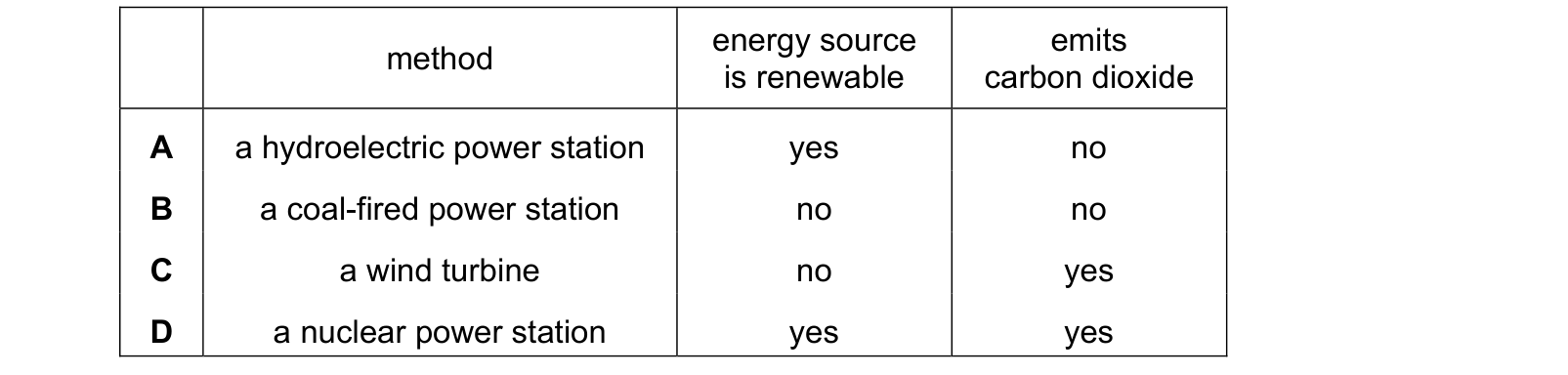
This question is about four methods used to produce electrical energy. Which method has a correct description? Each answer gives, in order: method; energy source is renewable; emits carbon dioxide.
Answer: A.
A says a hydroelectric station is renewable and emits no carbon dioxide. Both are true: the water cycle keeps refilling the reservoir, and nothing is burned. That is the answer.
B says a coal-fired station emits no carbon dioxide. Burning coal releases a great deal of it, so the row fails on its second claim even though the first is right.
C says a wind turbine is not renewable. Wind keeps arriving whatever we do, so it plainly is, and the row also claims it emits carbon dioxide while generating, which it does not.
D says nuclear is renewable. It runs on mined uranium from a fixed stock, so it is not, although its claim about carbon dioxide is also wrong: a nuclear station releases none while generating.
D is the interesting one to get straight. Renewable and clean are different questions. Nuclear scores well on carbon dioxide and still is not renewable, and the two ideas are worth keeping apart.
Question 2
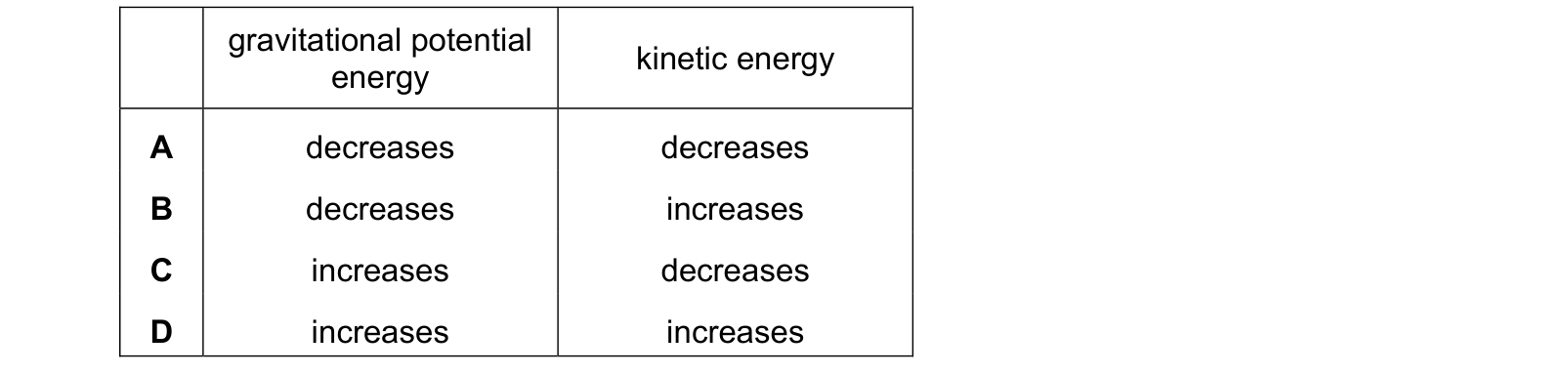
An object falls under gravity. What happens to the gravitational potential energy and to the kinetic energy of the object? Each answer gives, in order: gravitational potential energy; kinetic energy.
Answer: B.
Gravitational potential energy depends on height, and the height is falling, so the gravitational potential energy decreases.
Kinetic energy depends on speed, and the object accelerates as it falls, so the kinetic energy increases.
Decreases and increases, which is B.
C is the same idea running backwards and would describe something thrown upwards.
A and D have both stores moving the same way, and that breaks conservation of energy. In a fall with no air resistance the energy is not created or destroyed, it is handed from one store to the other, so if one goes down the other must go up by the same amount.
With air resistance included, some energy also becomes heat, so the kinetic energy gained is a little less than the potential energy lost. The two still move in opposite directions.
Question 3
The energy input to a device is E.
The amount of energy wasted by the device is W.
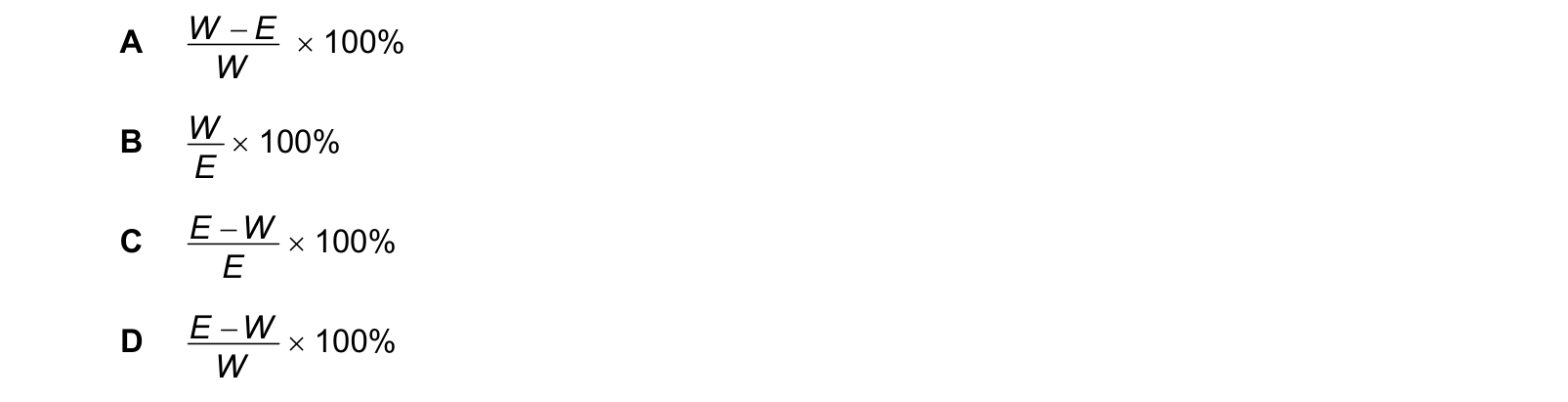
Which expression gives the efficiency of the device?
Answer: C.
The input is E and the wasted part is W, so the useful part is what is left over, E - W. The efficiency is therefore (E - W) / E, as a percentage, which is C.
D divides by W instead of E. That compares the useful output to the waste rather than to the input, so a device that wasted almost nothing would come out at thousands of percent.
B is W / E, the fraction wasted. It is the complement of the answer, so B and C add up to 100%, and it is the easiest one to choose by reading too quickly.
A subtracts the wrong way round and would give a negative number whenever the device wastes less than half its input, which is every reasonable device.
Sense check the extreme: a perfect device wastes nothing, so W = 0, and (E - 0) / E is 100%. Only C does that.
What the syllabus asks for on this topicSyllabus points
Syllabus points
- Identify energy stores and describe transfers between them.
- State the principle of conservation of energy.
- Recall and use the equations for kinetic and gravitational potential energy.
- Define work done and recall W = Fd.
- Define power and recall P = E/t, and calculate efficiency.
- Describe the main energy resources, and state which are renewable.
Related CIE 0625 Physics topics
Not the topic you were looking for? Describe what you are stuck on in your own words and we will take you to the notes that answer it.