Radioactivity
Contents: 9 sections
Detection and background
Radioactivity is detected with a Geiger-Muller tube connected to a counter, which registers each ionising particle or ray entering it.
Background radiation is present everywhere, from radon gas in the air, rocks and soil, cosmic rays, food and drink, and medical procedures. Most of it is natural.
Any measurement must have the background count subtracted before it is used. A question giving a background count is telling you to subtract it, and forgetting to do so is the most common arithmetic error in this topic.
The three emissions
| Alpha (α) | Beta (β) | Gamma (γ) | |
|---|---|---|---|
| What it is | Helium nucleus, 2 protons + 2 neutrons | Fast-moving electron | Electromagnetic wave |
| Relative charge | +2 | −1 | 0 |
| Relative mass | 4 | about 1/2000 | 0 |
| Ionising power | Very high | Moderate | Low |
| Penetrating power | Low | Moderate | Very high |
| Stopped by | A few cm of air, a sheet of paper | A few mm of aluminium | Several cm of lead, and never fully |
| Deflected by fields? | Yes, slightly | Yes, strongly and the opposite way | No |
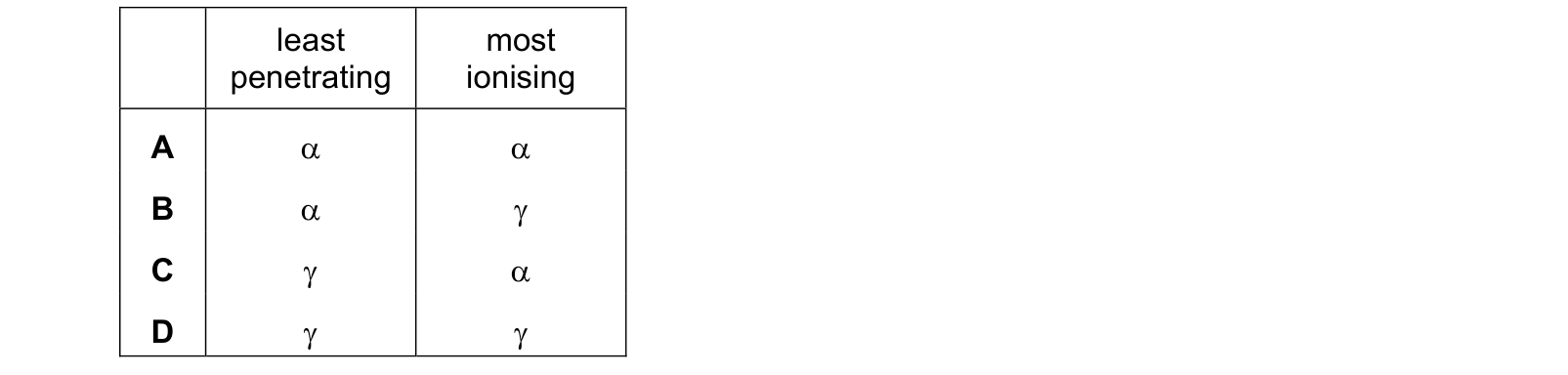
The two rankings are opposite, and that is the pattern to hold on to. Alpha ionises most because it is heavy and doubly charged, so it interacts strongly with the atoms it passes; that same interaction is what stops it quickly. Gamma barely interacts, so it ionises little and travels far.
In a magnetic field, alpha and beta curve in opposite directions, because their charges are opposite. Beta curves far more because it is so much lighter. Gamma, having no charge, is not deflected at all.
Decay equations

- Alpha decay: A falls by 4, Z falls by 2.
- Beta decay: A unchanged, Z rises by 1, as a neutron becomes a proton and emits an electron.
- Gamma emission: neither number changes; the nucleus loses excess energy.
Both nucleon number and proton number are conserved, so check that each side totals the same.
Randomness
Radioactive decay is a random process. It is impossible to predict which nucleus will decay next or when, and the rate is unaffected by temperature, pressure or chemical state.
Evidence for randomness is that a count rate fluctuates even when the source and detector are unchanged. Questions ask what the fluctuation shows, and the answer is that decay is random.
Randomness of individual events is compatible with a predictable average, which is what makes half-life useful.
Half-life
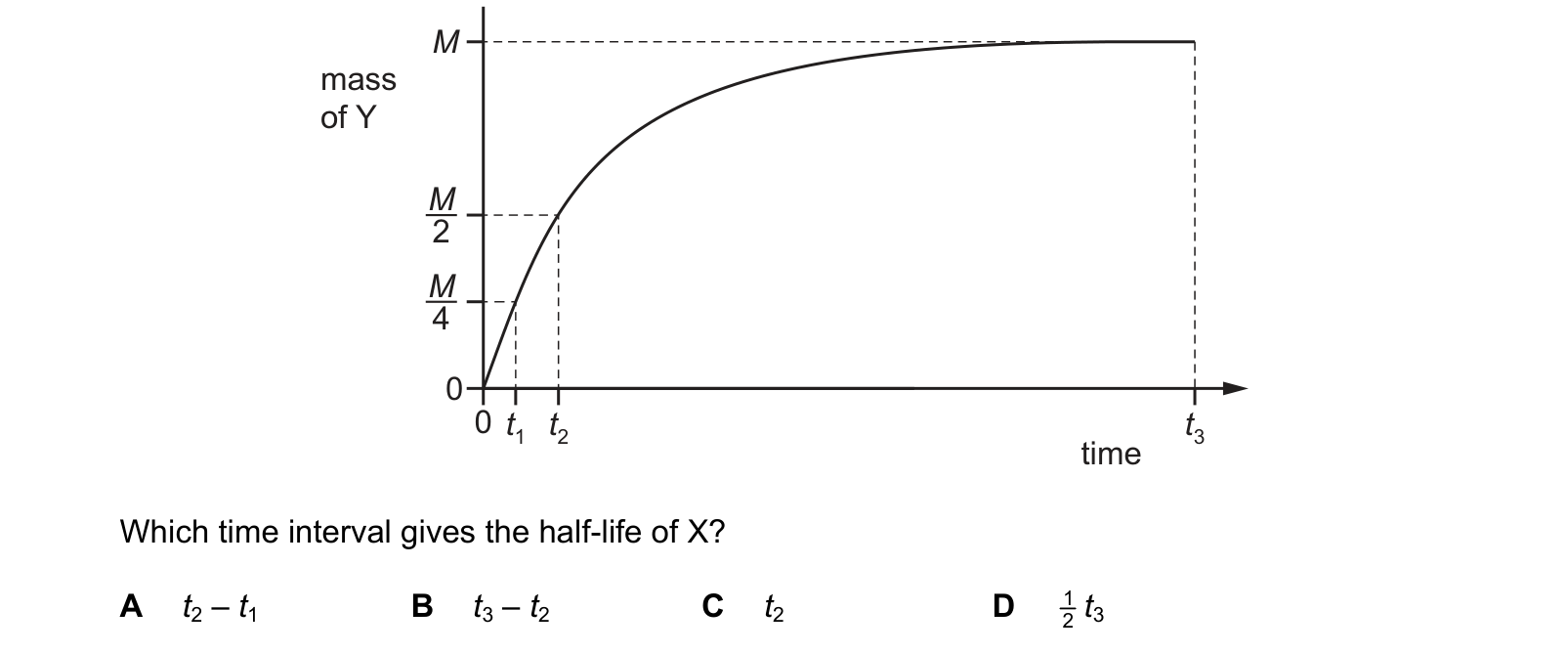
The half-life is the time taken for half the undecayed nuclei in a sample to decay, or equivalently for the count rate to fall to half its value.
Because the process is exponential, the count halves in every half-life, however many have already passed.
| Half-lives elapsed | Fraction remaining |
|---|---|
| 0 | 1 |
| 1 | 1/2 |
| 2 | 1/4 |
| 3 | 1/8 |
| 4 | 1/16 |
Worked example. A source has a count rate of 800 counts per minute above background. Its half-life is 6 hours. What is the count rate after 24 hours?
24 / 6 = 4 half-lives. 800 → 400 → 200 → 100 → 50 counts per minute.
Working the other way, if a count falls from 600 to 75, that is a factor of 8, so three half-lives have passed.
Half-life is a property of the isotope and cannot be changed.
Safety and handling
The three principles are time, distance and shielding: limit the exposure time, stay as far away as possible, and put dense material in the way.
In practice:
- Handle sources with long tongs, never with bare hands.
- Point them away from people.
- Store them in lead-lined containers.
- Wear a film badge to monitor cumulative dose.
Radiation is dangerous because it ionises, which damages or kills cells and can cause mutations leading to cancer.
Outside the body, gamma is the most dangerous, because it penetrates to the organs while alpha is stopped by skin or clothing. Inside the body, taken in through food or air, alpha is the most dangerous, because it deposits all its ionising energy in a small volume of tissue. That reversal is examined regularly.
Waste with a long half-life is sealed in glass or concrete and buried deep underground in geologically stable rock, because it stays dangerous for a very long time.
Uses
- Medical tracers: a source with a short half-life and gamma emission is given to a patient, and its progress is followed from outside. A short half-life limits the dose; gamma is used because it escapes the body to be detected.
- Sterilising medical instruments and food using gamma rays, which kill bacteria without heating.
- Treating cancer by directing gamma rays at a tumour.
- Thickness monitoring in paper or foil manufacture, using beta, because alpha would be stopped entirely and gamma would pass through unchanged. The count rate reveals any change in thickness.
- Smoke detectors, using alpha, which ionises the air in a small gap so a current flows; smoke absorbs the alpha and the current falls.
- Carbon dating of once-living material, and dating rocks from long-lived isotopes.
Notice that each use picks the emission whose penetration matches the job. That is the reasoning a question is looking for, not the name alone.
Common mistakes
- Forgetting to subtract the background count.
- Saying alpha is the most penetrating because it is the most ionising.
- Saying gamma is deflected in a magnetic field.
- Saying beta curves the same way as alpha.
- Treating half-life as the time for the sample to decay completely.
- Saying half-life can be changed by heating or by chemical treatment.
- Choosing gamma for thickness monitoring, where the reading would not change.
- Saying alpha is the most dangerous outside the body, or gamma the most dangerous inside it.
Check you have it
Question 1
Uranium-235 can undergo nuclear fission in many ways. Which equation correctly shows a possible fission reaction for uranium-235?
Answer: A.
Question 2
Radioisotope X decays to the stable isotope Y. The graph shows how the mass of Y present in a sample varies with time. Which time interval gives the half-life of X?
Answer: C.
Question 3
The table compares the penetrating abilities and ionising effects of α-particles and of γ-radiation. Which row is correct? Each answer gives, in order: least penetrating; most ionising.
Answer: A.
What the syllabus asks for on this topicSyllabus points
Syllabus points
- Describe the detection of radioactivity and the meaning of background radiation.
- Describe alpha, beta and gamma emission and compare their properties.
- Describe the random nature of radioactive decay.
- Define half-life and use it in calculations.
- Describe the safe handling and disposal of radioactive materials, and state uses of radioactivity.
Related CIE 0625 Physics topics
Not the topic you were looking for? Describe what you are stuck on in your own words and we will take you to the notes that answer it.