Radioactivity: five questions to try now
Real past-paper questions, the answer key from the mark scheme, and the explanation that goes with it. No account needed to answer them.
Question 1
The diagram shows the path followed by α-particles as they pass between two charged plates. They are deflected downwards. What happens to β-particles passing through the same electric field?
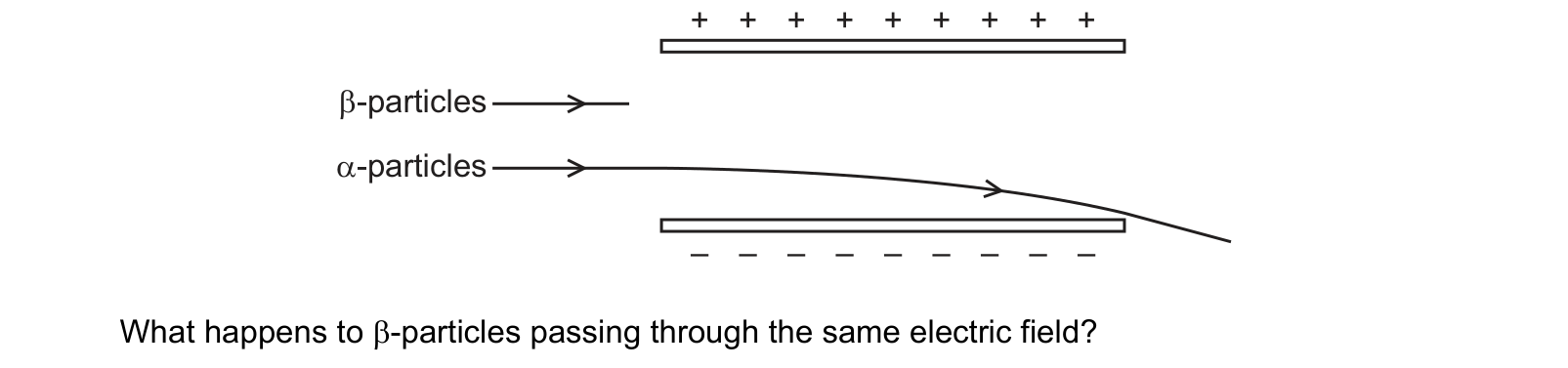
Answer: B.
Question 2
An α-particle and a β-particle have the same kinetic energy.
Why does the α-particle have a larger ionising effect than the β-particle as it passes through air?
Answer: B.
Charge: an alpha particle is a helium nucleus with a charge of +2. A beta particle is an electron with a charge of -1. So the alpha has the larger charge, and it pulls harder on the electrons in the atoms it passes.
Speed: kinetic energy is half m v squared. An alpha particle is around 7000 times more massive than a beta particle, so for the same energy it must travel much more slowly.
Larger charge and smaller speed, which is B.
Those two work together. The stronger charge exerts a bigger force on nearby electrons, and the lower speed means it spends longer near each atom it passes, so there is more time for that force to act. Both effects increase the chance of knocking an electron free.
The consequence is the standard pair of facts about penetration: alpha ionises heavily and therefore loses its energy within a few centimetres of air, stopped by paper. Beta ionises weakly, so it keeps going much further and needs a few millimetres of aluminium. Strong ionisation and poor penetration are two sides of the same coin.
Question 3
Which row correctly matches three radioactive sources to their uses? Each answer gives, in order: emits alpha-particles and has a long half-life; emits beta-particles and has a long half-life; emits gamma radiation and has a short half-life.
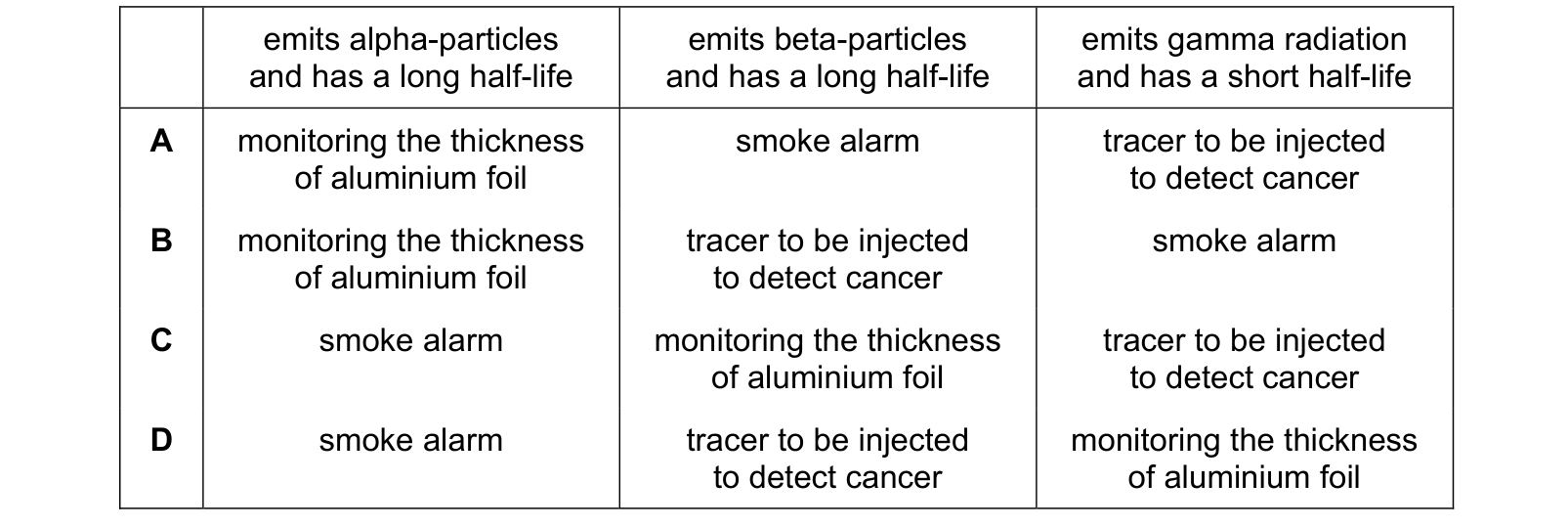
Answer: C.
Question 4
Four students are discussing ideas about radioactive decay. Which student’s statement is correct? Use the source image for M19 Paper 12, question 40.
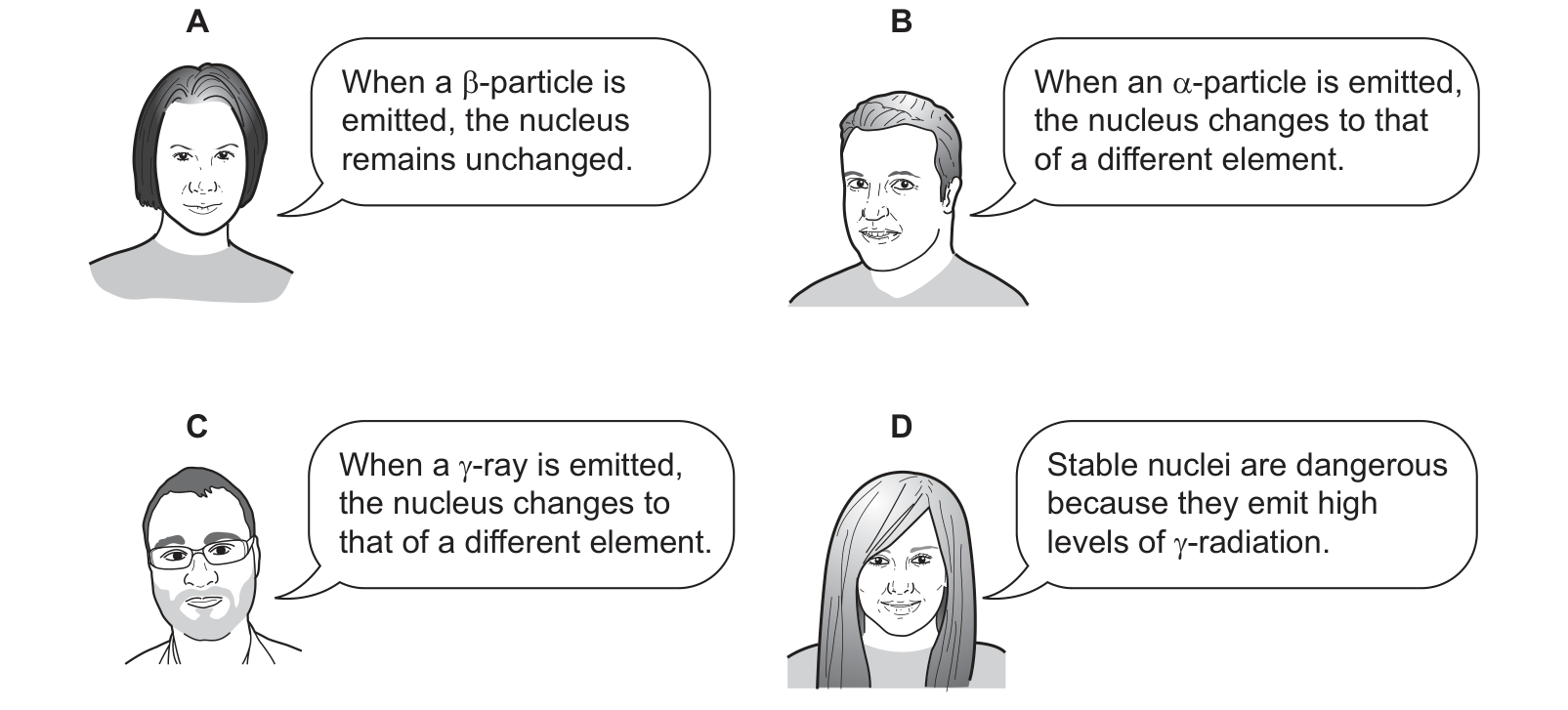
Answer: B.
Question 5
How do the ionising effect and the penetrating ability of α-particles compare with those of β-particles and γ-rays? Each answer gives, in order: ionising effect; penetrating ability.
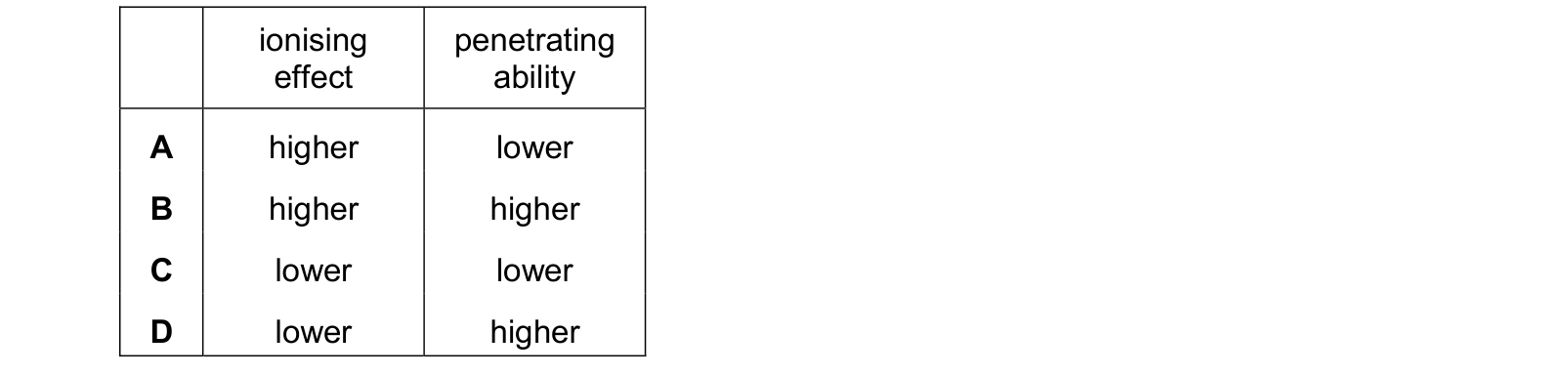
Answer: A.
What this practice covers
These questions are drawn from past CIE 0625 Physics papers and filtered to radioactivity. You answer, you find out immediately whether you were right, and you get the reasoning for the correct option and for each distractor. Wrong answers go to a mistakes locker so you can come back to exactly those.
Practice is free. You need an account only so your progress and your mistakes are still there next time.
Keep going Paper 1 and Paper 2 MCQs →
What examiners see students get wrong here
These are the errors that cost marks on radioactivity, taken from our own topic notes. Read them before you practise and you will recognise the traps in the questions.
- Forgetting to subtract the background count.
- Saying alpha is the most penetrating because it is the most ionising.
- Saying gamma is deflected in a magnetic field.
- Saying beta curves the same way as alpha.
- Treating half-life as the time for the sample to decay completely.
- Saying half-life can be changed by heating or by chemical treatment.
- Choosing gamma for thickness monitoring, where the reading would not change.
- Saying alpha is the most dangerous outside the body, or gamma the most dangerous inside it.
Revise it first
If any of the above is unfamiliar, work through the notes before practising: Radioactivity revision notes.