Mass and weight
Contents: 8 sections
Two different quantities
This subtopic exists because everyday speech merges two things that physics keeps apart.
| Mass | Weight | |
|---|---|---|
| What it is | Quantity of matter | Gravitational force on that matter |
| Unit | kilogram, kg | newton, N |
| Scalar or vector | Scalar | Vector, acting downwards |
| Changes with location? | No | Yes |
| Measured with | Balance | Newton meter (spring balance) |
A question asking for a mass is not answered in newtons, and a question asking for a weight is not answered in kilograms. Whole questions are built on nothing more than this, with all four options carrying the same number and only the units differing.
W = mg
weight = mass x gravitational field strength
- W in newtons
- m in kilograms
- g in N/kg, about 9.8 N/kg on Earth, and 10 N/kg is accepted in most questions
Worked example. A 6.0 kg object rests on a planet where g = 20 N/kg. Find its weight.
W = 6.0 x 20 = 120 N.
The commonest slip is to reach for Earth's g out of habit. If a question puts you on another planet, it is testing whether you read the value it gave you.
Why the same mass weighs different amounts
Mass is a property of the object. Move it and nothing about it changes: the same number of particles, the same amount of matter.
Weight depends on where the object is, because g depends on the body producing the field.
- On the Moon g is about one sixth of Earth's, so a 60 kg astronaut weighs about 100 N there instead of 600 N.
- On Mars g is smaller than Earth's, so a probe weighs less on arrival. Its mass is unchanged.
- In deep space, far from any large body, g is near zero, so the weight is near zero. The mass is still the same.
This is worth a moment. Asked what happens to a space probe taken to Mars, the answer is that the weight decreases and the mass is unchanged. Nothing about the journey removes matter.
Working the other way
If a spring stretches by the same amount, the force on it is the same, so the weight is the same.
On the Moon, where g is one sixth of Earth's, you need six times the mass to produce the same weight. A 3.0 kg mass on Earth is matched by an 18 kg mass on the Moon, not by 0.5 kg. Weaker gravity means more mass is needed for a given force, and getting that factor the right way up is the whole question.
Gravitational field strength
g is the force per unit mass, in N/kg:
g = W / m
It is also numerically equal to the acceleration of free fall, in m/s², and this is not a coincidence. An object in free fall has only its weight acting on it, so:
acceleration = force / mass = mg / m = g
The mass cancels, which is why every object falls at the same rate when air resistance is ignored, and why 9.8 N/kg and 9.8 m/s² are the same number written two ways.
Comparing masses with a balance
A beam balance compares the weight in one pan with the weight in the other. Because both pans sit in the same gravitational field, equal weights mean equal masses, and the comparison works anywhere. A beam balance taken to the Moon still balances correctly.
A spring balance measures force, so its reading changes with location. Taken to the Moon it reads about a sixth of what it read on Earth for the same object.
If a shopkeeper hangs rice in a dish from a spring balance and later hangs pasta that gives the same reading, the quantity that must be the same is the weight. Rice and pasta have different densities, so equal weights do not mean equal volumes.
Inertia
Mass also measures how strongly an object resists a change in motion. Loading a car makes it harder to accelerate and harder to stop, because both are changes in motion. Inertia works in both directions, which catches out anyone who expects extra mass to help with one of them.
Common mistakes
- Giving a mass in newtons or a weight in kilograms.
- Saying an object's mass decreases in space, or on the Moon.
- Using Earth's g when the question supplies a different value.
- Dividing by six instead of multiplying, when asked what mass gives the same weight under weaker gravity.
- Saying a beam balance would give a different reading on the Moon.
- Forgetting that extra mass makes stopping harder as well as starting.
- Treating g as if it had only one meaning; it is both a field strength in N/kg and an acceleration in m/s².
Check you have it
Question 1
Four students are given two different objects, P and Q. Each student measures the mass of P and the weight of Q. The results are shown in the table. Which row gives a possible result? Each answer gives, in order: mass of object P; weight of object Q.
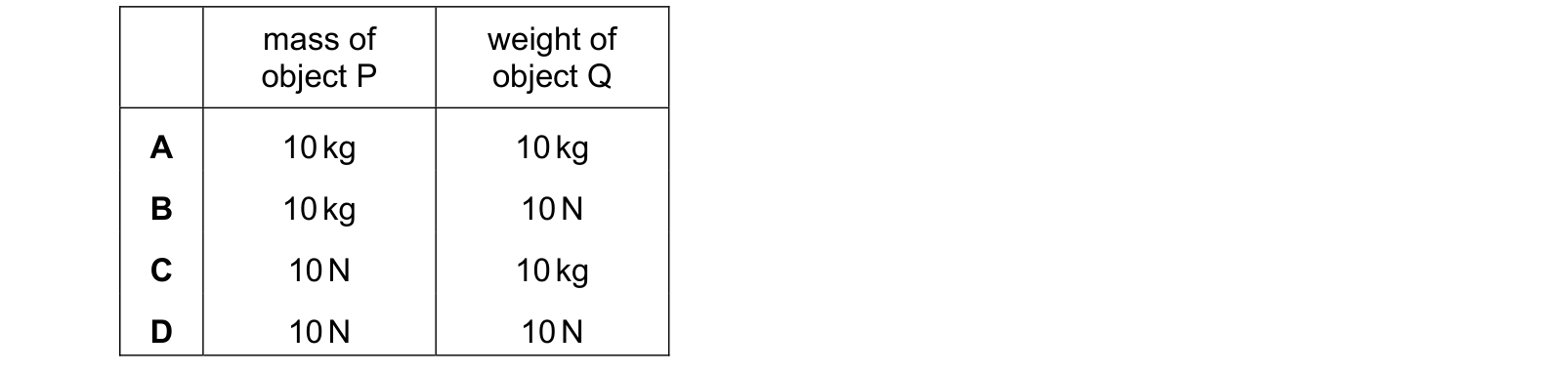
Answer: B.
Mass is measured in kilograms. Weight is a force, so it is measured in newtons.
The only row with mass in kg and weight in N is B.
A gives the weight in kilograms, C gives the mass in newtons, and D gets both wrong.
The numbers are all 10 on purpose. Nothing here can be decided by calculating; the question tests only whether you know which quantity carries which unit.
Everyday speech is the reason this catches people. Bathroom scales are marked in kilograms and we call the reading our weight, but strictly that is a mass, and the weight it produces on Earth is about ten times as many newtons.
Question 2
Which statements about weight are correct?
1 Weight is the quantity of matter in an object.
2 Weight is the force due to gravity acting on an object.
3 Weight is measured in kilograms.
4 Weight is measured in newtons.
Answer: D.
1 calls weight the quantity of matter. That is mass. Wrong.
2 calls weight the force due to gravity acting on an object. Correct.
3 measures weight in kilograms. That is the unit of mass. Wrong.
4 measures weight in newtons. Correct, because weight is a force.
2 and 4, which is D.
C pairs the right definition with the wrong unit, and it is the most tempting distractor because the first half checks out and it is easy to stop reading there. In a question built from numbered statements, every one has to be tested.
The two errors here are really the same error twice: treating weight as though it were mass. Everyday language encourages it, because bathroom scales are marked in kilograms and we say we weigh 70 kg. Strictly that is a mass, and the corresponding weight is about 700 N.
The unit is the quickest test available. Newtons means force, kilograms means matter.
Question 3
On the Moon, the gravitational field strength g is 1.6 N / kg.
An object has a mass of 2.0 kg.
What is the weight of the object on the Moon?
Answer: C.
W = m x g = 2.0 x 1.6 = 3.2 N, which is C.
D, 20.0 N, is the weight on Earth, using g = 10 N / kg. It is the right calculation done in the wrong place, and the question gives you the Moon's g in the first line for exactly this reason.
B, 1.3 N, divides 2.0 by 1.6 instead of multiplying.
A, 0 N, is the belief that there is no gravity away from the Earth. The Moon has its own gravitational field, which is why astronauts walked on it rather than floating off. The field is weaker, not absent.
What the syllabus asks for on this topicSyllabus points
Syllabus points
- State that mass is a measure of the quantity of matter in an object.
- State that weight is a gravitational force acting on an object.
- Recall and use the equation W = mg.
- Understand that weights, and therefore masses, can be compared using a balance.
- Understand gravitational field strength as force per unit mass, and that it is equivalent to the acceleration of free fall.
Related CIE 0625 Physics topics
Not the topic you were looking for? Describe what you are stuck on in your own words and we will take you to the notes that answer it.