General properties of waves
Contents: 10 sections
What a wave is
A wave transfers energy from place to place without transferring matter. The particles of the medium oscillate about fixed positions; they do not travel with the wave.
A cork on water bobs up and down as waves pass. It does not move along with them. That single observation is the standard evidence and the standard exam answer.
Transverse and longitudinal
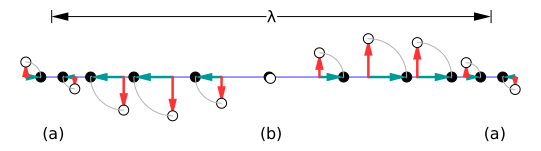
- In a transverse wave the oscillations are perpendicular to the direction of energy transfer. Water waves, waves on a rope and all electromagnetic waves are transverse.
- In a longitudinal wave the oscillations are parallel to the direction of energy transfer. Sound is the example, and the only one this syllabus needs.
A longitudinal wave consists of compressions, where the particles are bunched together, and rarefactions, where they are spread out.
Transverse waves can be polarised and longitudinal waves cannot, because polarisation only makes sense when there is a choice of perpendicular direction.
The quantities
- Wavelength (λ) is the distance between two neighbouring points in phase, for instance crest to crest or compression to compression. Metres.
- Amplitude is the maximum displacement from the undisturbed position. Metres.
- Frequency (f) is the number of complete waves passing a point per second. Hertz.
- Period (T) is the time for one complete wave to pass. Seconds.
- Wave speed (v) is the distance a crest travels per second. Metres per second.
Amplitude is measured from the middle line to a crest, not from a crest down to a trough. Crest to trough is twice the amplitude, and a diagram will usually mark both so you have to choose. Reading the axis label, "displacement from undisturbed position", settles it.
The wavefront is a line joining points in phase, such as the crests. Wavefronts are drawn perpendicular to the direction of travel.
The two equations
v = fλ
T = 1/f, and f = 1/T
Worked example. A wave has a frequency of 5.0 Hz and a wavelength of 0.60 m.
v = 5.0 x 0.60 = 3.0 m/s, and T = 1/5.0 = 0.20 s.
Where a question gives you a number of waves in a stated time, find the frequency first: 20 vibrations in 4.0 s is 5.0 Hz.
Frequency is set by the source and does not change when a wave moves into a new medium. The speed and the wavelength both change, and they change together so that v = fλ still holds.
Reflection
A wave striking a barrier is reflected. The angle of incidence equals the angle of reflection, both measured from the normal.
The wavelength, frequency and speed are all unchanged by reflection. Only the direction changes.
Refraction
A wave entering a medium where it travels at a different speed changes direction, provided it meets the boundary at an angle.
In a ripple tank, shallow water slows the waves. Passing from deep to shallow:
- The speed decreases.
- The frequency is unchanged.
- So from v = fλ the wavelength decreases, and the wavefronts are drawn closer together.
- The waves bend towards the normal.
Going the other way, from shallow to deep, everything reverses and the waves bend away from the normal.
A wave meeting the boundary along the normal, at 90 degrees to the surface, changes speed and wavelength but does not change direction.
Diffraction
Diffraction is the spreading of waves as they pass through a gap or round an edge.
The amount of spreading depends on how the gap compares with the wavelength:
- A gap much wider than the wavelength gives little diffraction, and the waves carry on with only the edges curved.
- A gap about equal to the wavelength gives the greatest spreading, and the waves emerge as almost semicircular ripples.
Wavelength itself does not change during diffraction. Neither does frequency or speed.
This explains why you can hear someone round a corner but not see them: sound has a wavelength comparable with the size of a doorway, while light's wavelength is far smaller, so sound diffracts noticeably and light does not.
The ripple tank
A small motor with a bar or dipper makes waves on shallow water, lit from above so the crests and troughs show as bright and dark bands on a screen below.
- A straight bar gives plane wavefronts, a point dipper gives circular ones.
- A submerged glass plate makes a shallow region, used to show refraction.
- Barriers with an adjustable gap show diffraction.
- A stroboscope makes the pattern appear frozen so it can be measured.
Common mistakes
- Saying a wave transfers matter as well as energy.
- Measuring amplitude from crest to trough rather than from the undisturbed position.
- Saying the frequency changes when a wave enters a new medium.
- Saying the wavelength changes during diffraction.
- Getting refraction backwards: slowing down bends the wave towards the normal.
- Forgetting that a wave meeting a boundary along the normal does not change direction.
- Saying diffraction is greatest through a very wide gap.
- Calling sound a transverse wave.
Check you have it
Question 1
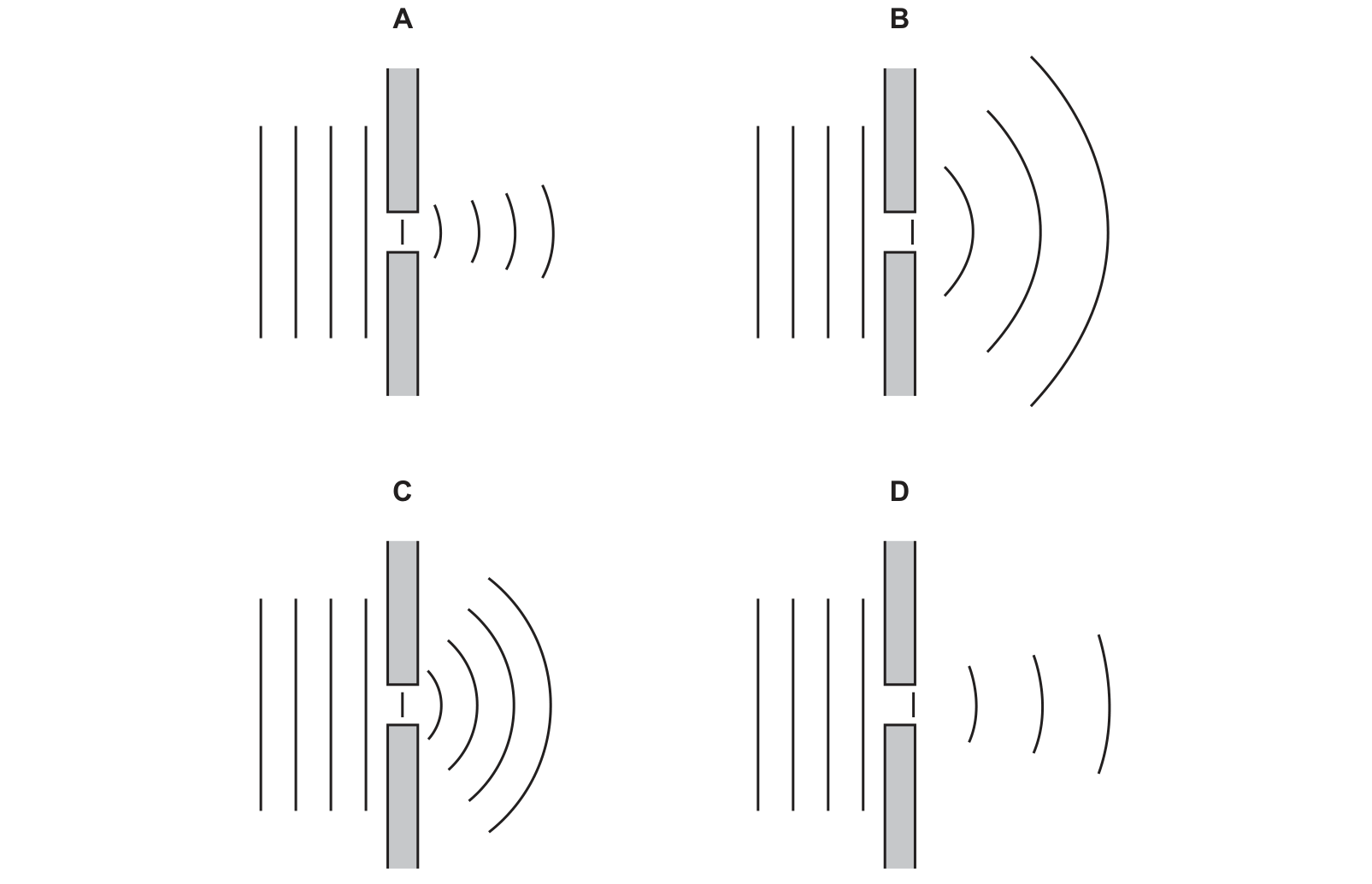
Plane water waves approach a narrow gap in a barrier. Which diagram shows the diffraction pattern that would occur? Use the source image for W19 Paper 13, question 22.
Answer: C.
C shows both, with the emerging fronts curving into wide arcs whose spacing matches the straight wavefronts arriving on the left. A keeps the spacing right but lets the waves through as a narrow fan, barely spreading at all, which is what a much wider gap would give.
B and D stretch the emerging wavefronts further apart than the incoming ones, which would mean the wavelength had grown as the waves passed through. Nothing about the gap changes the speed or the frequency, so the wavelength has to stay the same.
Question 2
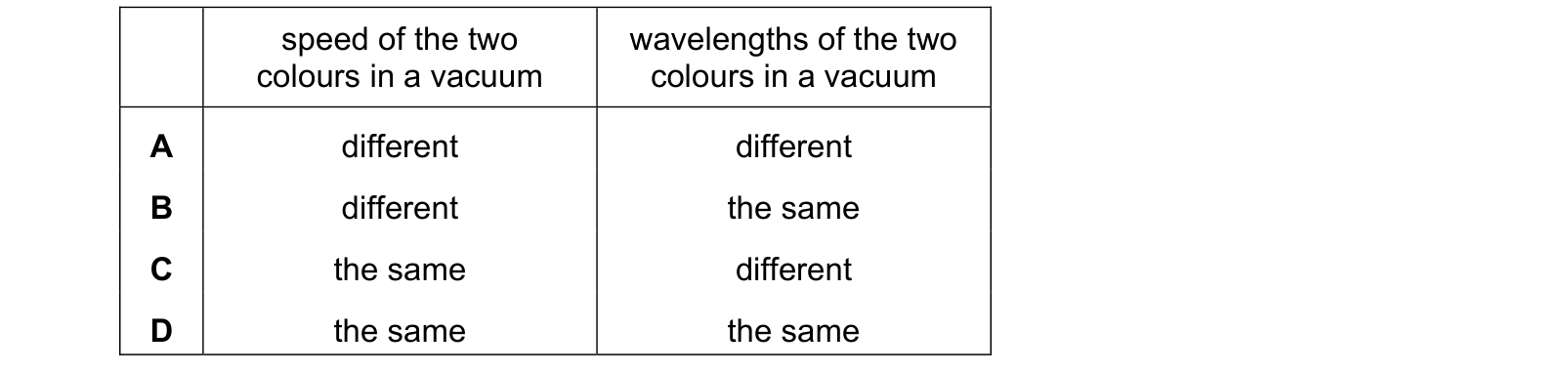
Two rays of light are different colours. Which row is correct? Each answer gives, in order: speed of the two colours in a vacuum; wavelengths of the two colours in a vacuum.
Answer: C.
Speed in a vacuum: every colour of light, and indeed every electromagnetic wave, travels at exactly the same speed in a vacuum. So the speeds are the same.
Wavelength: colour is wavelength. Red light is around 700 nm and blue around 450 nm. Two different colours therefore have different wavelengths.
Same speed, different wavelengths, which is C.
A and B make the speed depend on the colour. That does happen in glass, which is why a prism splits white light, but the question says in a vacuum, and in a vacuum there is nothing to slow one colour more than another.
D makes the wavelengths equal, which would leave nothing to tell the two colours apart.
Question 3
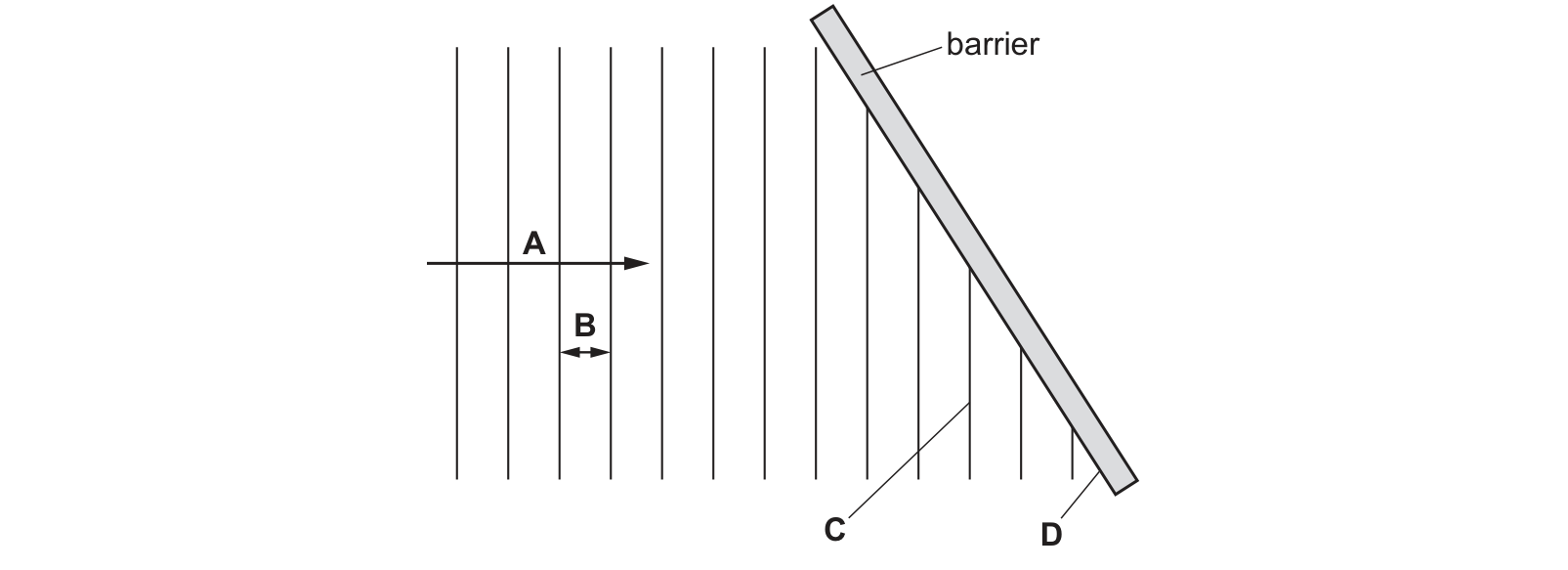
The diagram shows a wave before it reflects from a barrier. Which labelled section of the diagram represents a wavefront? Use the source image for W24 Paper 12, question 18.
Answer: C.
A is the arrow drawn along the direction of travel, which makes it a ray, and rays are always at right angles to wavefronts rather than lying along one. B is the short double-headed arrow between two neighbouring lines, so it measures the wavelength.
D points at the shaded barrier, which is a solid object the wave is about to meet, not part of the wave at all. Checking what kind of thing each label points to, a line, a direction, a gap or an object, sorts them quickly.
What the syllabus asks for on this topicSyllabus points
Syllabus points
- Describe what a wave transfers, and distinguish transverse from longitudinal waves.
- Define wavelength, amplitude, frequency, period and wave speed.
- Recall and use v = fλ and T = 1/f.
- Describe reflection, refraction and diffraction of waves using a ripple tank.
Related CIE 0625 Physics topics
Not the topic you were looking for? Describe what you are stuck on in your own words and we will take you to the notes that answer it.