General properties of waves: five questions to try now
Real past-paper questions, the answer key from the mark scheme, and the explanation that goes with it. No account needed to answer them.
Question 1
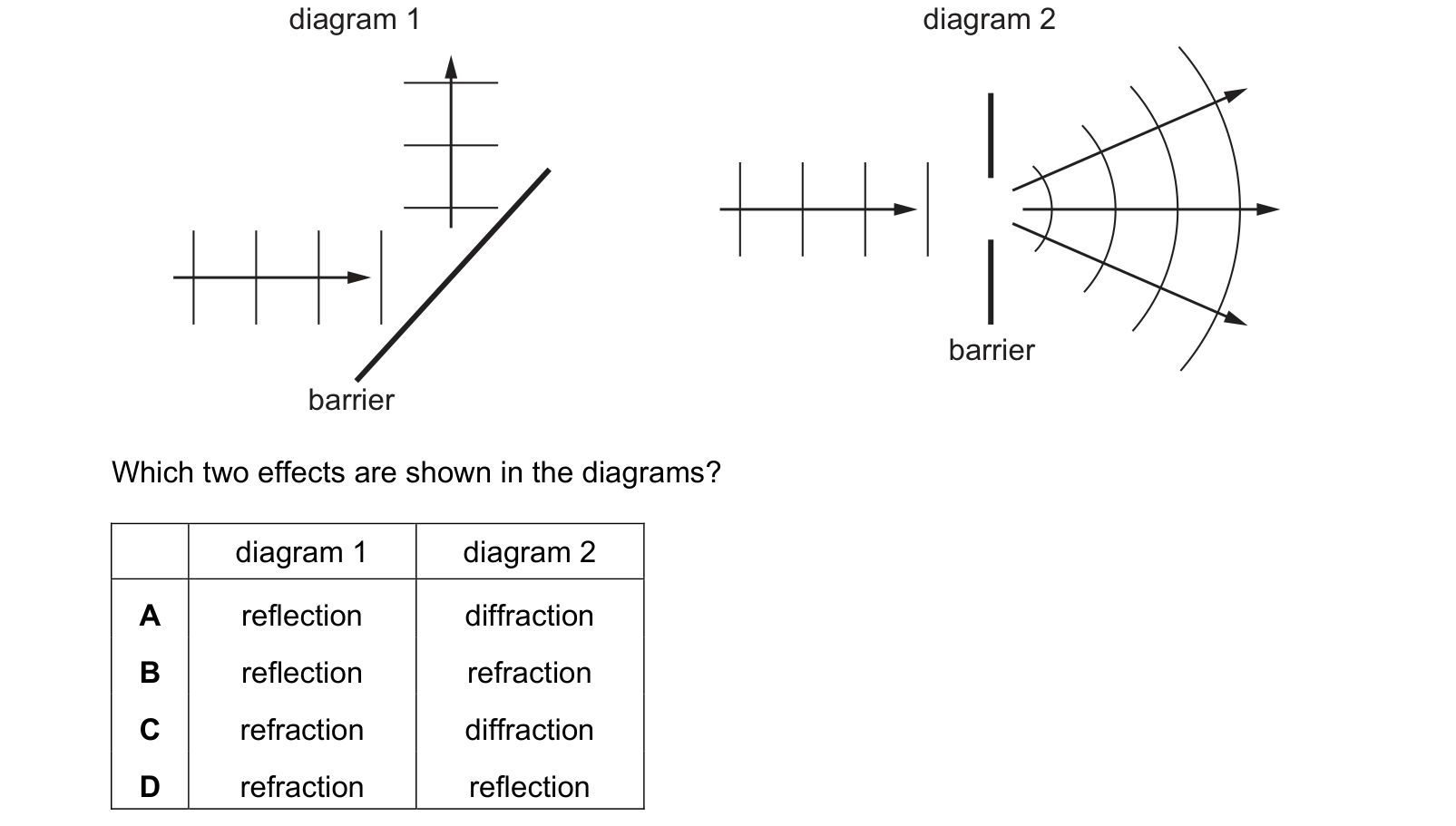
The diagrams show two patterns produced by water waves. diagram 1 diagram 2 Which two effects are shown in the diagrams? Each answer gives, in order: diagram 1; diagram 2.
Answer: A.
In diagram 2 the waves meet a barrier with a gap and emerge as curved fronts fanning out into the space beyond, which is diffraction. That order is A.
Refraction would need the waves to cross into a region where they travel at a different speed, showing up as a change of spacing as well as direction, and neither picture shows that, which rules out B, C and D. Looking for what the obstacle is, a solid barrier or a gap, decides both diagrams quickly.
Question 2
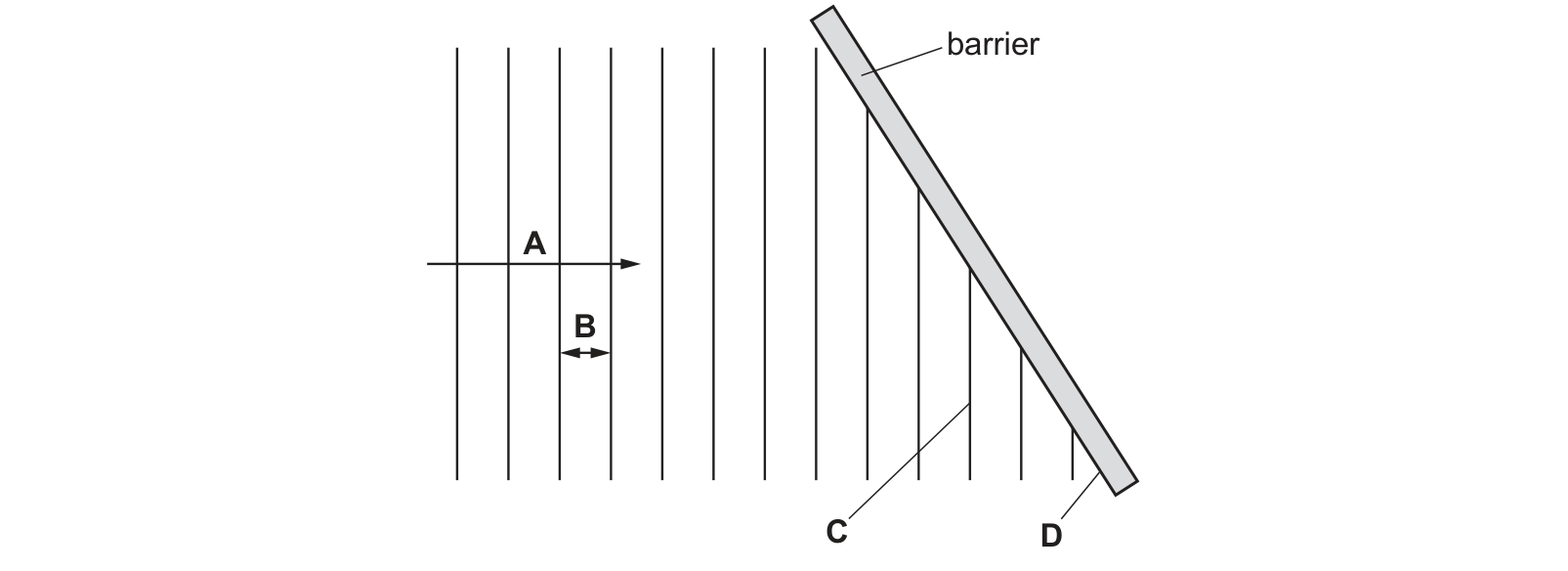
The diagram shows a wave before it reflects from a barrier. Which labelled section of the diagram represents a wavefront? Use the source image for M19 Paper 12, question 20.
Answer: C.
A is the arrow drawn along the direction the wave is travelling, which is a ray, and a ray runs at right angles to the wavefronts rather than along one. B is the short double-headed arrow spanning the gap between two neighbouring lines, so it marks the wavelength. D points at the shaded barrier, which is the surface the wave is about to bounce off and is not part of the wave at all.
Notice that every line is parallel to the next and equally spaced, which is what tells you the whole set is a train of wavefronts from one steady source.
Question 3
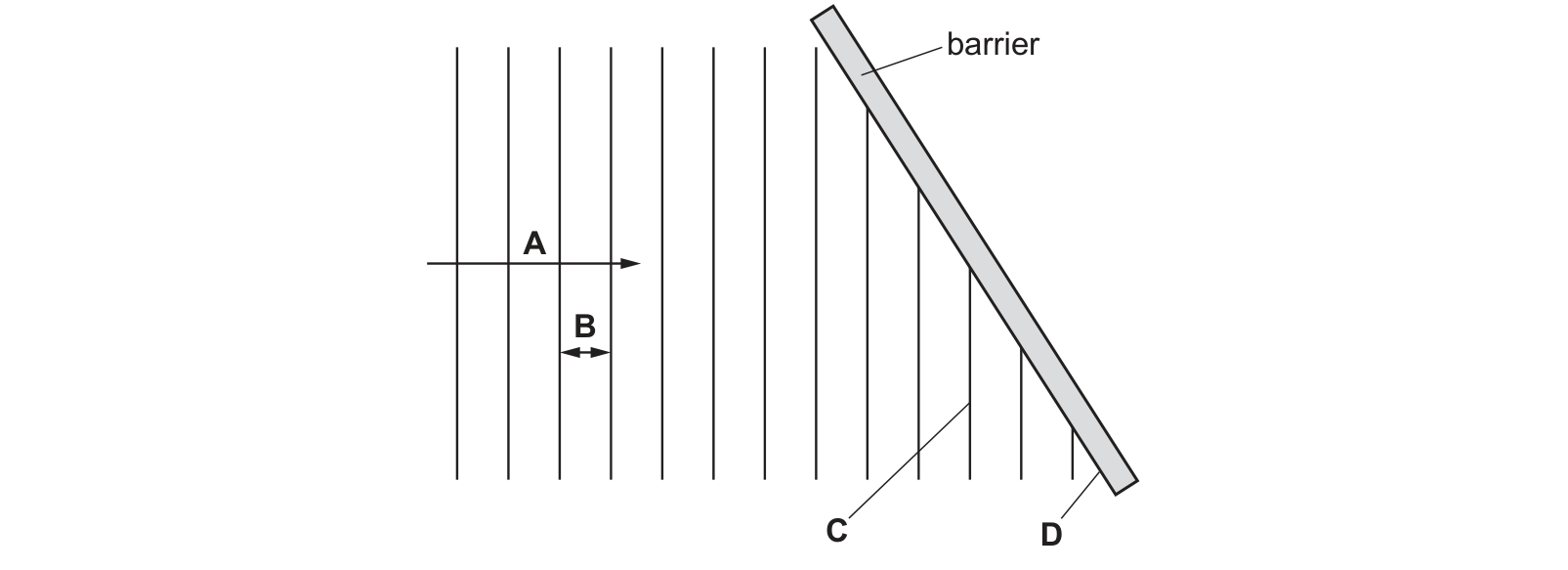
The diagram shows a wave before it reflects from a barrier. Which labelled section of the diagram represents a wavefront? Use the source image for M19 Paper 22, question 21.
Answer: C.
A is an arrow pointing along the direction of travel, which makes it a ray, and rays are drawn perpendicular to wavefronts, not along them. B is the little double-headed arrow between two neighbouring lines, which measures the wavelength. D points at the shaded barrier itself, a solid object rather than any part of the wave.
The easy check is that a wavefront is a whole line, while B is a gap and A is a direction, so only C is the right kind of thing to begin with.
Question 4
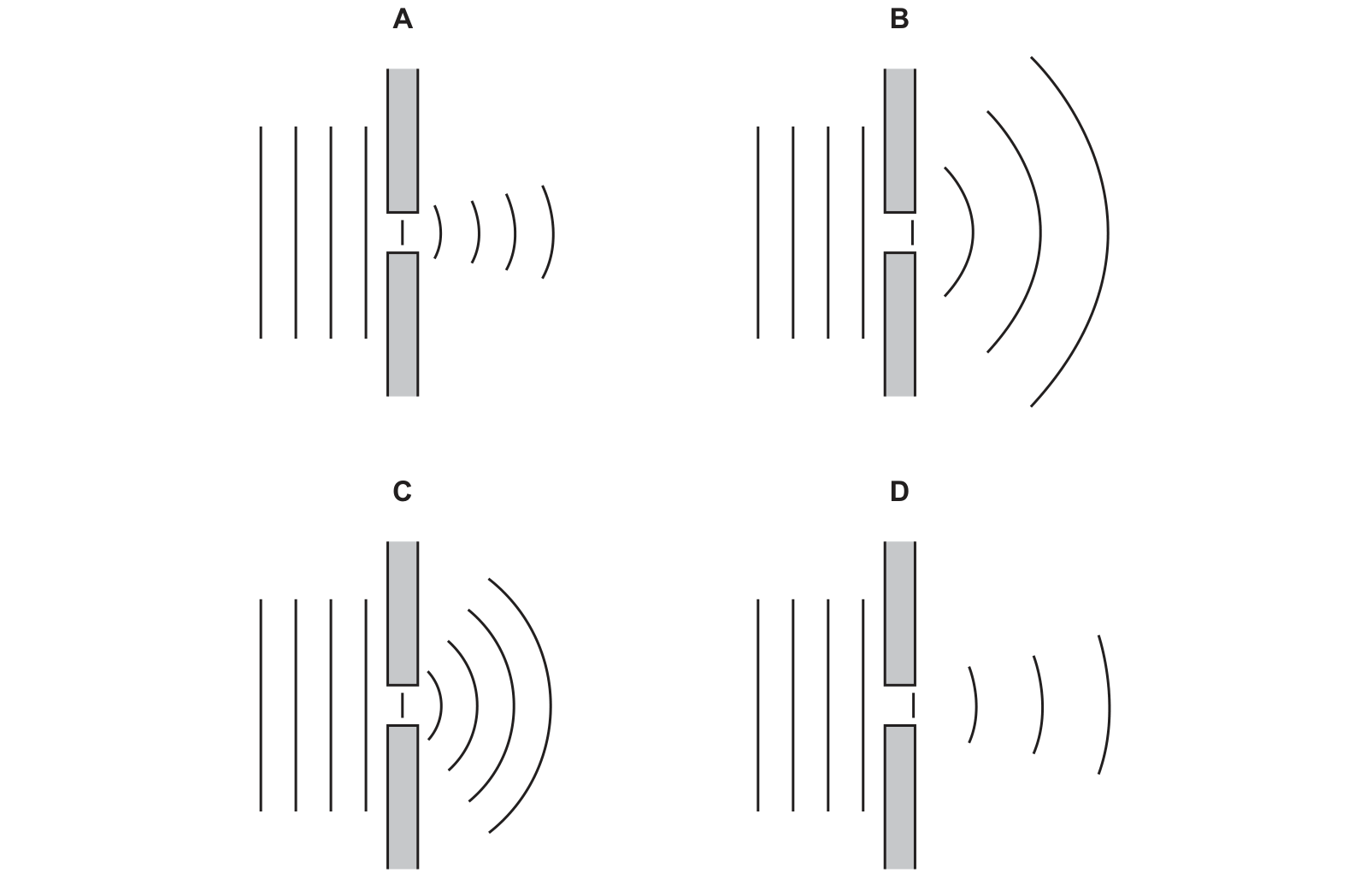
Plane water waves approach a narrow gap in a barrier. Which diagram shows the diffraction pattern that would occur? Use the source image for W19 Paper 11, question 22.
Answer: C.
C shows both, with the emerging fronts curving into wide arcs whose spacing matches the straight wavefronts arriving on the left. A keeps the spacing right but lets the waves through as a narrow fan, barely spreading at all, which is what a much wider gap would give.
B and D stretch the emerging wavefronts further apart than the incoming ones, which would mean the wavelength had grown as the waves passed through. Nothing about the gap changes the speed or the frequency, so the wavelength has to stay the same.
Question 5
Plane water waves approach a narrow gap in a barrier. Which diagram shows the diffraction pattern that would occur? Use the source image for W19 Paper 12, question 22.
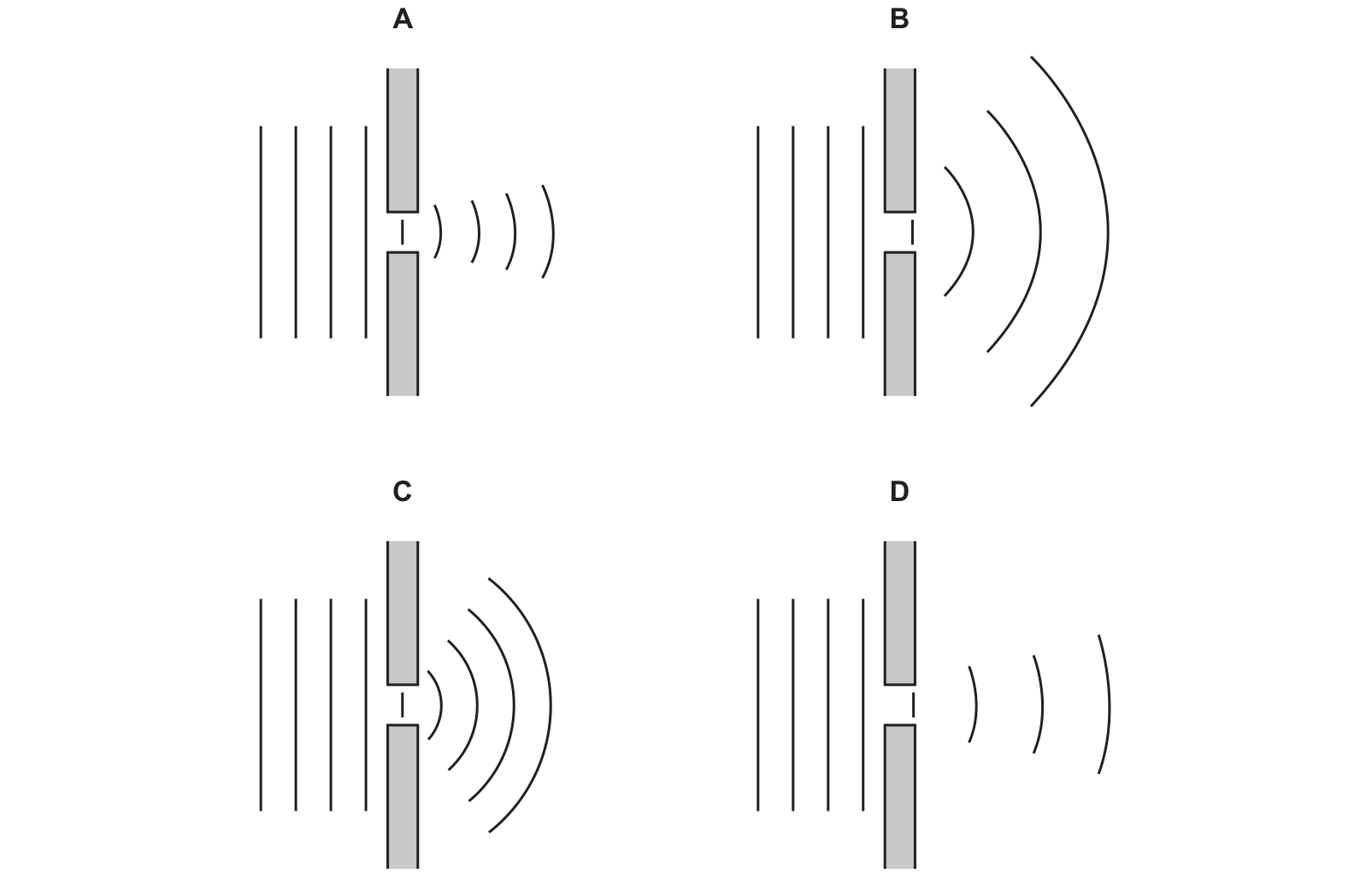
Answer: C.
C shows both, with the emerging fronts curving into wide arcs whose spacing matches the straight wavefronts arriving on the left. A keeps the spacing right but lets the waves through as a narrow fan, barely spreading at all, which is what a much wider gap would give.
B and D stretch the emerging wavefronts further apart than the incoming ones, which would mean the wavelength had grown as the waves passed through. Nothing about the gap changes the speed or the frequency, so the wavelength has to stay the same.
What this practice covers
These questions are drawn from past CIE 0625 Physics papers and filtered to general properties of waves. You answer, you find out immediately whether you were right, and you get the reasoning for the correct option and for each distractor. Wrong answers go to a mistakes locker so you can come back to exactly those.
Practice is free. You need an account only so your progress and your mistakes are still there next time.
Keep going Paper 1 and Paper 2 MCQs →
What examiners see students get wrong here
These are the errors that cost marks on general properties of waves, taken from our own topic notes. Read them before you practise and you will recognise the traps in the questions.
- Saying a wave transfers matter as well as energy.
- Measuring amplitude from crest to trough rather than from the undisturbed position.
- Saying the frequency changes when a wave enters a new medium.
- Saying the wavelength changes during diffraction.
- Getting refraction backwards: slowing down bends the wave towards the normal.
- Forgetting that a wave meeting a boundary along the normal does not change direction.
- Saying diffraction is greatest through a very wide gap.
- Calling sound a transverse wave.
Revise it first
If any of the above is unfamiliar, work through the notes before practising: General properties of waves revision notes.