Electromagnetic spectrum
Contents: 7 sections
The spectrum
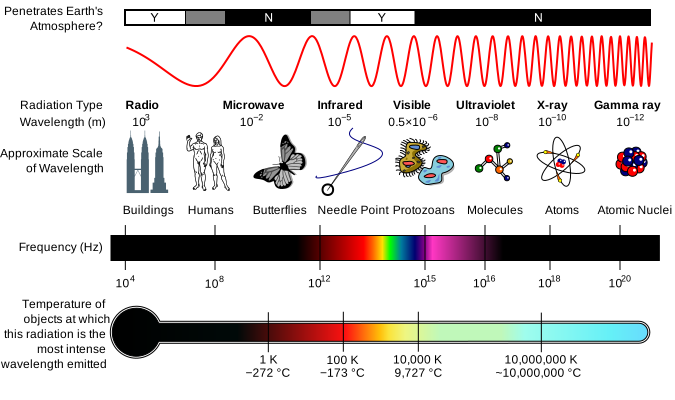
In order of increasing frequency and decreasing wavelength:
| Region | Typical wavelength | Uses |
|---|---|---|
| Radio waves | 10⁻¹ m and longer | Radio and television broadcasting, radio astronomy |
| Microwaves | 10⁻² m | Satellite television, mobile phones, cooking |
| Infrared | 10⁻⁵ m | Thermal imaging, remote controls, optical fibres, grills |
| Visible light | 10⁻⁷ m | Vision, photography, illumination |
| Ultraviolet | 10⁻⁸ m | Sterilising water, security marking, fluorescent lamps, forming vitamin D |
| X-rays | 10⁻¹⁰ m | Medical imaging of bones, security scanners |
| Gamma rays | 10⁻¹² m | Sterilising equipment and food, detecting and treating cancer |
Learn the order rather than the numbers. A mnemonic helps, and so does noticing that the list runs from the longest waves to the shortest throughout.
Visible light occupies a tiny band, and within it red has the longest wavelength and violet the shortest.
Properties they all share
All electromagnetic waves:
- are transverse
- can travel through a vacuum
- travel at the same speed in a vacuum, 3.0 x 10⁸ m/s
- transfer energy
- can be reflected, refracted and diffracted
That third point is the one most often tested. In a vacuum they all travel at the same speed, whatever their frequency. In a material medium they do not: this is exactly why a prism disperses white light.
Since v = fλ and v is fixed in a vacuum, frequency and wavelength are inversely related. Higher frequency always means shorter wavelength.
Energy and danger
Energy increases with frequency, so the hazard increases from left to right across the table.
- Microwaves are absorbed by water molecules, so they heat internal body tissue.
- Infrared causes skin burns.
- Ultraviolet damages surface cells, causing sunburn, premature ageing and skin cancer, and can damage the eyes. Sunscreen and sunglasses absorb it.
- X-rays and gamma rays are ionising. They can knock electrons out of atoms and damage or mutate cells, causing cancer. Radiographers stand behind lead screens and use the lowest dose that gives a usable image.
Radio waves are the least energetic and are generally regarded as harmless.
Note the pattern: the same property that makes a region useful usually makes it dangerous. Gamma rays kill bacteria on surgical instruments and can also kill healthy cells.
Communication
Different regions suit different jobs.
- Radio waves diffract around hills and buildings and can reflect off the ionosphere, so they cover long distances and do not need line of sight. Long wavelengths diffract most.
- Microwaves pass through the atmosphere with little absorption, which is what makes satellite communication possible. They need a clearer line of sight.
- Infrared travels along optical fibres with very little loss, carrying telephone and internet traffic.
Analogue and digital
An analogue signal varies continuously. A digital signal has only two states, usually written as 1 and 0.
Digital signals are preferred because:
- Noise picked up along the way can be stripped out, since the receiver only has to decide between two levels. An analogue signal carries its noise onwards and amplifiers amplify the noise too.
- More information can be carried per second.
- The signal can be regenerated exactly, so quality does not fall with distance.
The rate at which a digital signal can carry information depends on how many bits are sent per second. The signal itself still travels at the speed of the electromagnetic wave carrying it.
Communication delays
Because the speed is finite, distance produces a measurable delay. A signal to a geostationary satellite and back travels about 72 000 km, taking roughly 0.24 s, which is why there is a noticeable pause on some long-distance calls.
Worked example. How long does a radio signal take to travel 300 km?
t = d/v = 300 000 / (3.0 x 10⁸) = 1.0 x 10⁻³ s, one millisecond.
Common mistakes
- Reciting the spectrum in the wrong order, or reversing wavelength and frequency.
- Saying different electromagnetic waves travel at different speeds in a vacuum; they do not, though they do in glass.
- Saying electromagnetic waves need a medium.
- Calling any of them longitudinal.
- Saying microwaves are ionising; only X-rays and gamma rays are, in this syllabus.
- Confusing ultraviolet with infrared when listing hazards.
- Saying a digital signal travels faster than an analogue one; it carries more information more reliably, at the same wave speed.
Check you have it
Question 1
A student compares the wavelength and uses of infrared waves with microwaves. Which row is correct? Each answer gives, in order: wavelength of infrared compared to microwaves; use of infrared waves.

Answer: C.
For the use, intruder alarms detect the infrared given off by a warm body, while satellite television is a microwave job, so C pairs both correctly. A and B give infrared the longer wavelength, which reverses the spectrum order.
D gets the wavelength comparison right but then hands infrared the satellite television use. Since each row has two claims, checking the wavelength column first cuts the choice to two, and the dish on a roof settles the rest.
Question 2
Which row correctly compares microwaves and ultraviolet? Each answer gives, in order: frequency of microwaves compared to ultraviolet; uses.
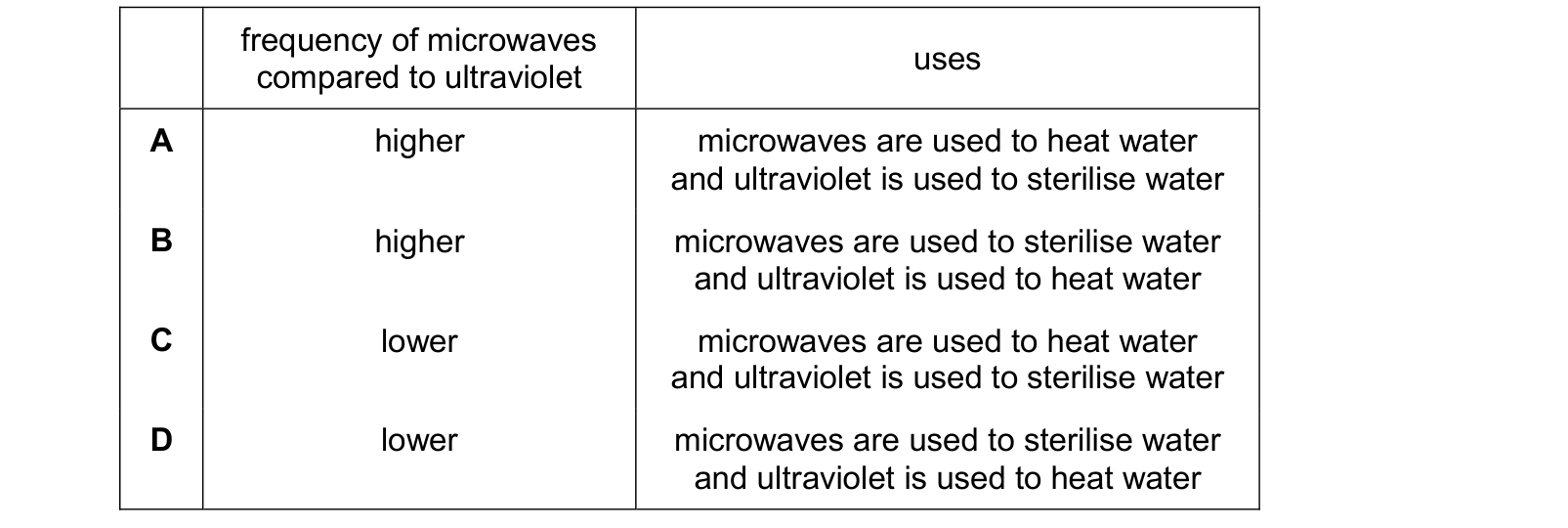
Answer: C.
For the uses, microwaves are absorbed by water molecules and make them vibrate, which is how a microwave oven heats water, while ultraviolet damages living cells and is used to sterilise water. That pairing is C.
D keeps the frequency comparison right but swaps the two jobs, which would need ultraviolet to warm things and microwaves to kill bacteria. The link worth remembering is that heating effects sit at the low-frequency end and cell damage at the high-frequency end.
Question 3
The table shows different types of wave in the electromagnetic spectrum.
radio infrared visible ultraviolet gamma microwaves X-rays waves waves light waves rays
Where do all the waves travel at the same speed?

Answer: A.
Inside a material each region is slowed by a different amount, because the refractive index depends on frequency. That is precisely why a prism splits white light: violet is slowed more than red in glass, so the colours travel at different speeds and are bent by different amounts.
The same argument rules out B, C and D, since diamond, glass and water all disperse light. Only empty space treats every wavelength identically.
What the syllabus asks for on this topicSyllabus points
Syllabus points
- State the regions of the electromagnetic spectrum in order of wavelength and frequency.
- State that all electromagnetic waves travel at the same speed in a vacuum.
- Describe typical uses of each region.
- Describe the harmful effects of excessive exposure.
- Describe the use of electromagnetic waves in communication, including the speed of digital signals.
Related CIE 0625 Physics topics
Not the topic you were looking for? Describe what you are stuck on in your own words and we will take you to the notes that answer it.