Transfer of thermal energy
Contents: 6 sections
Conduction
Conduction is the transfer of thermal energy through a substance without the substance moving as a whole.
Two mechanisms:
- Particle vibration. Heated particles vibrate more and knock into their neighbours, passing energy along. This is slow, and it is the only mechanism available in non-metals.
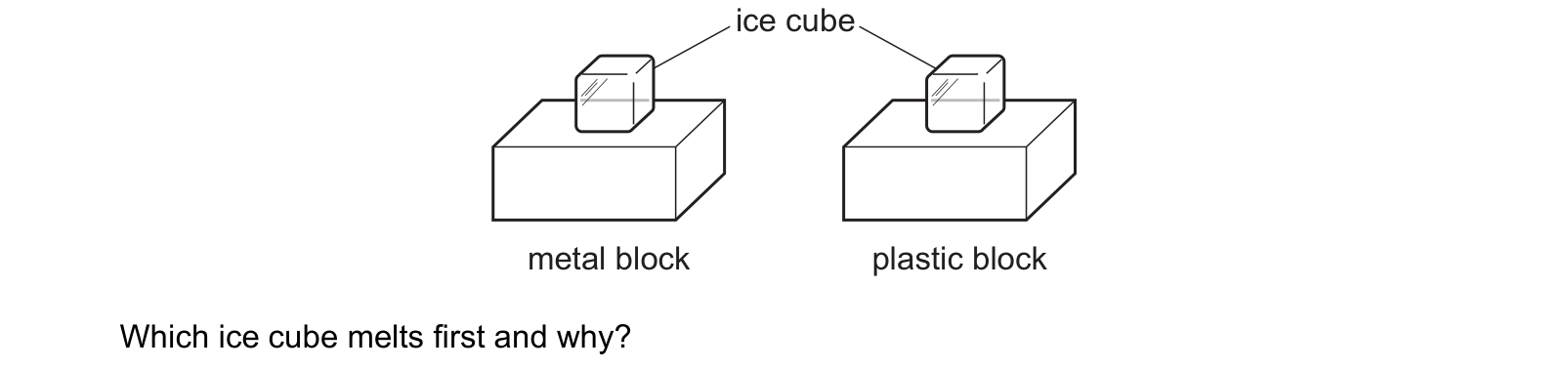
- Free electrons. In a metal, delocalised electrons move freely, gain kinetic energy at the hot end and carry it rapidly to the cold end. This is much faster and is why metals are the best conductors.
That second mechanism is the whole answer to "why are metals good conductors", and an answer that mentions only vibration will not get full marks.
Liquids and gases are poor conductors, because their particles are further apart and collide less often. Gases are the worst of all, which is why trapped air is the basis of most insulation: wool, fur, foam, double glazing and loft insulation all work by holding air still.
A metal handle feels colder than a wooden one at the same temperature because it conducts energy away from your hand faster.
Convection
Convection happens in fluids, meaning liquids and gases, and it moves the fluid itself.
The chain of reasoning is always the same three steps, and questions expect all of them:
- The fluid near the heat source warms and expands.
- Its density falls, because the same mass now occupies a greater volume.
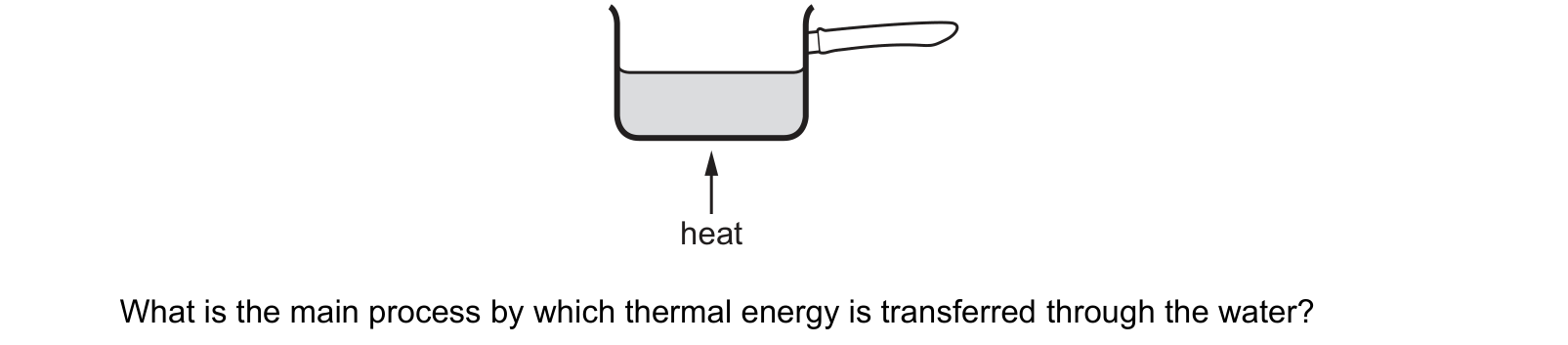
- Being less dense than the fluid around it, it rises. Cooler, denser fluid sinks to take its place, and a convection current forms.
Air rising from a hot kettle, the sea breeze, the circulation in a room with a radiator and the currents in a beaker of heated water are all this.
Convection cannot happen in a solid, because the particles cannot move from place to place. It cannot happen in a vacuum either, because there is no fluid.
Practical consequences worth knowing: a heater is placed low in a room and a cooling element high in a refrigerator, so that the fluid circulates through the whole space.
Radiation
Thermal radiation is infrared electromagnetic waves. It needs no medium, which is why it is the only way energy reaches us from the Sun across empty space.
Every object emits thermal radiation, and hotter objects emit more.
The surface decides how much is emitted or absorbed:
| Surface | Emitter | Absorber | Reflector |
|---|---|---|---|
| Dull black | Good | Good | Poor |
| Shiny silver or white | Poor | Poor | Good |
A surface that is a good emitter is also a good absorber. That pairing is often tested.
The rate also rises with surface area and with the temperature difference between the object and its surroundings.
Applications: solar panels are matt black; the backs of refrigerators and cooling fins on engines are painted black to lose energy quickly; survival blankets, vacuum flasks and the outside of a kettle are shiny to reduce it; light-coloured clothing and buildings in hot countries reflect rather than absorb.
Showing it in the laboratory
A Leslie cube is a metal cube filled with hot water, with faces of different finishes. A detector placed the same distance from each face registers most radiation from the dull black face and least from the shiny one.
For absorption, two metal plates, one black and one shiny, are placed the same distance from a radiant heater with a small wax-held coin on the back of each. The wax on the black plate melts first.
Reducing transfer, all three at once
A vacuum flask is the standard example and is worth being able to reproduce.
- The vacuum between the double walls stops conduction and convection, since both need a medium.
- The silvered surfaces reflect radiation back.
- The stopper stops convection and evaporation from the open top.
A house is insulated on the same principles: loft insulation and cavity wall foam trap air to cut conduction and convection, double glazing puts a gas layer between two panes, and shiny foil behind a radiator reflects radiation back into the room.
Common mistakes
- Explaining conduction in a metal only by particle vibration, without mentioning free electrons.
- Saying convection occurs in solids, or in a vacuum.
- Giving only one step of the convection chain; expansion, density fall and rising are all needed.
- Saying that warm air rises because it is lighter, without mentioning density.
- Saying radiation needs a medium.
- Saying a good absorber is a poor emitter.
- Describing insulation as "keeping the cold out" rather than reducing the transfer of energy out.
- Forgetting that the vacuum in a flask stops two processes, not one.
Check you have it
Question 1
One ice cube is placed on a metal block. An identical ice cube is placed on a plastic block. The blocks are left next to each other on a table in a laboratory. Which ice cube melts first and why?
Answer: C.
Question 2
The diagram shows a pan of water being heated.
After a short time, all the water in the pan begins to boil.
heat
What is the main process by which thermal energy is transferred through the water?
Answer: B.
Question 3
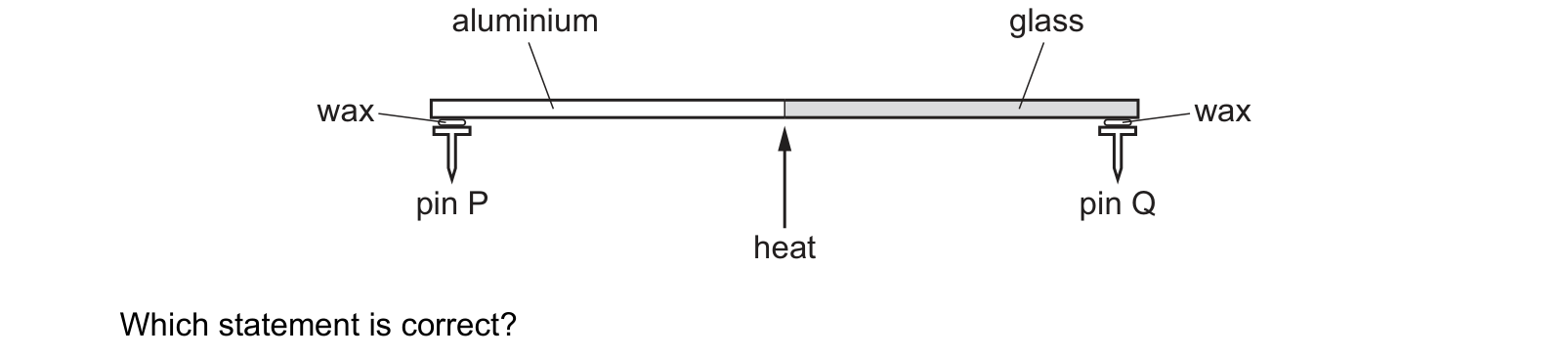
A rod is made half of aluminium and half of glass.
A pin is attached to each end of the rod by wax.
The rod is heated at the centre.
A pin falls off when the wax melts. Which statement is correct?
Answer: A.
What the syllabus asks for on this topicSyllabus points
Syllabus points
- Describe conduction and explain it in terms of particles and free electrons.
- Describe convection and explain it in terms of density changes.
- Describe thermal radiation and the factors affecting how much a surface emits and absorbs.
- Describe experiments to distinguish good and bad emitters, absorbers and conductors.
- Explain everyday applications and ways of reducing thermal energy transfer.
Energy moves from hotter places to colder ones by three processes. Which one applies depends on the material and on whether the material itself moves.
Related CIE 0625 Physics topics
Not the topic you were looking for? Describe what you are stuck on in your own words and we will take you to the notes that answer it.