90 past-paper questions on this unit. Five of them are below. Answer on the page: each one is marked the moment you pick, the correct option is shown whether or not you found it, and the full explanation opens either way.
CIE 0625 PhysicsPaper 1 and Paper 2 MCQsFree account
Transfer of thermal energy: five questions to try now
Real past-paper questions, the answer key from the mark scheme, and the explanation that goes with it. No account needed to answer them.
Question 1
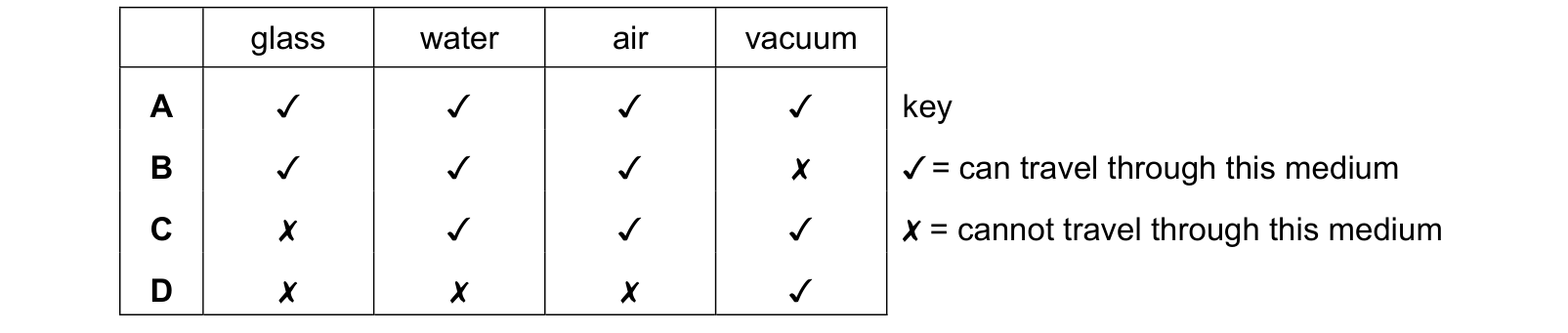
Thermal radiation is emitted from all objects. Which mediums can thermal radiation travel through? glass water air vacuum Use the source image for S24 Paper 12, question 15.
Answer: A.
Thermal radiation is an electromagnetic wave, mostly infrared, and electromagnetic waves need no medium at all. That is why row A, with a tick in every column, is right: radiation passes through glass, water and air, and it crosses a vacuum just as happily. The vacuum column is the decisive one, because it is what separates radiation from conduction and convection, both of which need particles and so stop dead where there are none. B ticks the three materials but crosses the vacuum, which would leave the Sun's energy unable to reach the Earth. C blocks radiation at glass, yet sunlight warming a room through a closed window shows it gets through, and D allows only the vacuum, which would make a fire impossible to feel across a room full of air.
Question 2
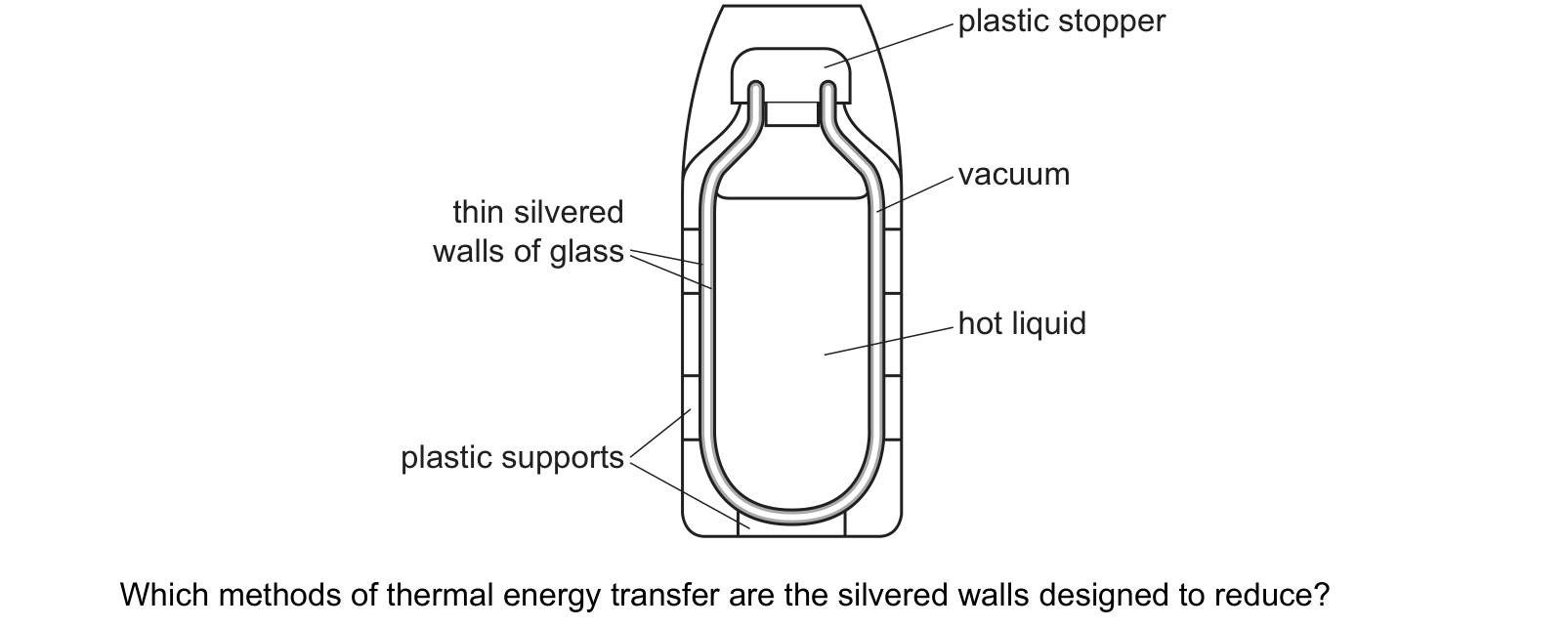
The diagram shows a flask designed to reduce the loss of thermal energy from a hot liquid. Which methods of thermal energy transfer are the silvered walls designed to reduce?
Answer: D.
The diagram labels the parts of the flask separately: a vacuum between the walls, plastic supports, a plastic stopper, and thin silvered walls of glass. The vacuum is what stops conduction and convection, because both of those need particles to carry the energy and a vacuum contains none. Radiation crosses a vacuum perfectly well, though, so a further measure is needed, and that is the silvering: a shiny surface is a poor emitter and a good reflector, so it cuts the infrared leaving the hot liquid and bounces back whatever does cross the gap. The silvered walls therefore target radiation only, which is D. A, B and C each credit the silvering with a job the vacuum is already doing.
Question 3
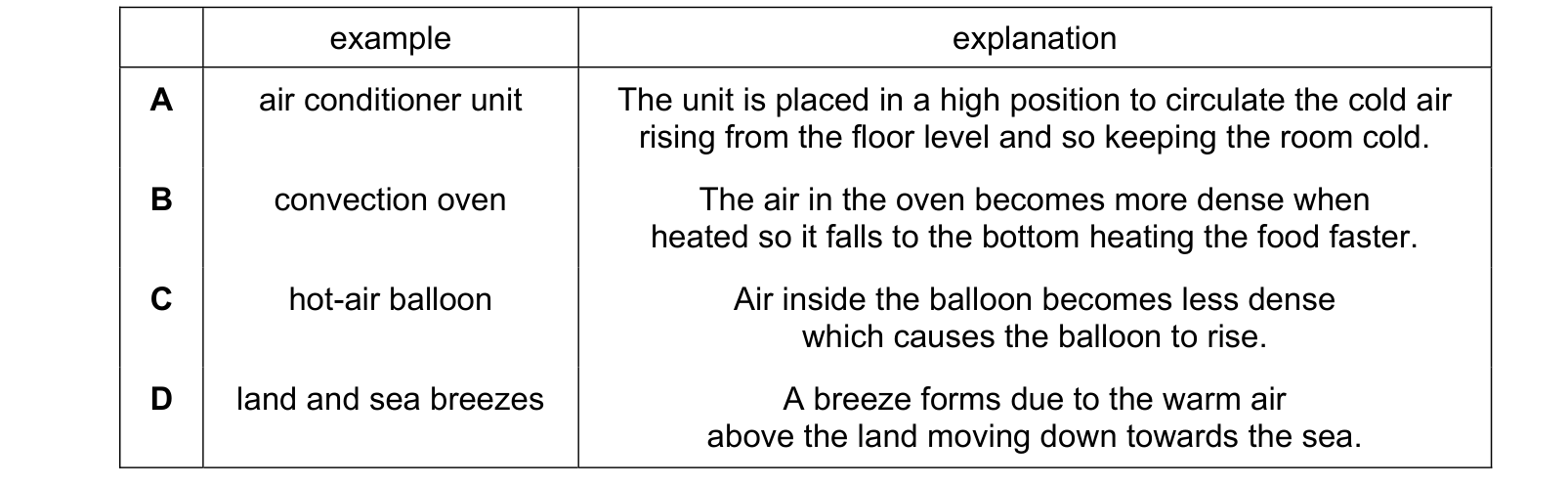
The table gives some examples of convection and an explanation of why the convection occurs. Which row is correct? Each answer gives, in order: example; explanation.
Answer: C.
Convection works because heating a fluid makes it expand, lowers its density, and lets the surrounding cooler fluid push it upwards. Row C applies that correctly: the burner makes the air inside the balloon less dense than the air outside, so the balloon rises. B states the opposite physics, since heated air becomes less dense, not more, and so it rises to the top of the oven rather than falling to the bottom. A has cold air rising from floor level, but cold air is denser and sinks, which is precisely why an air conditioner is mounted high up. D has warm air over the land moving downwards, whereas the warm land air rises and cooler air from over the sea flows in underneath to replace it.
Question 4
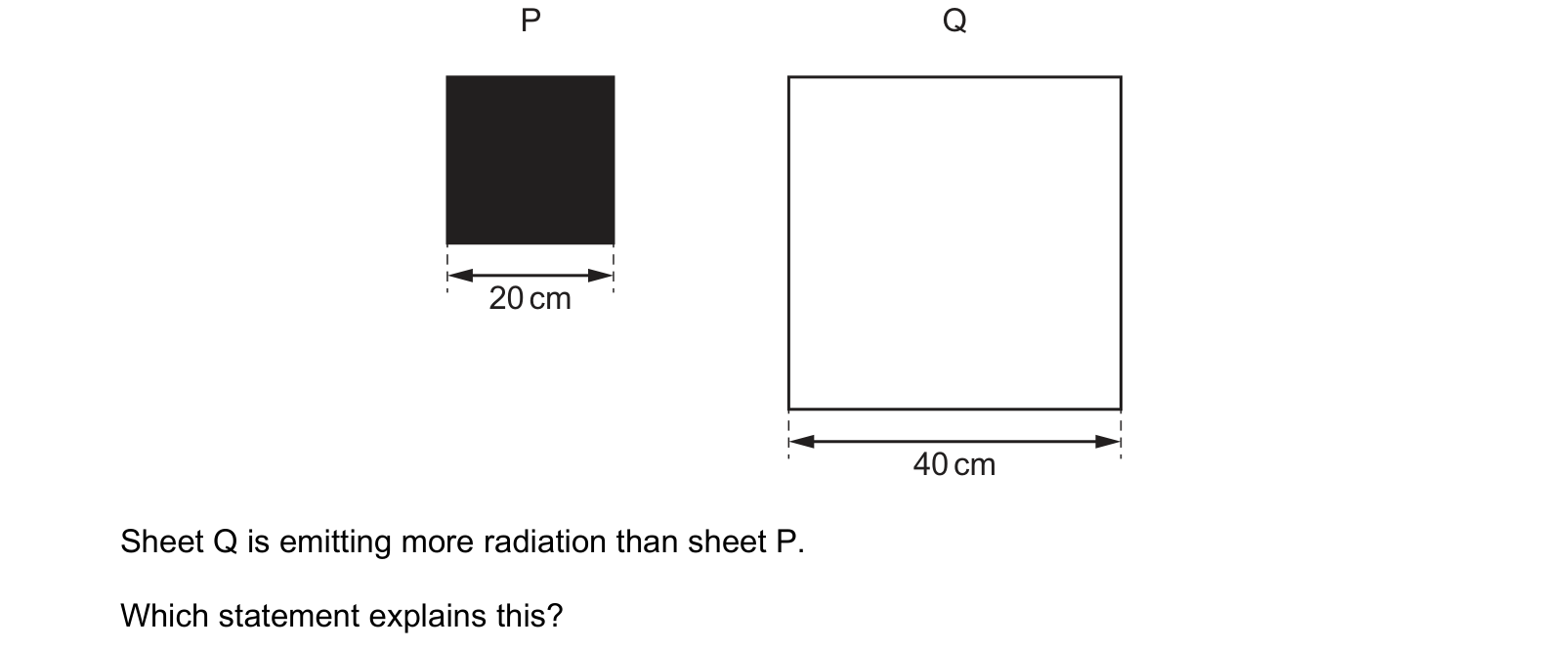
Two square sheets of metal, P and Q, are heated to the same temperature. The metal sheets are shown. P Q Sheet Q is emitting more radiation than sheet P. Which statement explains this?
Answer: C.
Look at the two sheets before reasoning: P is the dull black one but measures only 20 cm across, while Q is white and measures 40 cm across. Doubling the side length gives four times the area, so Q presents 1600 cm2 of surface against P's 400 cm2. The rate of emission depends on both the surface finish and the surface area, and here Q's fourfold area outweighs the fact that a white surface emits less per unit area, which is why C explains the observation. B states a true rule, that dull black surfaces are better emitters, but applying it to these sheets would predict P emitting more, the opposite of what happens. A talks about conducting radiation, which is not how radiation travels, and D is about absorbing rather than emitting and gets white surfaces wrong as well.
Question 5
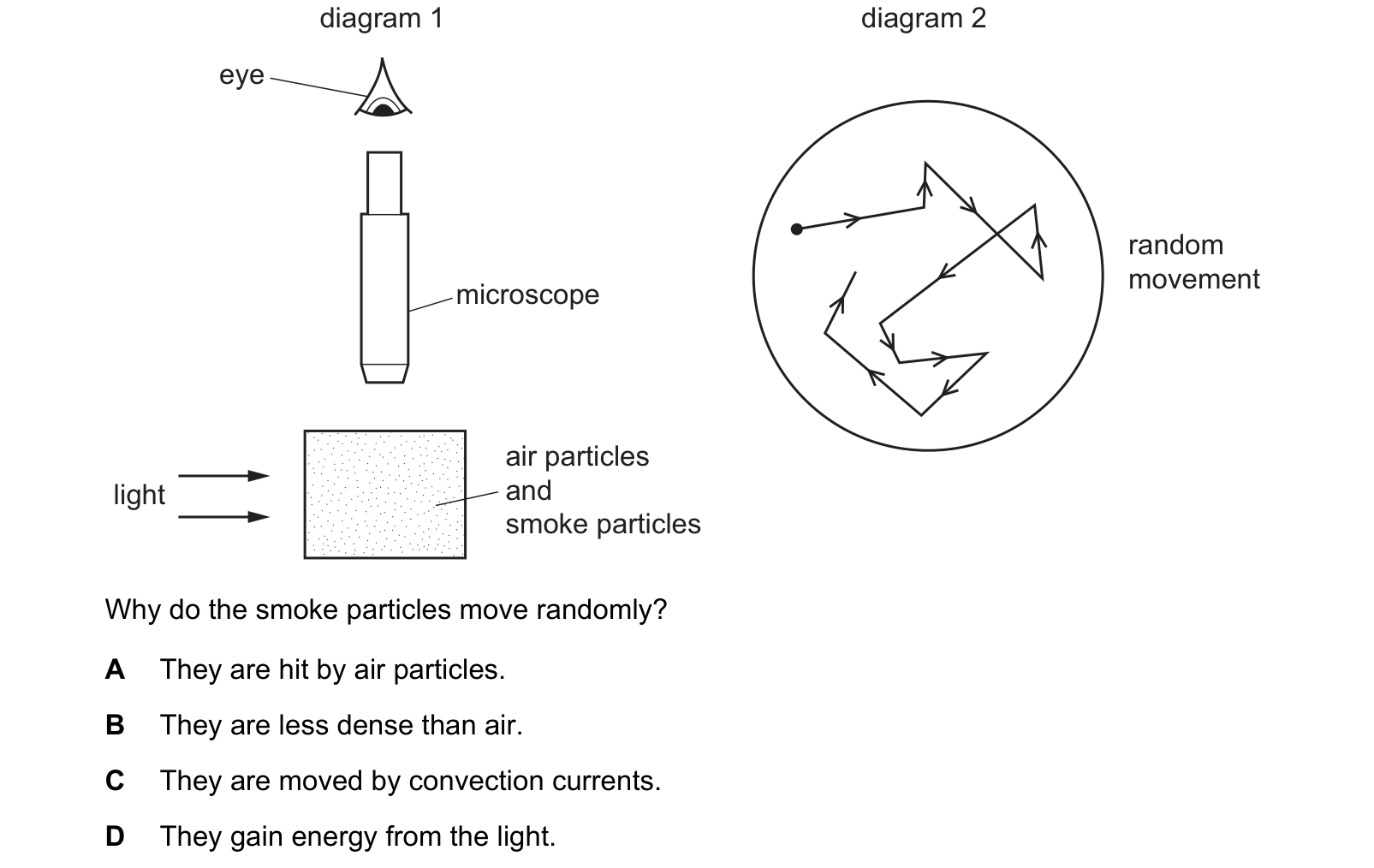
Diagram 1 shows apparatus being used to observe smoke particles. Diagram 2 shows how a smoke particle moves randomly. diagram 1 diagram 2 light and Why do the smoke particles move randomly?
Answer: A.
Diagram 1 shows smoke particles in air lit from the side and watched through a microscope, and diagram 2 shows the jagged track one of them follows. The smoke particles are just big enough to see, but the air particles striking them are not, so what is being watched is the effect of countless invisible air molecules hitting the smoke particle from random directions at random moments. Each unbalanced burst of hits shoves it a short way, and that builds the zigzag path in diagram 2, so A is correct. B is irrelevant, because a density difference would give a steady drift up or down rather than random jerks. C would produce a smooth circulating flow, not this erratic track, and D is wrong because the light only makes the particles visible: the collisions do the moving.
These questions are drawn from past CIE 0625 Physics papers and filtered to transfer of thermal energy. You answer, you find out immediately whether you were right, and you get the reasoning for the correct option and for each distractor. Wrong answers go to a mistakes locker so you can come back to exactly those.
Practice is free. You need an account only so your progress and your mistakes are still there next time.
These are the errors that cost marks on transfer of thermal energy, taken from our own topic notes. Read them before you practise and you will recognise the traps in the questions.
Explaining conduction in a metal only by particle vibration, without mentioning free electrons.
Saying convection occurs in solids, or in a vacuum.
Giving only one step of the convection chain; expansion, density fall and rising are all needed.
Saying that warm air rises because it is lighter, without mentioning density.
Saying radiation needs a medium.
Saying a good absorber is a poor emitter.
Describing insulation as "keeping the cold out" rather than reducing the transfer of energy out.
Forgetting that the vacuum in a flask stops two processes, not one.