Physical quantities and measurement techniques
Contents: 8 sections
Choosing the instrument
Each quantity has an instrument that reads it directly, and exam questions turn on that word more often than on anything else.
| Quantity | Instrument | Typical smallest division |
|---|---|---|
| Length, a few centimetres | Ruler | 1 mm |
| Length, small and precise | Micrometer screw gauge | 0.01 mm |
| Volume of a liquid | Measuring cylinder | 1 or 2 cm³ |
| Mass | Balance | 0.1 g or 0.01 g |
| Time | Stopwatch | 0.01 s |
A balance gives mass in grams. A newton meter gives weight in newtons. Everyday speech treats these as the same and physics does not, so a question asking for mass is not answered by a spring balance.
Reading a scale
Before reading anything, work out what one small division is worth. Count the small divisions between two labelled marks and divide.
If a measuring cylinder is labelled every 10 cm³ and there are five small divisions between labels, each small division is 2 cm³, and a reading three divisions above the 10 mark is 16 cm³, not 13 cm³. Assuming every small division is worth 1 is the single most common way to lose this mark.
Read a liquid level at the bottom of the meniscus, with your eye level with the surface. Looking from above or below introduces a parallax error.
Volume of an irregular solid
A ruler is useless on a stone, so use displacement.
- Part fill a measuring cylinder and read the level.
- Lower the object in until it is fully submerged.
- Read the new level.
- The volume of the object is the difference between the two readings.
The quantity you want is always the rise, never the final reading. A question that gives you a starting volume is telling you to subtract it.
If the object floats, hold it under with a sinker: measure the sinker alone first, then the sinker and the object together, and subtract.
Repeating and averaging
A single reading carries your reaction error in full. Repeating the measurement and taking a mean spreads that error out and gives a better estimate.
For a pendulum, do not time one swing. Time 20 oscillations, then divide by 20:
- average time for 20 oscillations = total time / number of repeats
- period T = that average / 20
Both divisions are needed and both are easy to forget. Timing many swings works because your reaction error, perhaps 0.2 s, is shared across 20 periods instead of landing on one.
The same idea gives the thickness of one sheet of paper: measure the thickness of 100 sheets with a ruler and divide by 100.
Worked example. A pendulum takes 17.6 s, 19.8 s, 17.6 s and 18.6 s for 20 oscillations. Find the period.
Mean time for 20 = (17.6 + 19.8 + 17.6 + 18.6) / 4 = 73.6 / 4 = 18.4 s. Period = 18.4 / 20 = 0.92 s.
Note that averaging first and dividing second is not the same as picking one reading. Repeating is pointless if you then use a single result.
Scalars and vectors
- A scalar has magnitude only: distance, speed, time, mass, energy, temperature.
- A vector has magnitude and direction: displacement, velocity, acceleration, force, weight, momentum.
The distinction matters whenever direction can change. Momentum is a vector, which is why two objects can approach each other and both end up stationary without any momentum disappearing: the two momenta were opposite in sign and cancelled.
Adding vectors
Two vectors are added head to tail: draw the first, start the second at the tip of the first, and the resultant runs from the tail of the first to the head of the last.
Drawn from the same point instead, complete the parallelogram and the resultant is the diagonal from that point.
Two checks catch most errors:
- Does the resultant start where the vectors start and end where the chain ends?
- Does the arrowhead point from start to finish? A correct triangle with a reversed arrow is a wrong answer, and it is offered as an option surprisingly often.
Forces at right angles
When the two vectors are perpendicular, the resultant follows from Pythagoras:
resultant = square root of (first² + second²)
So 3 N and 4 N at right angles give 5 N, and 6 N and 8 N give 10 N. Both triangles are worth recognising on sight.
The resultant of two perpendicular forces is always larger than either one and smaller than their sum. Adding them (3 + 4 = 7) is right only for parallel forces, and subtracting them (4 − 3 = 1) only for opposite ones. Both wrong answers are usually on offer.
Common mistakes
- Assuming every small division on a scale is worth 1 without counting.
- Using the final reading as a volume instead of the rise in level.
- Timing one oscillation instead of many, or forgetting to divide by the number of oscillations at the end.
- Quoting a mass in newtons or a weight in kilograms.
- Adding perpendicular forces arithmetically instead of using Pythagoras.
- Drawing a correct vector triangle and putting the arrowhead on the resultant the wrong way round.
- Reading a meniscus from above rather than at eye level.
Check you have it
Question 1
Which row shows the best choice of measuring instruments to obtain accurate values for the distances shown? Each answer gives, in order: diameter of wire; height of bench; length of laboratory.
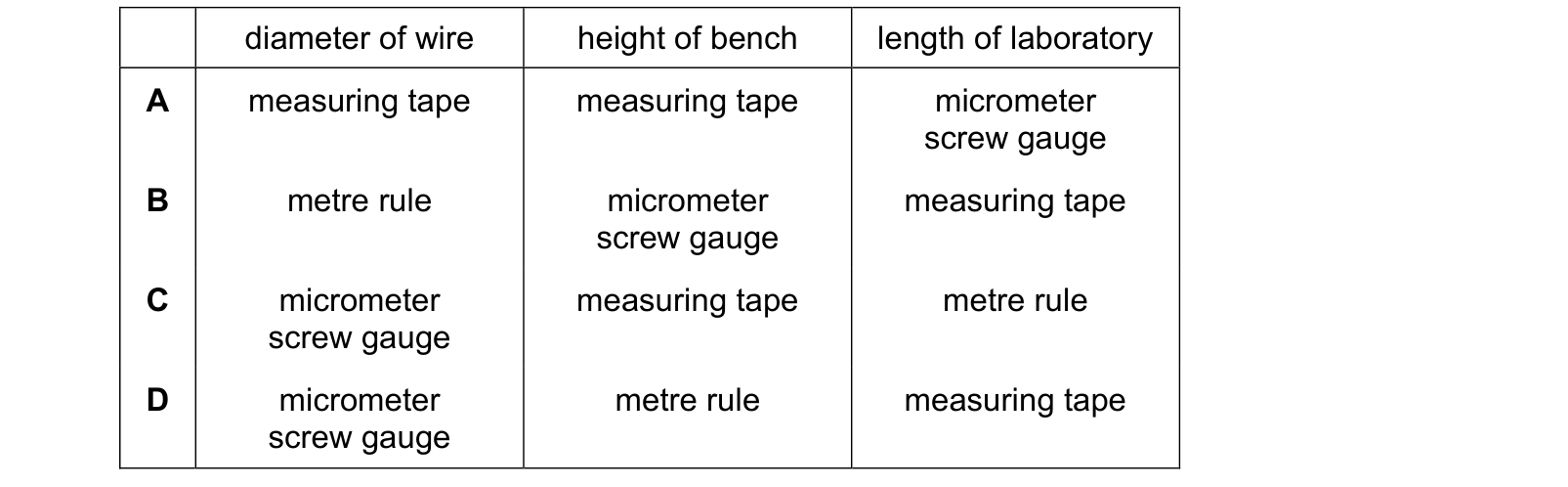
Answer: D.
Micrometer, metre rule, measuring tape, which is D.
The rule behind it: the instrument must be long enough to cover the length in one go, and its smallest division must be small enough that the reading is not mostly guesswork.
A tries to measure a wire with a tape and a laboratory with a micrometer, which is both errors at once. B puts a micrometer on a bench, which cannot physically be done, and a metre rule on a wire, where the millimetre divisions are far too coarse. C is the near miss and the one most students pick: the wire is right, but it then measures the laboratory with a metre rule, laying it end to end and collecting an error at every step.
Question 2
The diagram shows a pendulum that oscillates between P and Q. Which method is used to find the average period of oscillation for the pendulum?
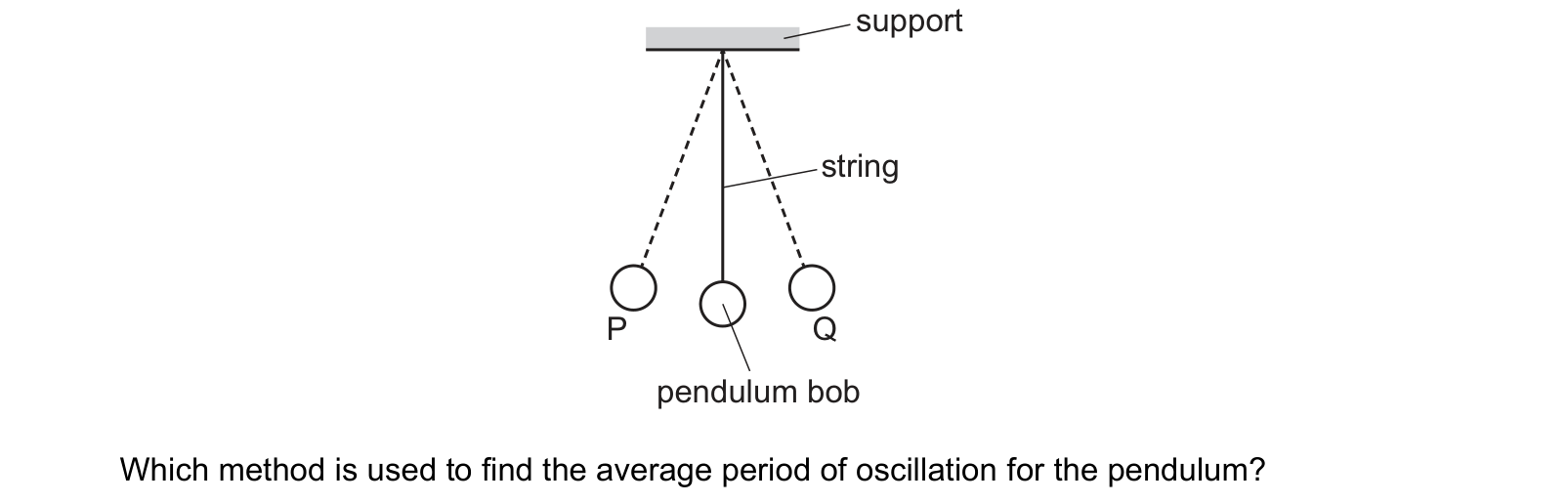
Answer: B.
Timing 10 complete oscillations and dividing by 10 spreads the same reaction error across a measurement ten times longer, cutting its effect on the period by a factor of ten. That is B.
C times ten oscillations and then multiplies by ten, which gives a hundred times the period.
A and D time a single journey from P to Q, which is only half an oscillation. A complete period is there and back, P to Q to P, so both would give half the true period even if the timing were perfect. They also keep the interval short, which is the original problem.
Two ideas are being tested at once: knowing what a full oscillation is, and knowing why you time many of them. The second generalises well beyond pendulums. Whenever a fixed error sits on each measurement, measure something larger and divide.
Question 3
Which vector diagram correctly shows the force Z as the resultant of forces X and Y? Use the source image for S23 Paper 21, question 1.

Answer: D.
In D, X runs up the left side, Y starts where X finishes and runs to the right, and Z runs from the bottom of X straight to the tip of Y. Tail of X to head of Y is exactly what a resultant is, so D is correct.
C draws the same triangle and reverses the arrowhead on Z, so it points from the finish back to the start. That is the resultant of the wrong sign, and it is the single most common slip in this topic: the triangle can be right while the arrow is wrong.
A and B place X and Y so that they share a tail rather than joining head to tail. Reading those triangles carefully, each one actually shows X or Y as the resultant of the other two, not Z.
Two checks worth running on any vector triangle: do the first two vectors join head to tail, and does the resultant start where the chain starts and end where it ends.
What the syllabus asks for on this topicSyllabus points
Syllabus points
- Describe how to measure length, volume and time, and choose the right instrument for each.
- Take an average from repeated readings, and explain why repeating improves the result.
- Determine the period of a pendulum by timing several oscillations.
- Understand that a scalar has size only and a vector has size and direction.
- Add two vectors, including two forces at right angles, by scale drawing or calculation.
Related CIE 0625 Physics topics
Not the topic you were looking for? Describe what you are stuck on in your own words and we will take you to the notes that answer it.