Physical quantities and measurement techniques: five questions to try now
Real past-paper questions, the answer key from the mark scheme, and the explanation that goes with it. No account needed to answer them.
Question 1
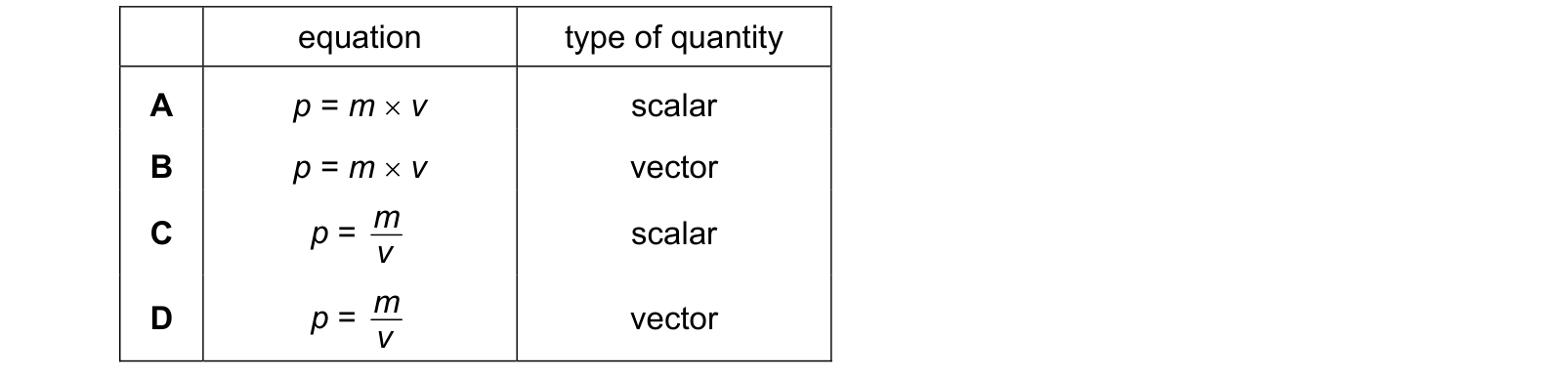
How is momentum p calculated in terms of the mass m of a body and its velocity v, and what type of quantity is p? Each answer gives, in order: equation; type of quantity.
Answer: B.
Velocity is a vector: it has a direction as well as a size. Multiplying a vector by a scalar mass leaves a vector, so momentum is a vector too, which makes it B.
A has the right equation and calls the result a scalar. That matters more than it looks: it is the direction of momentum that lets it cancel in a collision, which is why two objects can approach each other and both end up stationary without any momentum disappearing.
C and D use p = m / v, which is not a physical quantity at all. A quick check is the units: kg / (m / s) is nothing you will ever meet, while kg m / s is momentum.
Speed is a scalar and velocity is a vector. Momentum inherits its direction from the velocity.
Question 2
A student wishes to find the volume of a small, irregularly shaped stone.
A ruler and a measuring cylinder containing some water are available.
Which apparatus is needed?

Answer: B.
C adds the ruler. It is available, and it is useless here: there are no regular dimensions to measure. Having an instrument to hand does not make it part of the method.
D offers the ruler alone, which cannot give a volume for a shape like this.
A gives up when a perfectly good method is sitting on the bench.
The reason displacement works is that it sidesteps shape entirely. The water does not care how lumpy the stone is; it simply gets pushed aside by however much space the stone occupies, and the rise in level measures that directly.
Two practical points worth carrying into the laboratory: take the difference between the readings before and after, and make sure the stone is fully submerged, or you measure only the part that went under.
Question 3
A measuring cylinder contains water.
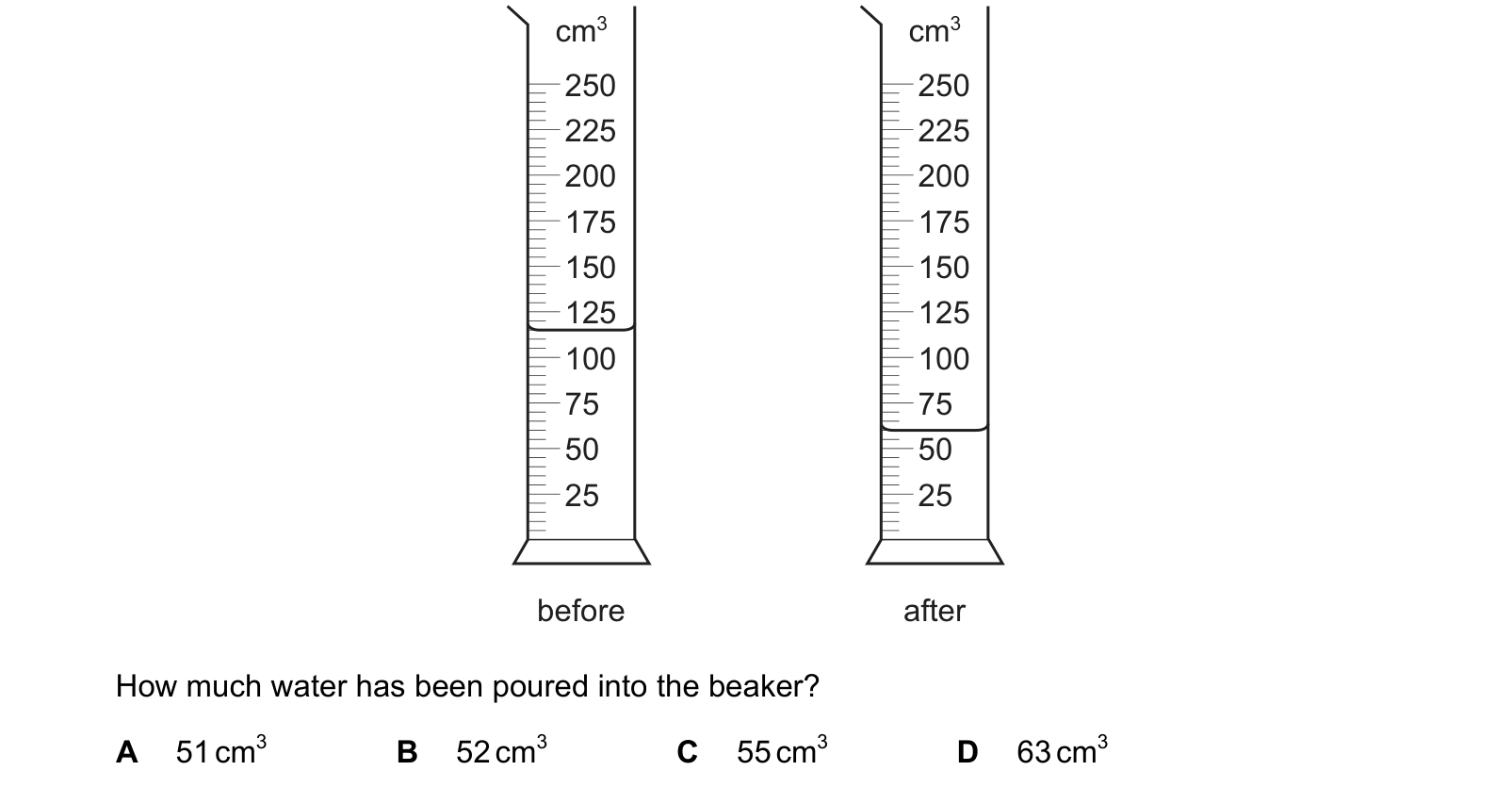
The diagrams show the measuring cylinder before and after some of the water is poured into a beaker. How much water has been poured into the beaker?
Answer: C.
The scale is labelled every 25 cm3 with finer ticks between, so read to the nearest small division.
Before, the level sits a little below 125, at about 120 cm3. After, it sits a little below 75, at about 65 cm3.
poured out = 120 - 65 = 55 cm3, which is C.
The wrong answers, 51, 52 and 63, are all what you get by misreading one level by a division or two, which is exactly what the question is testing. Count the small ticks rather than eyeballing the position between the labelled numbers.
Two habits protect the reading. Take both values to the same precision, since an error in either goes straight into the difference. And read the bottom of the meniscus with your eye level with it, consistently for both cylinders. Reading the top on one and the bottom on the other introduces an error of a few cubic centimetres, which is the size of the gaps between these options.
Question 4
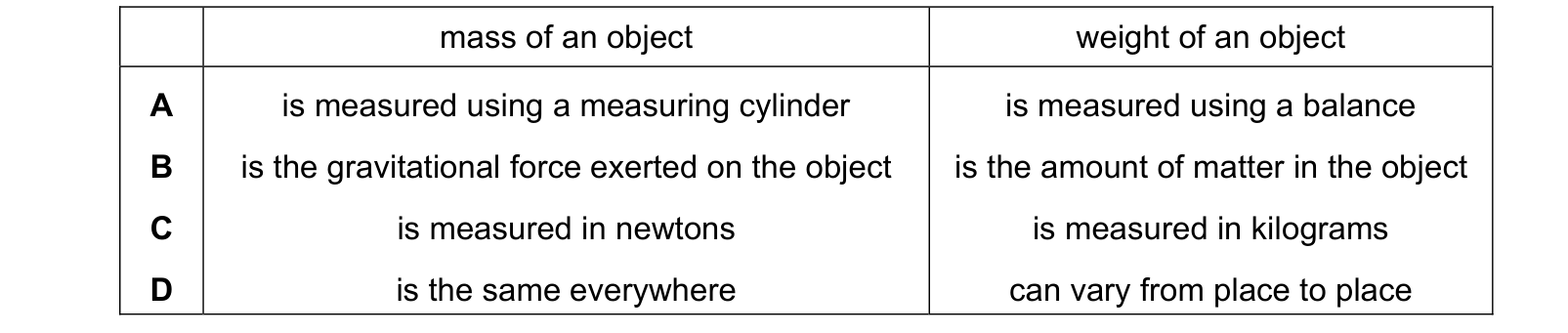
Which row contains two correct statements about the mass and the weight of an object? Each answer gives, in order: mass of an object; weight of an object.
Answer: D.
B has the two definitions swapped: it calls mass the gravitational force and weight the amount of matter, which is exactly backwards.
C swaps the units. Mass is measured in kilograms and weight, being a force, is measured in newtons.
A is the one worth pausing on. A measuring cylinder measures volume, not mass, so the first half is wrong immediately. The second half is a fair description of what a balance does in everyday use, which is what makes the row tempting, but a row only scores if both halves are right.
That is the habit this question is really testing: check both entries before choosing a row.
Question 5
The diagram shows a stone of irregular shape.
Which property of the stone can be found by lowering it into a measuring cylinder half-filled with water?

Answer: C.
A, length, is not a single well defined thing for an irregular stone, and the water level tells you nothing about it anyway.
B and D, mass and weight, both need a balance or a newton meter. Water displacement measures how much space the stone takes up, not how much matter is in it.
Displacement exists precisely for shapes you cannot measure with a ruler. Pair it with a balance and you can then work out the density, but the cylinder on its own gives you only the volume.
What this practice covers
These questions are drawn from past CIE 0625 Physics papers and filtered to physical quantities and measurement techniques. You answer, you find out immediately whether you were right, and you get the reasoning for the correct option and for each distractor. Wrong answers go to a mistakes locker so you can come back to exactly those.
Practice is free. You need an account only so your progress and your mistakes are still there next time.
Keep going Paper 1 and Paper 2 MCQs →
What examiners see students get wrong here
These are the errors that cost marks on physical quantities and measurement techniques, taken from our own topic notes. Read them before you practise and you will recognise the traps in the questions.
- Assuming every small division on a scale is worth 1 without counting.
- Using the final reading as a volume instead of the rise in level.
- Timing one oscillation instead of many, or forgetting to divide by the number of oscillations at the end.
- Quoting a mass in newtons or a weight in kilograms.
- Adding perpendicular forces arithmetically instead of using Pythagoras.
- Drawing a correct vector triangle and putting the arrowhead on the resultant the wrong way round.
- Reading a meniscus from above rather than at eye level.
Revise it first
If any of the above is unfamiliar, work through the notes before practising: Physical quantities and measurement techniques revision notes.