Stars and the Universe
Contents: 7 sections
Stars
A star is a body that emits its own light, powered by nuclear fusion. In the core, hydrogen nuclei fuse to form helium, releasing energy.
The Sun is an ordinary star, unremarkable except for being close. It appears far brighter and larger than other stars for that reason alone.
A star is stable while two effects balance: gravity pulling it inwards and the outward pressure produced by the energy released in fusion. The whole life cycle is the story of that balance holding and then failing.
Galaxies and distances
A galaxy is a huge collection of stars, held together by gravity. Our galaxy is the Milky Way, and the Solar System is one of many systems within it.
The Universe contains billions of galaxies, separated by vast distances.
The light-year
A light-year is the distance light travels in one year. It is a unit of distance, not of time, and calling it a length of time is the standard error.
light-year = speed of light x time in one year = 3.0 x 10⁸ x (365 x 24 x 60 x 60) = about 9.5 x 10¹⁵ m
The nearest star beyond the Sun is about 4 light-years away, and the Milky Way is about 100 000 light-years across.
Because light takes time to arrive, looking at distant objects is looking into the past. Light from a galaxy a million light-years away left it a million years ago.
The life cycle of a star
A star begins as an interstellar cloud of gas and dust, mostly hydrogen. Gravity pulls it together, and it heats as it contracts. When it is hot enough for fusion to begin, a protostar becomes a stable star.
The star spends most of its life in this stable phase, which for the Sun is about ten billion years.
When the hydrogen in the core runs low, the balance fails and the star swells:
For a star about the size of the Sun:
- Stable star
- Red giant as the outer layers expand and cool
- White dwarf as the outer layers drift away and the hot core is left
- It cools slowly and fades
For a star much more massive than the Sun:
- Stable star
- Red supergiant
- Supernova, an enormous explosion
- The remnant becomes a neutron star, or a black hole if the star was massive enough
The route taken depends on the star's mass, and questions ask which path a given star follows.
Elements heavier than iron are formed in supernovae and scattered into space. The material of the Earth, and of us, was made in earlier generations of stars.
Redshift
Light from distant galaxies is shifted towards the red, or longer-wavelength, end of the spectrum. This is redshift, and it indicates that the galaxy is moving away from us.
The key observation is that the further away a galaxy is, the greater its redshift, and so the faster it is receding.
This is the evidence that the Universe is expanding. It does not mean the Earth is at the centre of that expansion: an observer in any galaxy would see the same thing, because space itself is expanding and every galaxy is moving away from every other.
The Big Bang
Running the expansion backwards suggests the Universe began from a single point, expanding from an extremely hot, dense state. This is the Big Bang theory, and the estimated age of the Universe is about 13.8 billion years.
Two pieces of evidence support it:
- Redshift of distant galaxies, showing the expansion.
- Cosmic microwave background radiation (CMBR), a faint microwave radiation coming from all directions, understood as the remnant of the radiation from the early Universe, stretched to microwave wavelengths by the expansion since.
The CMBR is the more decisive of the two, because the Big Bang predicted it before it was found.
Common mistakes
- Saying a light-year is a unit of time.
- Saying redshift means galaxies are moving towards us.
- Concluding from redshift that the Earth is at the centre of the Universe.
- Giving the same life cycle for all stars regardless of mass.
- Saying a star the size of the Sun will become a black hole.
- Saying the Sun is bigger or brighter than other stars, rather than closer.
- Saying stars burn their fuel; the process is nuclear fusion, not combustion.
- Naming redshift as the only evidence for the Big Bang and omitting the microwave background.
Check you have it
Question 1
The table lists some information about some stars. Which star will eventually explode as a supernova? Each answer gives, in order: name of star; type of star; temperature / °C.

Answer: B.
Question 2
The graph shows the energy radiated by the Sun at different wavelengths. Most of the energy is radiated in just three parts of the electromagnetic spectrum, labelled P, Q and R. Which parts of the electromagnetic spectrum are P and R? Each answer gives, in order: P; R.
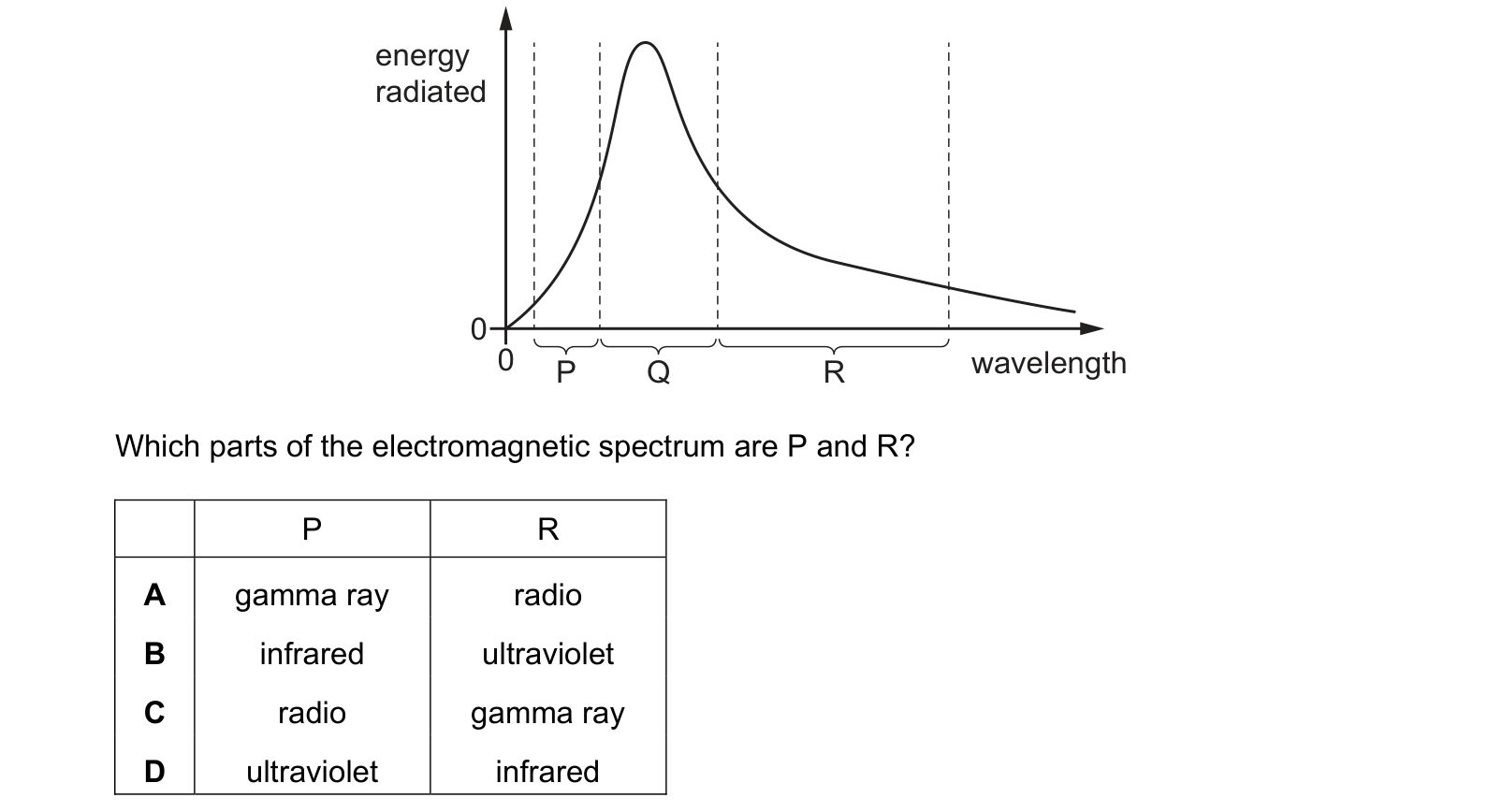
Answer: D.
Just shorter than visible is ultraviolet and just longer than visible is infrared, so P is ultraviolet and R is infrared, which is D. B has them the right way round in name but swapped between the labels, putting infrared at short wavelengths.
A and C bring in gamma rays and radio waves, which lie far out on either side of the graph and carry a negligible share of the Sun's output. The shape of the curve is the clue: a single peak with the neighbouring regions on either side of it, not scattered extremes.
Question 3
A galaxy is 3.0 × 10²⁰ km from the Earth. At which speed is the galaxy moving away from the Earth?
Answer: A.
v = H0 x d
with the Hubble constant taken as about 2.2 x 10^-18 per second on this syllabus.
v = 2.2 x 10^-18 x 3.0 x 10^20 = 660 km / s, which is A.
C and D give the answer in metres per second rather than kilometres per second. The distance was handed to you in kilometres, so multiplying by a constant measured per second leaves the answer in km / s. Watch the unit that arrives with the data rather than assuming SI.
B is out by a factor of ten.
The idea behind the number is worth more than the arithmetic. Every distant galaxy is moving away from us, and the further off it is the faster it goes. That is not because we are at the centre of anything; it is what expanding space looks like from any point inside it. Running it backwards gives an age for the Universe of roughly 1 / H0.
What the syllabus asks for on this topicSyllabus points
Syllabus points
- Describe the Sun as a star, and stars as sources of energy from nuclear fusion.
- Describe galaxies, and the Milky Way as the galaxy containing the Solar System.
- Use the light-year as a unit of distance.
- Describe the life cycle of a star.
- Describe redshift and its use as evidence for an expanding Universe, and state the Big Bang theory.
Related CIE 0625 Physics topics
Not the topic you were looking for? Describe what you are stuck on in your own words and we will take you to the notes that answer it.