Stars and the Universe: five questions to try now
Real past-paper questions, the answer key from the mark scheme, and the explanation that goes with it. No account needed to answer them.
Question 1
The Sun radiates most of its energy in three regions of the electromagnetic spectrum.
In the pie chart, region 1 is infrared radiation and region 2 is visible radiation. What is region 3?

Answer: C.
The three regions are next to each other in the spectrum for a reason. A hot object radiates in a broad band around a peak, and the Sun's surface temperature puts that peak in the visible, with infrared just below it and ultraviolet just above.
A, B and D name microwave, radio and X-ray regions, which lie far from the peak on either side and carry only a tiny fraction of the output, nothing like the visible slice drawn here.
Question 2
Which row shows the most common elements in the Sun and the regions of the electromagnetic spectrum in which most of the Sun’s energy is radiated? Each answer gives, in order: elements; regions.

Answer: D.
The Sun's radiation peaks in the visible part of the spectrum, with a large share in the infrared just beyond it and a smaller share in the ultraviolet. So most of the energy arrives as infrared and visible, making D the row. C pairs the right elements with gamma and radio waves, which carry a negligible share.
The everyday check is that sunlight is bright and it feels warm on your skin, which is the visible and the infrared arriving together.
Question 3
An astronomer observes a distant galaxy. The table shows how the distance and the speed of recession of the galaxy are determined. Which row is correct? Each answer gives, in order: distance; speed of recession.
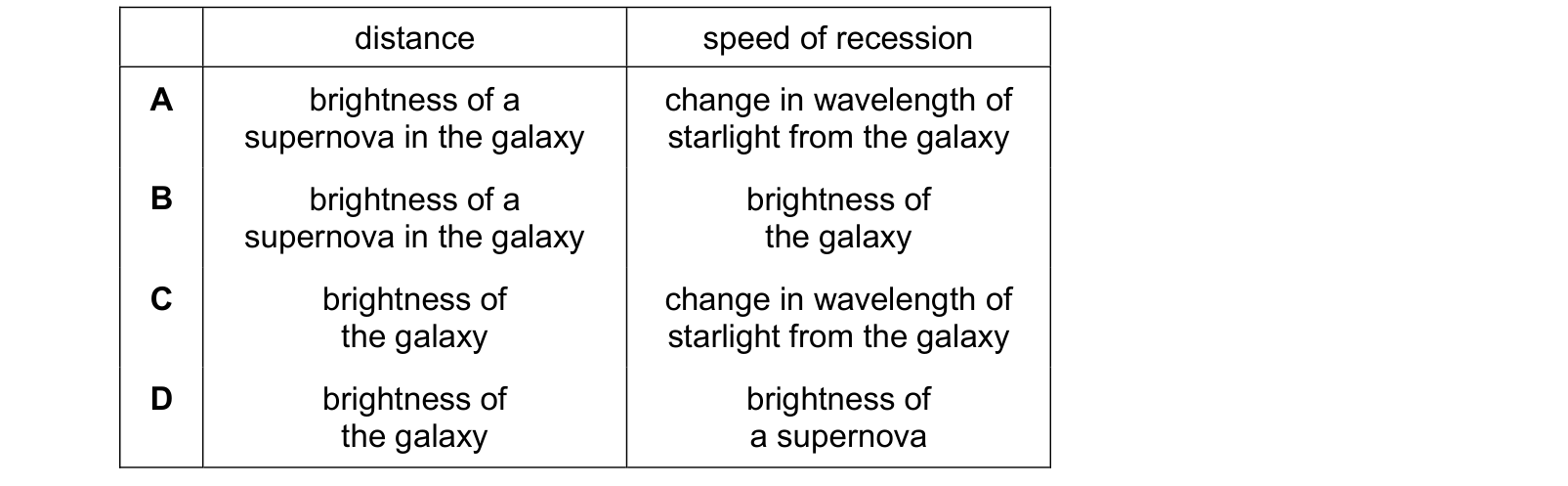
Answer: A.
Question 4
The diagram shows a radio signal from the Earth being reflected by Pluto and returning to the Earth.
The distance between the Earth and Pluto is 0.00050 light-years. What is the time taken for the radio signal to return to the Earth after being sent?

Answer: C.
The signal goes out to Pluto and back, so it covers 2 x 0.00050 = 0.0010 light-years, which takes 0.0010 years. That is C.
D, 0.00050 years, is the one-way time, forgetting the return trip. A and B, 2000 and 1000 years, come from dividing by the distance instead of using it directly, turning a small number into a huge one. A quick sense check helps: Pluto is only a fraction of a light-year away, so the round trip must take a small fraction of a year, not centuries.
Question 5
The table shows some elements and some regions of the electromagnetic spectrum. Which row shows one of the most common elements in the Sun and one of the regions in which the Sun radiates most of its energy? Each answer gives, in order: element; region.

Answer: D.
The Sun's output peaks in the visible, with a large share in the infrared just beyond it, so infrared is one of the regions where most of the energy is radiated, making D the row. Gamma rays are produced deep in the core but are absorbed and re-emitted on the way out, so almost none of the Sun's energy reaches us as gamma radiation.
The everyday check works well here: sunlight is bright and it feels warm, which is the visible and the infrared arriving together.
What this practice covers
These questions are drawn from past CIE 0625 Physics papers and filtered to stars and the universe. You answer, you find out immediately whether you were right, and you get the reasoning for the correct option and for each distractor. Wrong answers go to a mistakes locker so you can come back to exactly those.
Practice is free. You need an account only so your progress and your mistakes are still there next time.
Keep going Paper 1 and Paper 2 MCQs →
What examiners see students get wrong here
These are the errors that cost marks on stars and the universe, taken from our own topic notes. Read them before you practise and you will recognise the traps in the questions.
- Saying a light-year is a unit of time.
- Saying redshift means galaxies are moving towards us.
- Concluding from redshift that the Earth is at the centre of the Universe.
- Giving the same life cycle for all stars regardless of mass.
- Saying a star the size of the Sun will become a black hole.
- Saying the Sun is bigger or brighter than other stars, rather than closer.
- Saying stars burn their fuel; the process is nuclear fusion, not combustion.
- Naming redshift as the only evidence for the Big Bang and omitting the microwave background.
Revise it first
If any of the above is unfamiliar, work through the notes before practising: Stars and the Universe revision notes.