Earth and the Solar System
Contents: 7 sections
Rotation and orbit
The Earth rotates on its own axis once in approximately 24 hours. This gives day and night: the half facing the Sun is in daylight, the half facing away is in darkness.
The Earth orbits the Sun once in approximately 365 days, and that defines the year.
The Sun appears to move across the sky from east to west because the Earth rotates from west to east. The apparent motion of the Sun and stars is a consequence of our rotation, not of their movement.
The Moon orbits the Earth in about one month. It is a natural satellite, kept in orbit by the Earth's gravity, and it does not produce its own light: we see it by reflected sunlight.
The Solar System
The Sun is at the centre, and eight planets orbit it. In order outwards:
Mercury, Venus, Earth, Mars, Jupiter, Saturn, Uranus, Neptune.
The first four are the rocky (terrestrial) planets: small, dense, close together and close to the Sun. The outer four are the gas giants: much larger, less dense and far more widely spaced.
Between Mars and Jupiter lies the asteroid belt, a region of rocky debris.
The Solar System also contains moons, orbiting planets, and comets, which orbit the Sun on long, highly elliptical paths.
The Sun is a star, and its energy comes from nuclear fusion of hydrogen into helium in its core. It is the source of almost all the energy on Earth, directly or indirectly.
Accretion is the process by which the Solar System formed: a cloud of gas and dust was pulled together by gravity, with the Sun forming at the centre and the planets from the remaining material.
Gravity and orbits
Everything in the Solar System is held in orbit by the gravitational attraction of the body it orbits.
- Planets are held by the Sun.
- Moons are held by their planet.
- Comets are held by the Sun.
The gravitational field strength falls with distance from the body producing it. A planet twice as far from the Sun experiences a much weaker pull.
The force on an orbiting body always points towards the centre of its orbit. It changes the direction of the velocity without changing its size for a circular orbit, which is what keeps the body curving round instead of flying off in a straight line.
Orbital speed
For a circular orbit:
v = 2πr / T
where r is the orbital radius and T the orbital period, since 2πr is the circumference.
Worked example. A planet orbits at a radius of 1.5 x 10¹¹ m with a period of 3.2 x 10⁷ s.
v = 2π x 1.5 x 10¹¹ / 3.2 x 10⁷ = 2.9 x 10⁴ m/s.
Planets further from the Sun move more slowly and have longer periods, for two reasons at once: the pull of gravity is weaker out there, and the path they must travel is longer. Neptune takes about 165 Earth years for one orbit; Mercury takes 88 days.
Comets
A comet's orbit is a long ellipse, so its distance from the Sun varies enormously.
Its speed varies with it:
- Fastest when closest to the Sun, where gravity is strongest.
- Slowest when furthest away.
Approaching the Sun, gravitational potential energy is converted into kinetic energy, so it speeds up; receding, the exchange runs the other way. A comet's tail always points away from the Sun, blown outwards by the solar wind, whichever way the comet is travelling.
Common mistakes
- Saying the Sun moves round the Earth to give day and night.
- Confusing the cause of day and night (rotation) with the cause of the year (orbit).
- Giving the planets in the wrong order, or putting the asteroid belt in the wrong place.
- Saying the Moon produces its own light.
- Saying a comet moves fastest when it is furthest from the Sun.
- Saying planets further out move faster.
- Drawing the gravitational force on an orbiting planet along its direction of motion rather than towards the Sun.
- Using the diameter instead of the circumference in v = 2πr/T.
Check you have it
Question 1
The Sun transfers energy to the Earth through electromagnetic radiation.
What are two of the parts of the electromagnetic spectrum to which most of the energy belongs?
Answer: B.
Question 2
Which statement about the Sun is correct?
Answer: C.
Question 3
Comets are bodies which orbit the Sun in the Solar System. What is the shape of the orbit and how is the Sun positioned within the orbit? Each answer gives, in order: shape of orbit; position of the Sun.
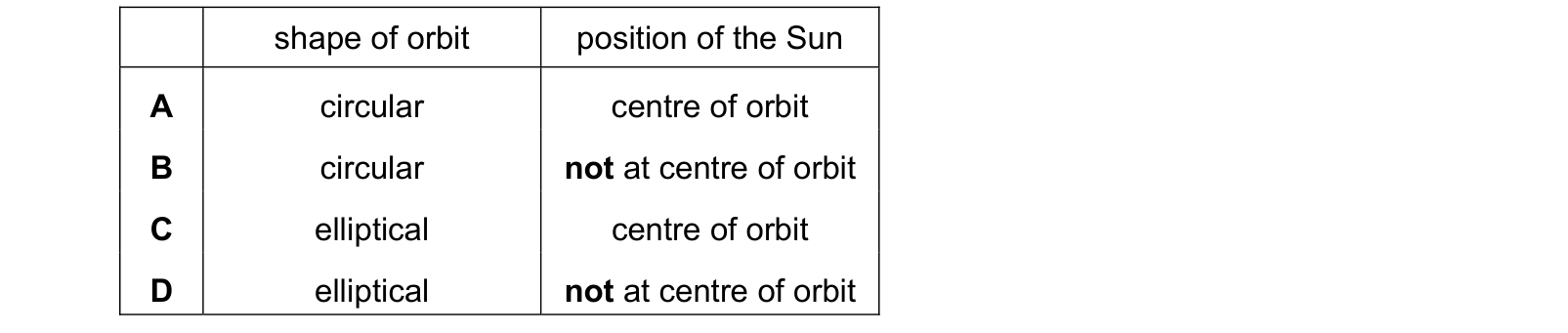
Answer: D.
What the syllabus asks for on this topicSyllabus points
Syllabus points
- Describe the Earth's rotation and orbit, and explain day, night and the year.
- Describe the Moon's orbit of the Earth.
- Describe the Solar System and the order of the planets.
- Explain the orbits of planets, moons and comets in terms of gravitational attraction.
- Relate orbital speed to distance from the Sun, and use v = 2πr/T.
Related CIE 0625 Physics topics
Not the topic you were looking for? Describe what you are stuck on in your own words and we will take you to the notes that answer it.