Earth and the Solar System: five questions to try now
Real past-paper questions, the answer key from the mark scheme, and the explanation that goes with it. No account needed to answer them.
Question 1
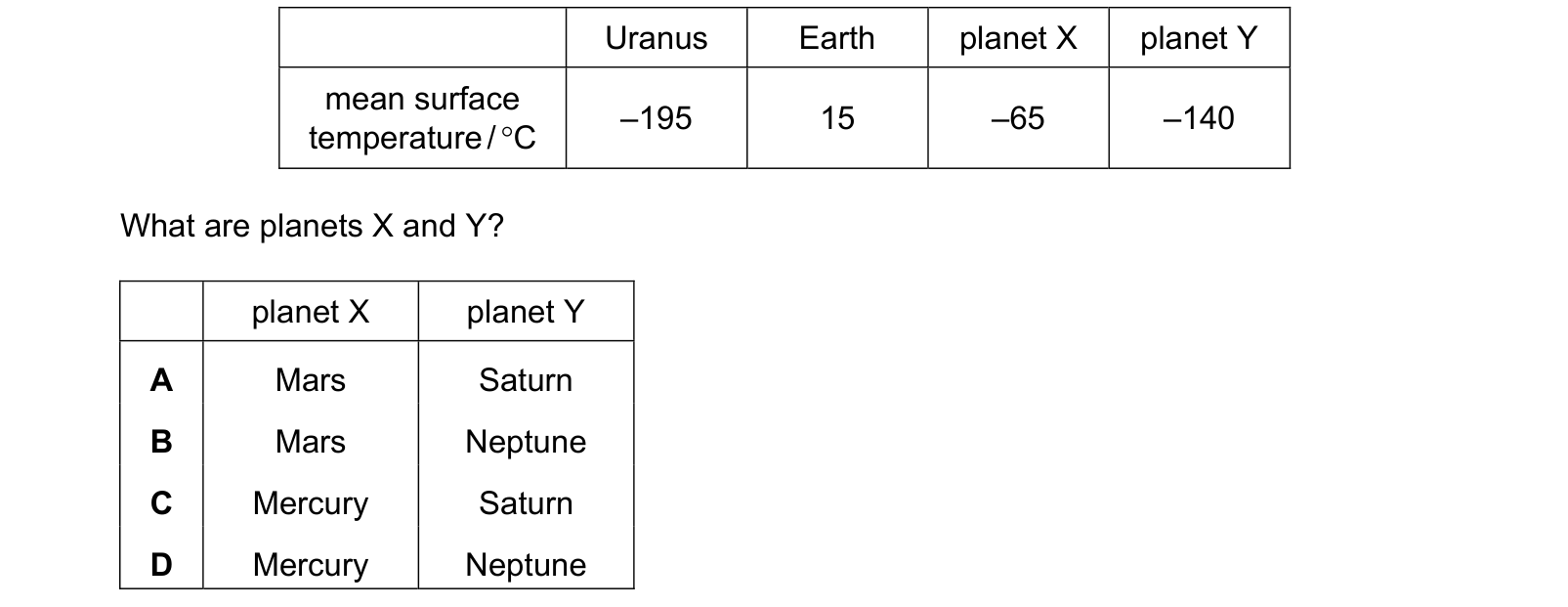
The table gives data about four planets in our Solar System. What are planets X and Y? Each answer gives, in order: planet X; planet Y.
Answer: A.
Question 2
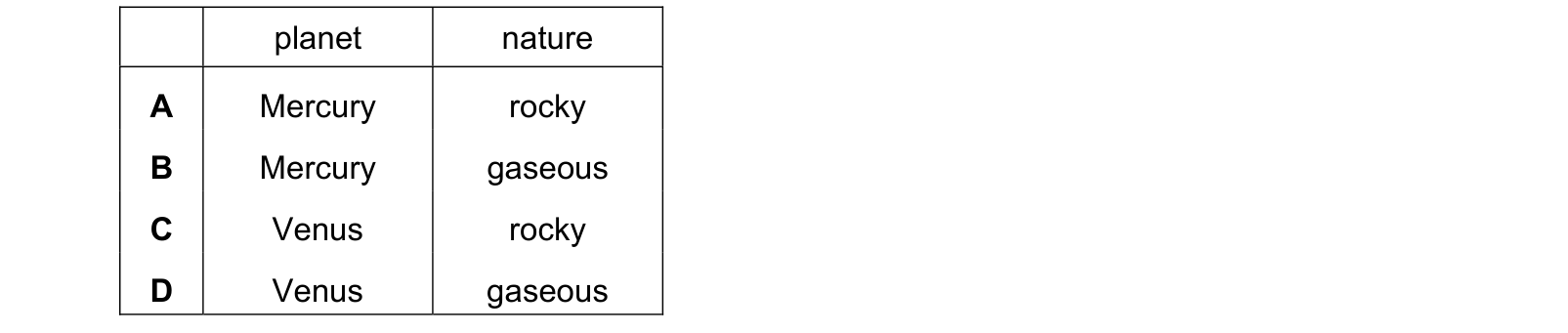
Which planet in our Solar System is nearest to the Sun and what is the nature of the planet? Each answer gives, in order: planet; nature.
Answer: A.
Question 3
The Solar System contains eight major planets.
What is the correct order of three of the major planets, starting with the planet furthest from the Sun?
Answer: C.
Question 4
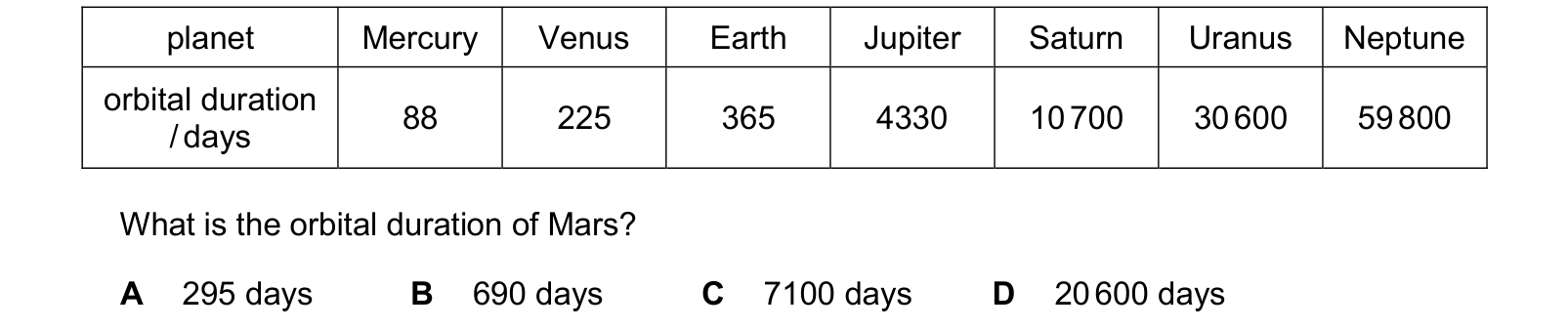
The table gives the orbital durations of planets in the Solar System.
planet Mercury Venus Earth Jupiter Saturn Uranus Neptune
orbital duration 88 225 365 4330 10 700 30 600 59 800 / days
What is the orbital duration of Mars?
Answer: B.
Question 5
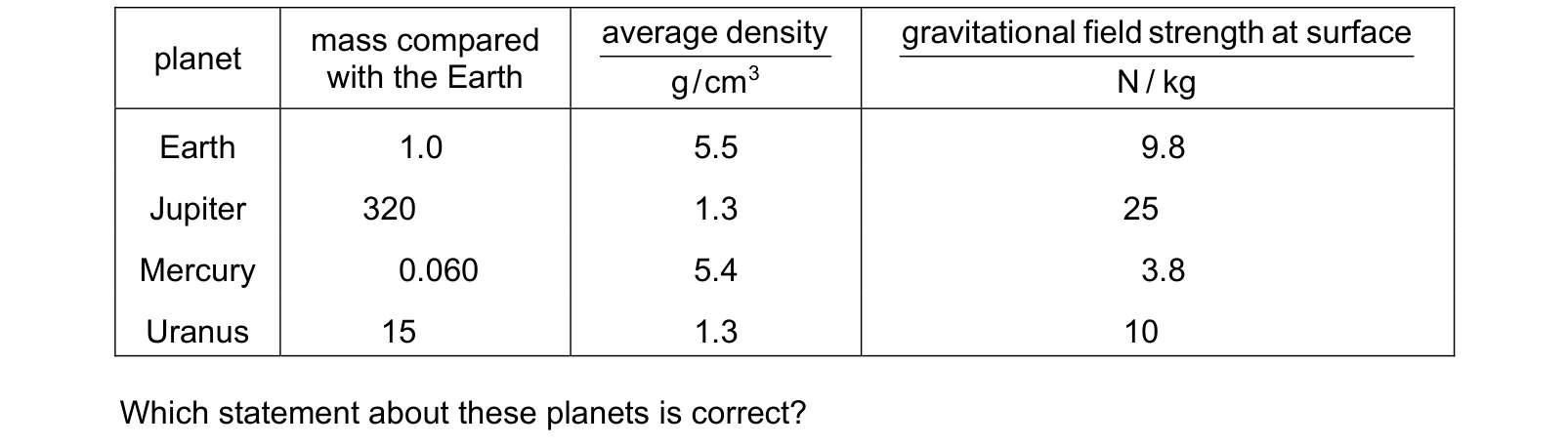
The table gives information about some of the planets in our Solar System.
mass compared average density gravitational field strength at surface planet with the Earth g / cm 3 N / kg
Earth 1.0 5.5 9.8
Jupiter 320 1.3 25
Mercury 0.060 5.4 3.8
Uranus 15 1.3 10
Which statement about these planets is correct?
Answer: B.
What this practice covers
These questions are drawn from past CIE 0625 Physics papers. You answer, you find out immediately whether you were right, and you get the reasoning for the correct option and for each distractor. Wrong answers go to a mistakes locker so you can come back to exactly those.
Practice is free. You need an account only so your progress and your mistakes are still there next time.
Keep going Paper 1 and Paper 2 MCQs →
What examiners see students get wrong here
These are the errors that cost marks on earth and the solar system, taken from our own topic notes. Read them before you practise and you will recognise the traps in the questions.
- Saying the Sun moves round the Earth to give day and night.
- Confusing the cause of day and night (rotation) with the cause of the year (orbit).
- Giving the planets in the wrong order, or putting the asteroid belt in the wrong place.
- Saying the Moon produces its own light.
- Saying a comet moves fastest when it is furthest from the Sun.
- Saying planets further out move faster.
- Drawing the gravitational force on an orbiting planet along its direction of motion rather than towards the Sun.
- Using the diameter instead of the circumference in v = 2πr/T.
Revise it first
If any of the above is unfamiliar, work through the notes before practising: Earth and the Solar System revision notes.