Electromagnetic spectrum: five questions to try now
Real past-paper questions, the answer key from the mark scheme, and the explanation that goes with it. No account needed to answer them.
Question 1
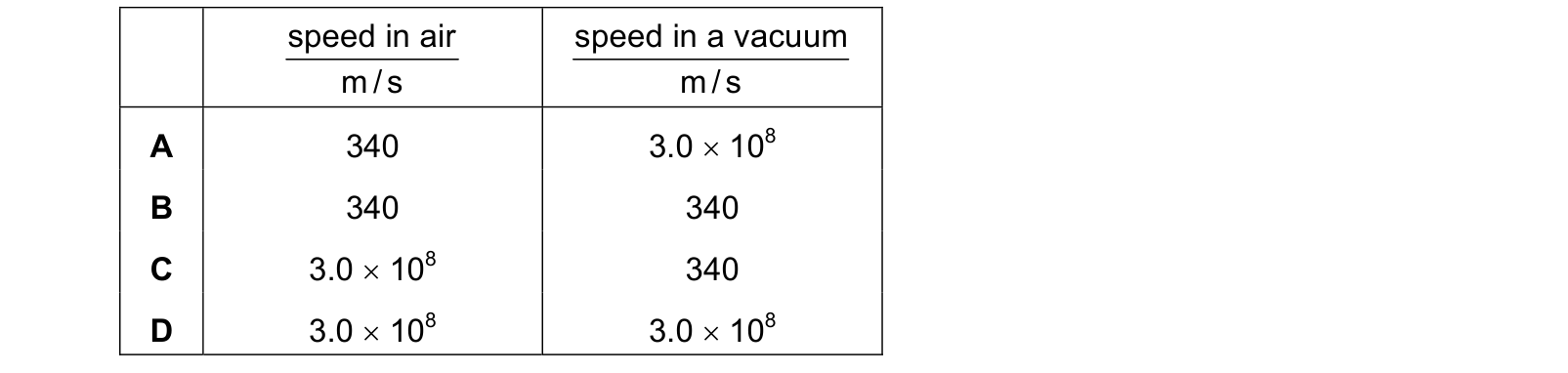
Which row gives the approximate speeds at which ultraviolet waves travel in air and in a vacuum? Each answer gives, in order: speed in air m /s; speed in a vacuum m /s.
Answer: D.
The 340 m/s appearing in the other rows is the speed of sound in air, which has nothing to do with ultraviolet. B puts 340 m/s in both columns, which would also mean ultraviolet crossing empty space at the speed of sound, when sound cannot cross a vacuum at all.
The idea being tested is that the speed of an electromagnetic wave in a vacuum does not depend on which part of the spectrum it comes from; only the frequency and wavelength change along the spectrum.
Question 2
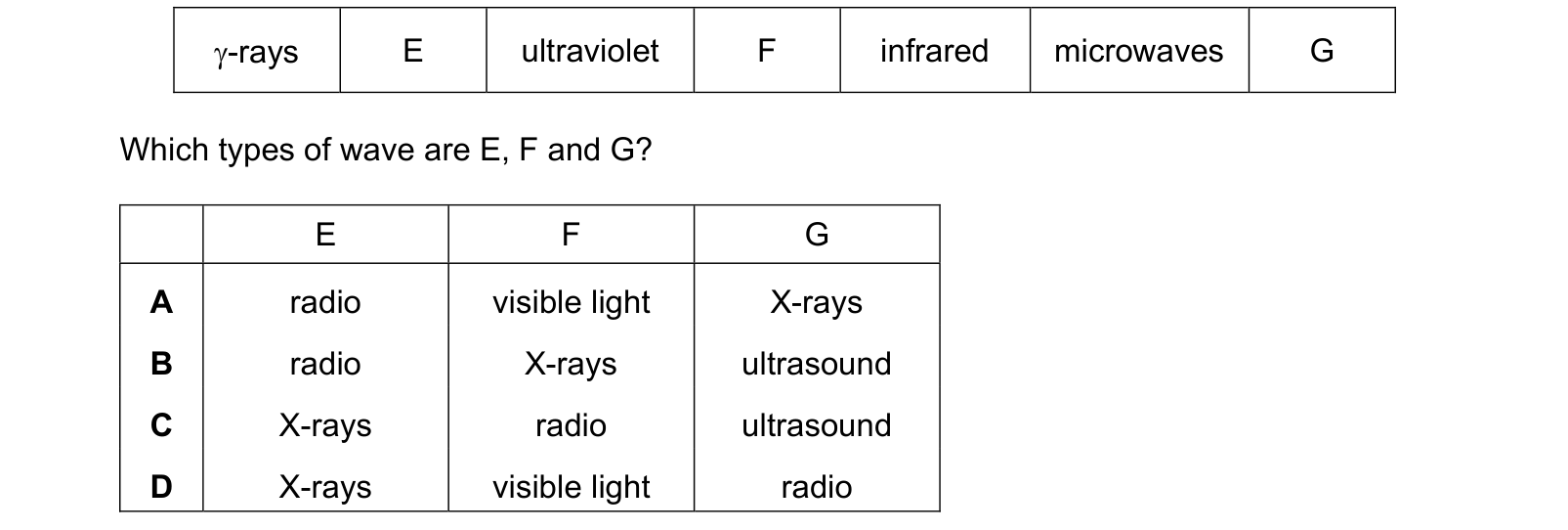
The diagram shows the electromagnetic spectrum. γ-rays E ultraviolet F infrared microwaves G Which types of wave are E, F and G? Each answer gives, in order: E; F; G.
Answer: D.
Comparing with the row given, E lies between gamma rays and ultraviolet, so E is X-rays; F lies between ultraviolet and infrared, so F is visible light; and G lies beyond microwaves, so G is radio waves. That is D.
B and C name ultrasound for G, but ultrasound is a sound wave and has no place in the electromagnetic spectrum at all, which rules both out immediately. A gets the three regions right but shuffles them, putting radio at the short-wavelength end where X-rays belong.
Question 3
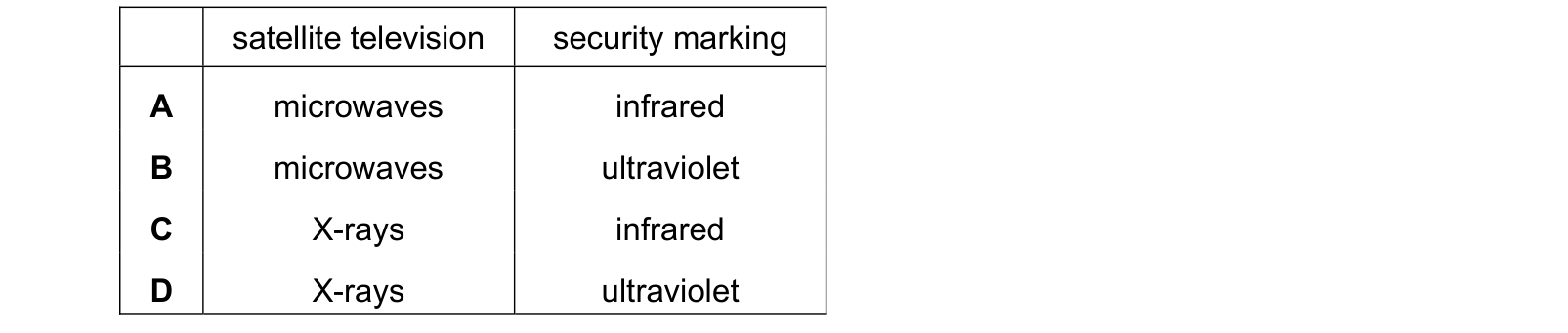
Which regions of the electromagnetic spectrum are used for satellite television and for security marking? Each answer gives, in order: satellite television; security marking.
Answer: B.
A gives the marking job to infrared, but infrared is heat radiation and is given out by everything warm, so it would make a poor invisible ink.
C and D use X-rays for satellite television, which is impossible: X-rays are absorbed by the atmosphere and would be dangerous to broadcast. Sorting by which regions pass through the air easily, radio and microwaves, is a quick way to handle communication questions.
Question 4
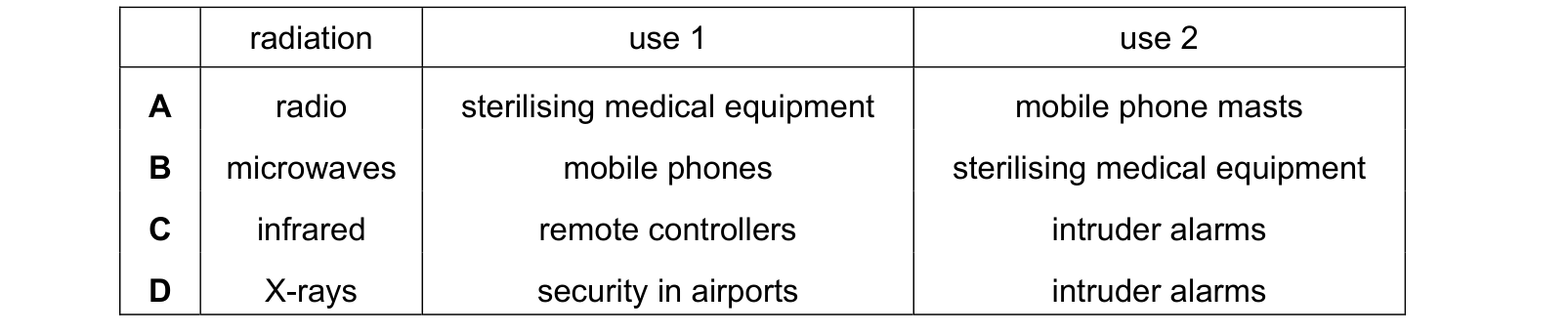
A student is asked to give two uses of four different types of electromagnetic radiation. In which row are both the uses correct? Each answer gives, in order: radiation; use 1; use 2.
Answer: C.
A pairs radio waves with sterilising medical equipment, which is a job for gamma rays, although radio waves and phone masts do belong together. B correctly links microwaves to mobile phones but then gives them the sterilising job as well. D correctly puts X-rays in airport security scanners but then gives them intruder alarms, which belong to infrared.
Sterilising and killing cells is high-energy work at the gamma and X-ray end, while heating and detecting warmth is infrared, and communication over distance is radio and microwaves. Sorting the uses by energy first makes these rows quick to check.
Question 5
The diagram shows the electromagnetic spectrum. γ-rays X-rays ultraviolet visible light infrared microwaves A word is missing from the label below the spectrum.
Which word is missing?
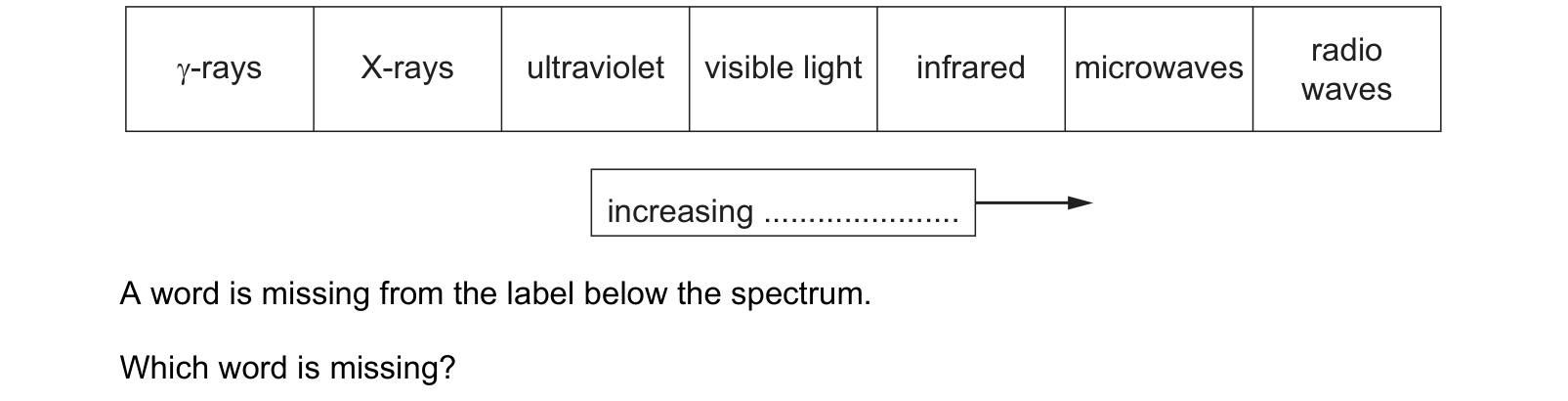
Answer: D.
B, frequency, runs the other way: gamma rays have the highest frequency and radio waves the lowest, so frequency decreases along this arrow rather than increasing. C, speed, does not change at all, since every electromagnetic wave travels at 3.0 x 10^8 m/s in a vacuum.
A, amplitude, is not a property that varies along the spectrum; it depends on how strong the source is, not on which region the radiation belongs to. Anchoring on one end helps: gamma rays are the shortest waves and the most energetic, so moving away from them the waves must be getting longer.
What this practice covers
These questions are drawn from past CIE 0625 Physics papers and filtered to electromagnetic spectrum. You answer, you find out immediately whether you were right, and you get the reasoning for the correct option and for each distractor. Wrong answers go to a mistakes locker so you can come back to exactly those.
Practice is free. You need an account only so your progress and your mistakes are still there next time.
Keep going Paper 1 and Paper 2 MCQs →
What examiners see students get wrong here
These are the errors that cost marks on electromagnetic spectrum, taken from our own topic notes. Read them before you practise and you will recognise the traps in the questions.
- Reciting the spectrum in the wrong order, or reversing wavelength and frequency.
- Saying different electromagnetic waves travel at different speeds in a vacuum; they do not, though they do in glass.
- Saying electromagnetic waves need a medium.
- Calling any of them longitudinal.
- Saying microwaves are ionising; only X-rays and gamma rays are, in this syllabus.
- Confusing ultraviolet with infrared when listing hazards.
- Saying a digital signal travels faster than an analogue one; it carries more information more reliably, at the same wave speed.
Revise it first
If any of the above is unfamiliar, work through the notes before practising: Electromagnetic spectrum revision notes.