Mass and weight: five questions to try now
Real past-paper questions, the answer key from the mark scheme, and the explanation that goes with it. No account needed to answer them.
Question 1
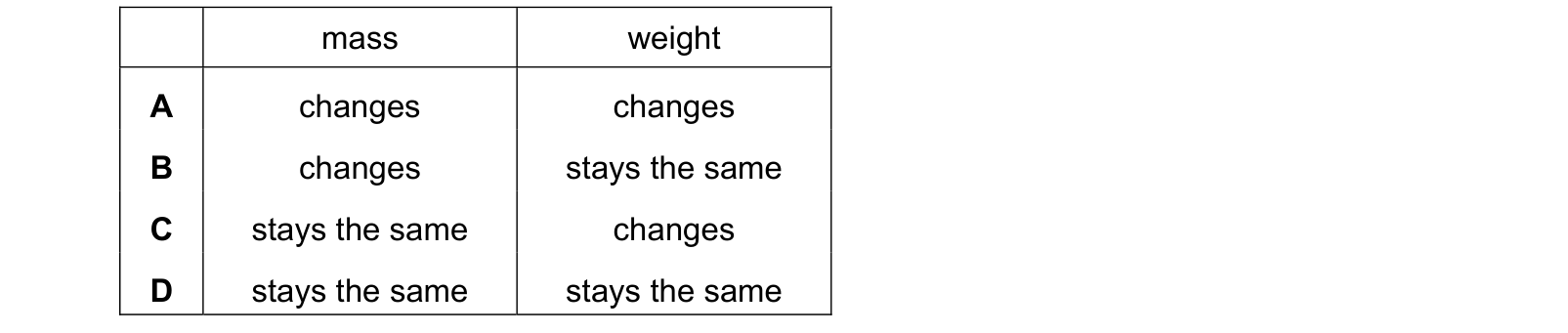
A body is moved from place X to place Y where the gravitational field strength is different. What happens to its mass and to its weight due to the move? Each answer gives, in order: mass; weight.
Answer: C.
Weight is the gravitational force on that mass, calculated as mass times gravitational field strength. The field strength is different at Y, so the weight changes.
Stays the same and changes, which is C.
A and B both change the mass, which is the misconception this question exists to catch. It usually comes from everyday language, where we talk about weighing ourselves in kilograms and treat the two words as interchangeable. In physics they are separate quantities with separate units.
D holds both fixed, which would only be true if the two places had the same field strength, and the question says they do not.
The one-line version: mass travels with you unchanged, weight depends on where you are standing.
Question 2
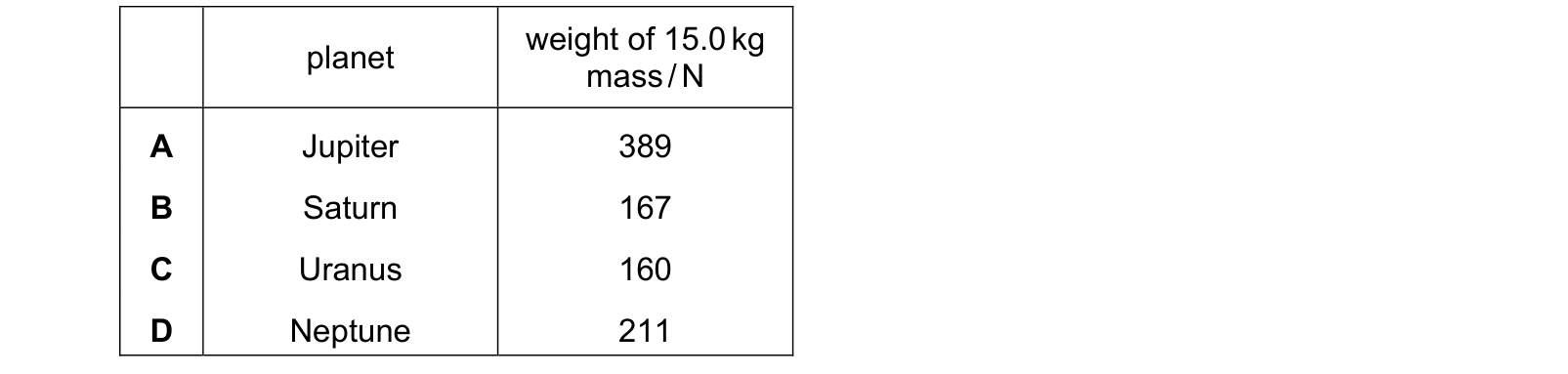
The table shows the weight of a 15.0 kg mass placed on different planets. Which planet has a gravitational field strength of 11.1 N / kg? Each answer gives, in order: planet; weight of 15.0 kg mass / N.
Answer: B.
weight = m x g = 15.0 x 11.1 = 166.5 N, which rounds to 167 N.
Reading down the table, that is Saturn: B.
The alternative route is to divide each weight by 15.0 and see which gives 11.1. Jupiter's 389 N gives 25.9 N / kg, Uranus's 160 N gives 10.7 N / kg and Neptune's 211 N gives 14.1 N / kg. Only Saturn lands on 11.1.
Multiplying once is quicker than dividing four times, and it is worth forming the habit: work out what the answer should look like, then find it, rather than testing every row.
Question 3
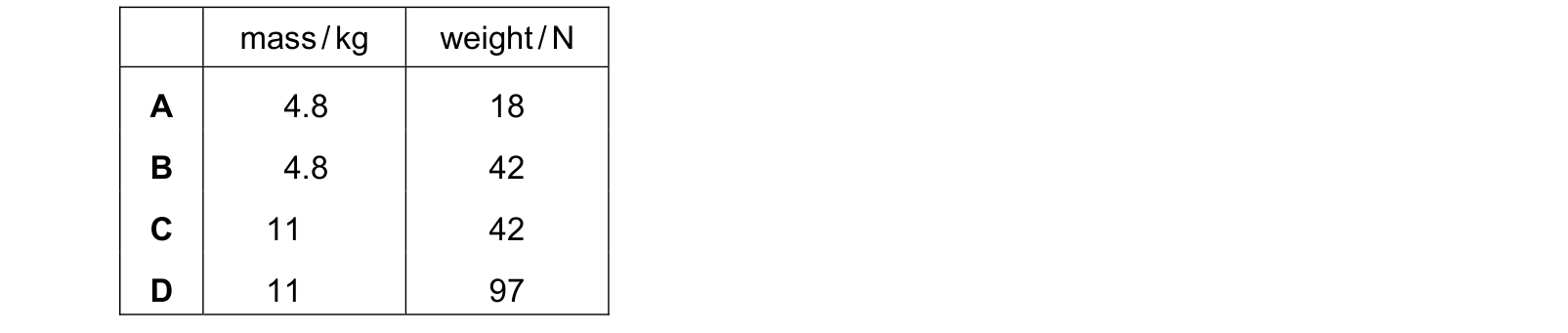
The gravitational field strength is 8.8 N / kg on Venus and 3.8 N / kg on Mars. An object has a weight of 42 N on Venus. What are the mass and the weight of the object on Mars? Each answer gives, in order: mass / kg; weight / N.
Answer: A.
Find the mass from the Venus data:
m = W / g = 42 / 8.8 = 4.8 kg
That mass is the same on Mars, so find the Mars weight:
W = m x g = 4.8 x 3.8 = 18 N
4.8 kg and 18 N, which is A.
B keeps the weight at 42 N. Weight depends on the gravitational field, and Mars pulls less than half as hard as Venus, so it cannot stay the same.
C and D give a mass of 11 kg, from dividing 42 by 3.8 and using the wrong planet's field strength for the first step.
Always find the mass first when a question moves an object between two worlds. The mass is the bridge, and the two weights are the ends.
Question 4
An astronaut of mass 80 kg is standing on a planet with gravitational field strength g = 3.8 N / kg.
What is the weight of the astronaut on this planet?
Answer: B.
W = 80 x 3.8 = 304 N, which rounds to 300 N, so B.
A, 780 N, is the astronaut's weight on Earth, using g = 9.8. The question gives this planet's field strength in the stem precisely because it is not Earth's, and using 9.8 answers a question that was not asked.
C, 210 N, and D, 21 N, come from dividing rather than multiplying, or from losing a factor of ten.
The sense check is quick: 3.8 N / kg is a little under half of Earth's 9.8, so the weight should come out a little under half the Earth value of 780 N. 300 is comfortably in that range, and 21 N is not, since 21 N would be the weight of about two kilograms.
Note that the astronaut's mass is 80 kg wherever they stand. Only the weight changes with the planet, which is the distinction this whole family of questions exists to test.
Question 5
On Earth, a spring stretches by 5.0 cm when a mass of 3.0 kg is suspended from one end. The gravitational field strength on the Moon is one sixth of that on Earth. Which mass, on the Moon, would stretch the spring by the same extension?

Answer: D.
On Earth: W = mg = 3.0 x 10 = 30 N.
On the Moon g is one sixth as large, about 1.7 N / kg, so to reach the same 30 N you need six times the mass.
mass on the Moon = 3.0 x 6 = 18 kg, which is D.
A, 0.50 kg, is 3.0 divided by 6, which is the answer to the question of what a 3.0 kg mass would weigh there rather than what mass matches the force.
B keeps the same mass, which would stretch the spring only a sixth as far. C is the extension in centimetres copied out as a mass.
The direction of the sixfold factor is the whole question. Weaker gravity means you need more mass to pull with the same force, not less.
What this practice covers
These questions are drawn from past CIE 0625 Physics papers and filtered to mass and weight. You answer, you find out immediately whether you were right, and you get the reasoning for the correct option and for each distractor. Wrong answers go to a mistakes locker so you can come back to exactly those.
Practice is free. You need an account only so your progress and your mistakes are still there next time.
Keep going Paper 1 and Paper 2 MCQs →
What examiners see students get wrong here
These are the errors that cost marks on mass and weight, taken from our own topic notes. Read them before you practise and you will recognise the traps in the questions.
- Giving a mass in newtons or a weight in kilograms.
- Saying an object's mass decreases in space, or on the Moon.
- Using Earth's g when the question supplies a different value.
- Dividing by six instead of multiplying, when asked what mass gives the same weight under weaker gravity.
- Saying a beam balance would give a different reading on the Moon.
- Forgetting that extra mass makes stopping harder as well as starting.
- Treating g as if it had only one meaning; it is both a field strength in N/kg and an acceleration in m/s².
Revise it first
If any of the above is unfamiliar, work through the notes before practising: Mass and weight revision notes.