Energy, work and power: five questions to try now
Real past-paper questions, the answer key from the mark scheme, and the explanation that goes with it. No account needed to answer them.
Question 1
The diagram shows the energy stores for a mobile (cell) phone and how the energy is transferred between stores. What describes how the chemical energy is transferred?

Answer: A.
A battery drives a current through the phone's circuits, and a current transferring energy is electrical work, so A is the label for the arrow. That current then warms the components, raising their internal energy, and drives the loudspeaker, giving the kinetic energy that becomes sound.
B, mechanical work, would need a force moving something, and nothing pushes the phone. C and D name the waves that a phone emits, but electromagnetic waves and sound are what leave the phone at the far end of the chain, not how the battery's chemical store is emptied in the first place.
Question 2
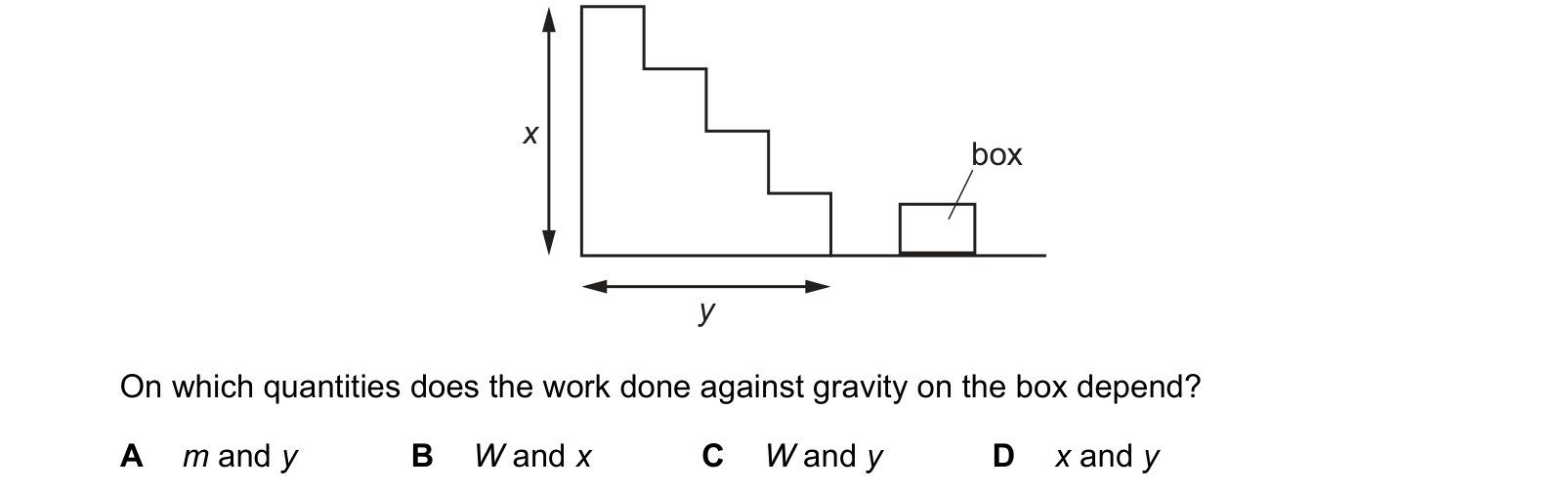
A box of mass m and weight W is carried up some stairs of total height x and total width y. On which quantities does the work done against gravity on the box depend?
Answer: B.
The force is the weight W, and the vertical distance is the total height x. So the work depends on W and x, which is B.
C and D both use y, the width of the staircase. Moving sideways does no work against gravity at all, because the motion is at right angles to the pull. Walking along a level corridor with the box would be free in these terms, however tiring it feels.
A uses the mass m rather than the weight W. Mass and weight are of course related, but the work is force times distance and the force here is the weight. Using m would leave the answer in the wrong units unless you also multiplied by the gravitational field strength.
Note also that the shape of the stairs is irrelevant. A steep flight and a gentle one of the same total height need the same work.
Question 3
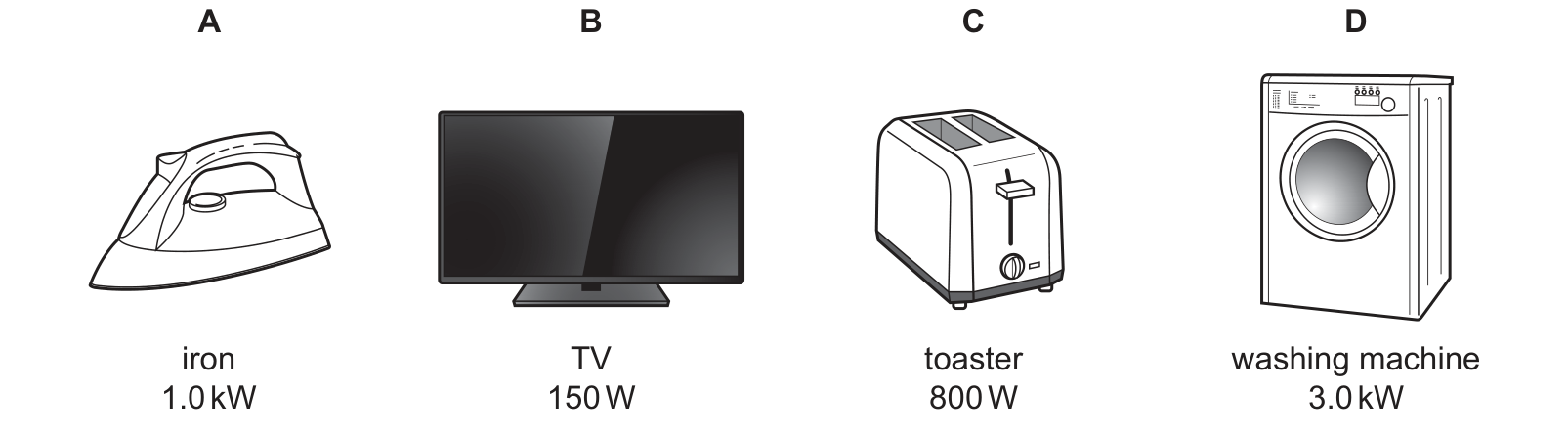
The diagrams show four appliances and their power ratings. Which appliance transfers the most energy per second? Use the source image for M22 Paper 12, question 11.
Answer: D.
A, iron: 1.0 kW = 1000 W
B, TV: 150 W
C, toaster: 800 W
D, washing machine: 3.0 kW = 3000 W
The washing machine is the largest by a clear margin, so D.
The conversion is the whole difficulty. Two ratings are in kilowatts and two in watts, so comparing the bare numbers would put the toaster's 800 above the iron's 1.0 and the washing machine's 3.0. Bringing everything to watts makes the order obvious.
A watt is one joule per second, so a 3000 W machine transfers 3000 J every second, twenty times what the television uses.
The reason a washing machine tops the list is that it heats water, and heating is expensive in energy terms. The appliances that dominate a household electricity bill are almost always the ones that heat something: kettles, showers, ovens and washing machines.
Question 4
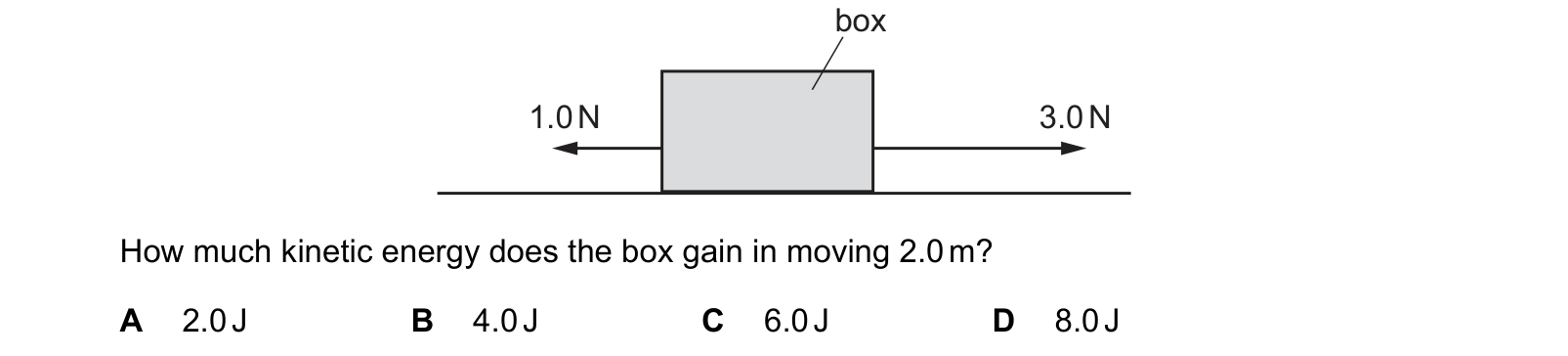
A box is pulled along a floor by a force of 3.0 N.
The friction acting on the box is 1.0 N, as shown. How much kinetic energy does the box gain in moving 2.0 m?
Answer: B.
resultant = 3.0 - 1.0 = 2.0 N
gain in kinetic energy = resultant x distance = 2.0 x 2.0 = 4.0 J, which is B.
C, 6.0 J, is 3.0 x 2.0: the total work done by the pulling force, which is right as a total but includes the 2.0 J that went into heating the floor.
D, 8.0 J, adds the friction to the pull instead of subtracting it. A, 2.0 J, is the energy lost to friction on its own.
The question asks what the box gains, not what the person put in. Those differ by exactly the friction losses whenever a surface is rough.
Question 5
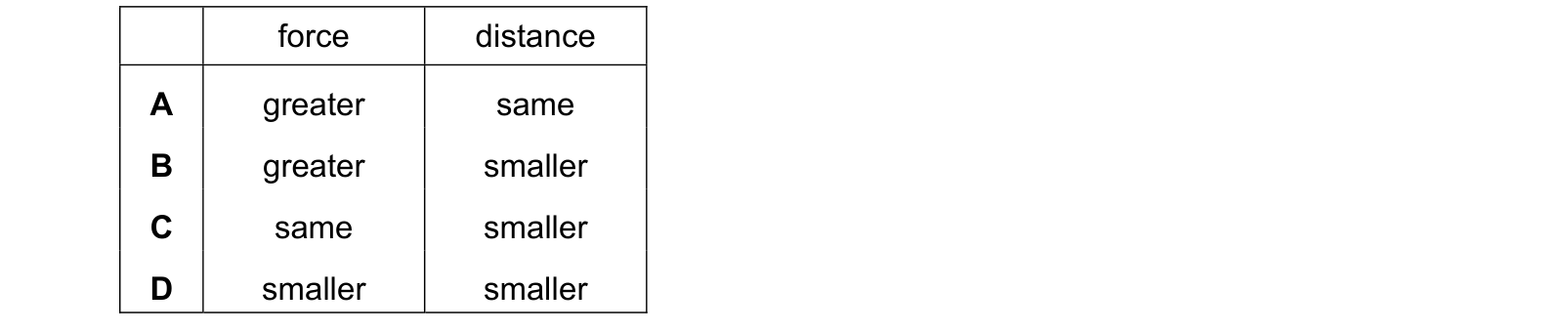
A force does work moving an object in the direction of the force. Which change in the force and distance always increases the work done? Each answer gives, in order: force; distance.
Answer: A.
A, greater force with the same distance, raises one factor and leaves the other alone, so the product must rise. That is guaranteed, so A.
B, greater force but smaller distance, pulls in opposite directions. Whether the work rises depends on which change is larger, so it does not always increase.
C, same force over a smaller distance, always decreases the work.
D, smaller force and smaller distance, decreases it on both counts.
B is the option worth pausing on. It could easily increase the work, if the force doubled while the distance fell by a tenth. It could equally decrease it. A question asking what always happens is asking what is guaranteed, not what is possible, and any option whose outcome depends on the numbers fails that test.
Reading for the quantifier, "always" here, is a skill in itself, and it turns an otherwise trivial formula question into one worth thinking about.
What this practice covers
These questions are drawn from past CIE 0625 Physics papers and filtered to energy, work and power. You answer, you find out immediately whether you were right, and you get the reasoning for the correct option and for each distractor. Wrong answers go to a mistakes locker so you can come back to exactly those.
Practice is free. You need an account only so your progress and your mistakes are still there next time.
Keep going Paper 1 and Paper 2 MCQs →
What examiners see students get wrong here
These are the errors that cost marks on energy, work and power, taken from our own topic notes. Read them before you practise and you will recognise the traps in the questions.
- Stopping at v² and not taking the square root.
- Using the total work done by a force when the question asks for the kinetic energy gained.
- Saying no energy is transferred when someone holds a heavy object still, and then saying work is done on it.
- Confusing power with energy, or with efficiency.
- Leaving a time in minutes or hours when calculating power.
- Using the final energy instead of the change in energy.
- Calling nuclear fission renewable because it emits no carbon dioxide.
- Saying energy is lost or used up rather than dissipated.
Revise it first
If any of the above is unfamiliar, work through the notes before practising: Energy, work and power revision notes.