Motion: five questions to try now
Real past-paper questions, the answer key from the mark scheme, and the explanation that goes with it. No account needed to answer them.
Question 1
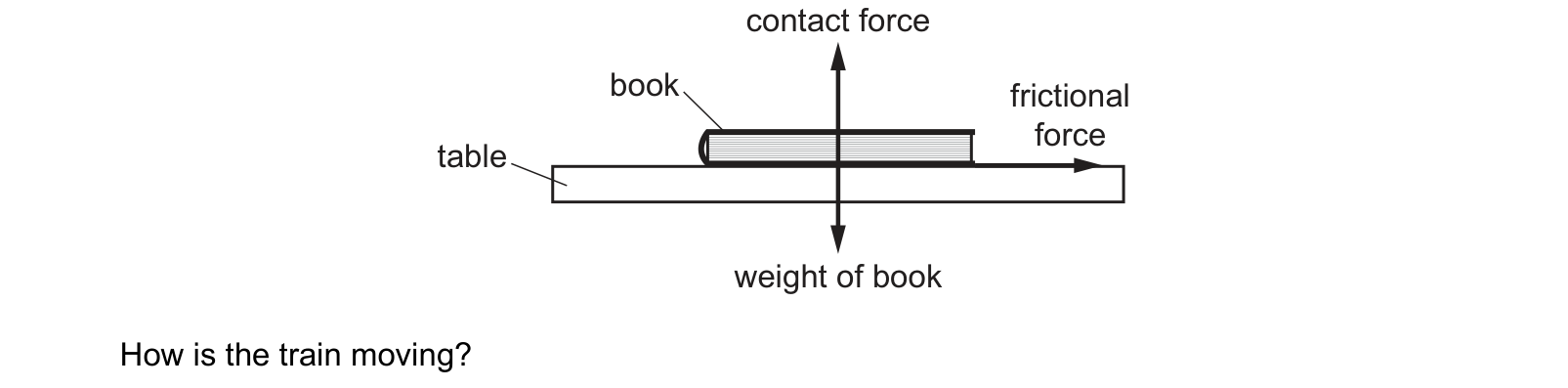
A train is travelling horizontally in a straight line. A book is on a table in the train.
The diagram shows all the forces acting on the book. How is the train moving?
Answer: B.
Vertically the contact force up and the weight down cancel, as they must for a book that is not rising off the table.
Horizontally there is only one force on the diagram, the frictional force, and it points to the right. One force with nothing to oppose it is a resultant force, and a resultant force means acceleration. So the book is accelerating to the right, and the train it sits in must be too: B.
C and D both describe uniform speed, which needs zero resultant force. The single unbalanced friction arrow rules both out before you consider the direction.
A has the direction backwards.
What the friction is doing is worth seeing. When the train accelerates, something has to accelerate the book with it, and friction from the table is the only thing available. On a very slippery table the book would be left behind, which is what a passenger feels as being pushed back into the seat.
Question 2
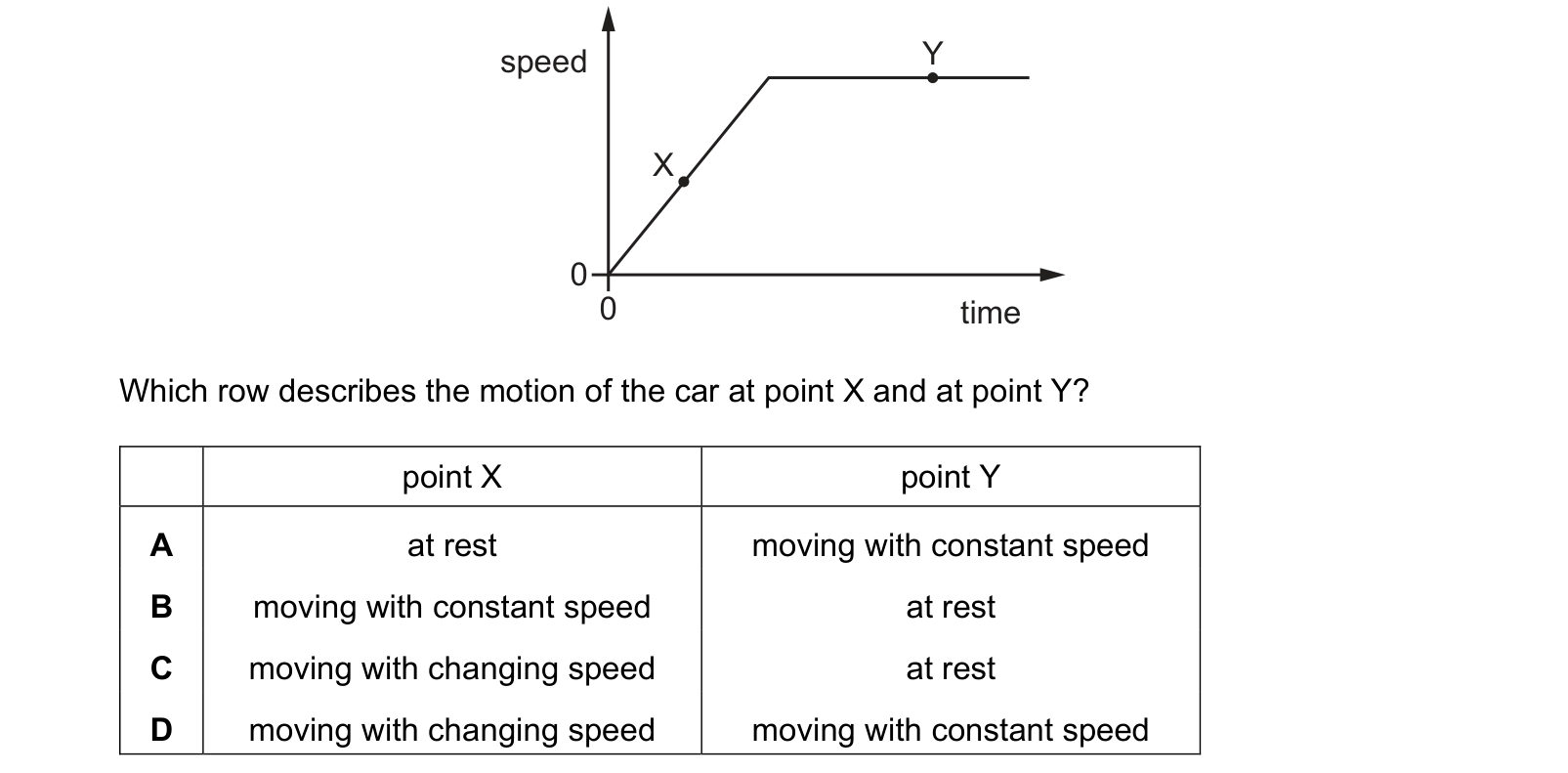
The diagram shows the speed–time graph for a car. Which row describes the motion of the car at point X and at point Y? Each answer gives, in order: point X; point Y.
Answer: D.
Point X sits on the sloping section. The line is rising, so the speed is increasing: the car is moving with changing speed.
Point Y sits on the horizontal section, and that line is well above the time axis. Horizontal means the speed is not changing, and being above the axis means that speed is not zero. So the car is moving with constant speed.
Changing then constant, which is D.
B and C both say the car is at rest at Y, and that is the error the graph is designed to catch. A horizontal line on a speed-time graph means steady speed, not stationary. The car would only be at rest if the line sat on the axis at zero. On a distance-time graph a horizontal line would indeed mean stopped, and confusing the two graph types is what produces this mistake.
A says the car is at rest at X, but X is partway up a rising line, so the car is already moving.
The habit worth building: on a speed-time graph, the height tells you how fast and the slope tells you whether that is changing.
Question 3
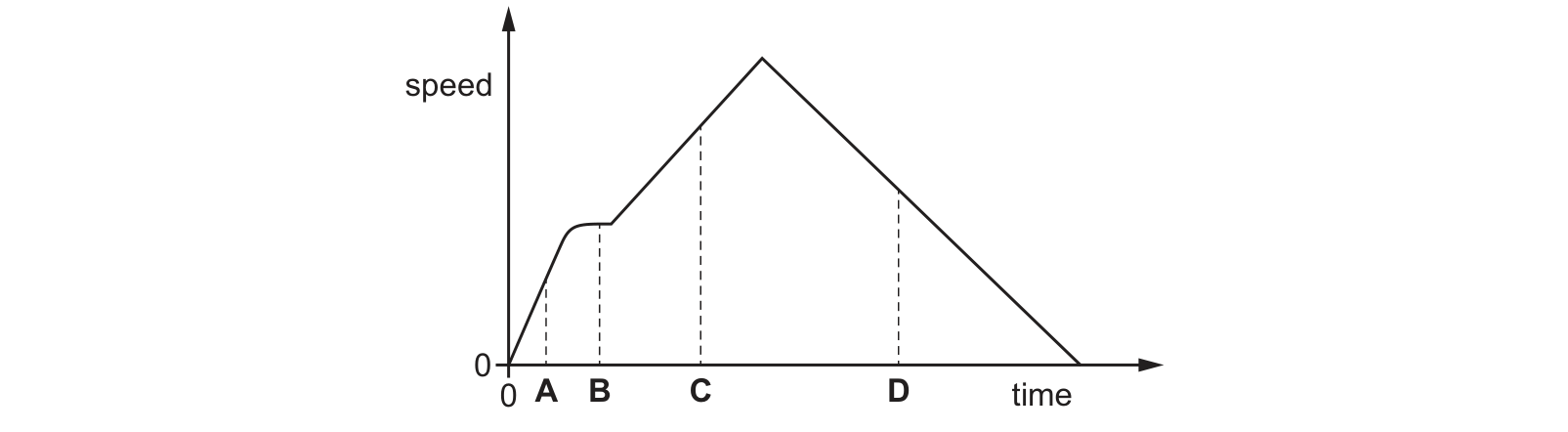
The graph shows how the speed of an object varies with time. At which labelled time is the acceleration greatest? Use the source image for S20 Paper 12, question 2.
Answer: A.
A sits on the first climb, which rises very sharply out of the origin. That is the steepest part of the whole graph, so A.
B is on the short flat section. Flat means the speed is not changing, so the acceleration there is zero.
C is on the second climb, which is clearly gentler than the first: the line covers less speed in more time.
D is on the long descent. The car is slowing, so the acceleration is negative there, and the slope is shallower than the first climb in any case.
Steepness is what you are comparing, not height. A is quite low on the speed axis and still has the largest acceleration, because acceleration is about how fast the speed is changing, not how big it is.
Question 4
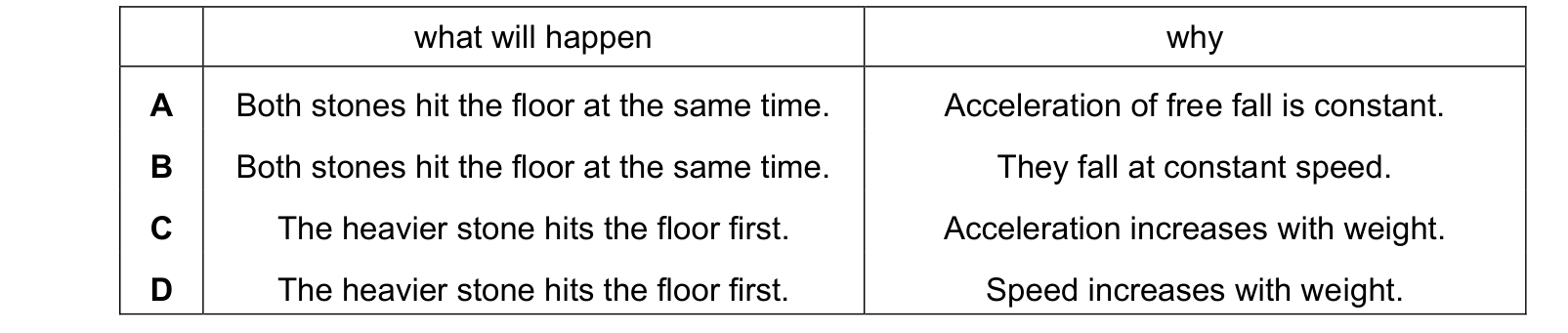
Two stones of different weights fall at the same time from a table. Air resistance may be ignored. What will happen and why? Each answer gives, in order: what will happen; why.
Answer: A.
C and D have the heavier stone landing first, which is the intuition almost everyone starts with and which air resistance usually confirms in everyday life. The stem removes air resistance precisely to isolate the physics.
The reason the weights do not matter is a cancellation. From F = ma, the acceleration is the weight divided by the mass, and the weight is the mass times g. The mass appears top and bottom and cancels exactly, leaving g for every object. The heavier stone is pulled harder and is correspondingly harder to accelerate, and the two effects balance perfectly.
B gives the right outcome with the wrong reason, saying they fall at constant speed. They do not: they accelerate the whole way down, gaining about 10 m / s every second.
B is worth noticing as a type. In a question offering a claim and a justification, both halves must be right, and an option with a correct conclusion and faulty reasoning is still wrong.
Question 5
Two rockets are launched at the same time from the surface of the Earth. The graph shows how the speeds of the rockets change with time. Which statement about the rockets is correct?

Answer: C.
Both rockets start from rest and reach the same final speed at the same moment. But P climbs steeply at first and then levels off, while Q rises in a straight line. That means P's curve sits above Q's line for the whole journey, so the area under P is larger and P travels further, which is C.
A says the distances are equal. They would be only if the graphs enclosed the same area, and one curve sitting entirely above the other rules that out. Ending at the same speed is not the same as covering the same ground.
B says P accelerates then decelerates. Watch the speed, not the steepness: P's speed never falls, it just stops rising as quickly. Its acceleration decreases towards zero, but it never goes negative, and decelerating would mean the curve turning downwards.
D says Q has zero acceleration. Q is a straight line with a positive gradient, which is constant, non-zero acceleration. Zero acceleration would be a horizontal line.
The useful habit: gradient answers questions about acceleration, area answers questions about distance.
What this practice covers
These questions are drawn from past CIE 0625 Physics papers and filtered to motion. You answer, you find out immediately whether you were right, and you get the reasoning for the correct option and for each distractor. Wrong answers go to a mistakes locker so you can come back to exactly those.
Practice is free. You need an account only so your progress and your mistakes are still there next time.
Keep going Paper 1 and Paper 2 MCQs →
What examiners see students get wrong here
These are the errors that cost marks on motion, taken from our own topic notes. Read them before you practise and you will recognise the traps in the questions.
- Averaging two speeds when the times spent at each are different.
- Excluding a stationary period from a total journey time.
- Reading a value off one axis instead of subtracting between two points.
- Treating a horizontal line on a speed-time graph as stationary.
- Confusing gradient with area, so acceleration is read off as an area.
- Saying a heavier object falls faster when air resistance has been ruled out.
- Saying an object at terminal velocity has stopped, or is still accelerating.
- Describing a straight speed-time line as increasing acceleration.
Revise it first
If any of the above is unfamiliar, work through the notes before practising: Motion revision notes.