Light: five questions to try now
Real past-paper questions, the answer key from the mark scheme, and the explanation that goes with it. No account needed to answer them.
Question 1
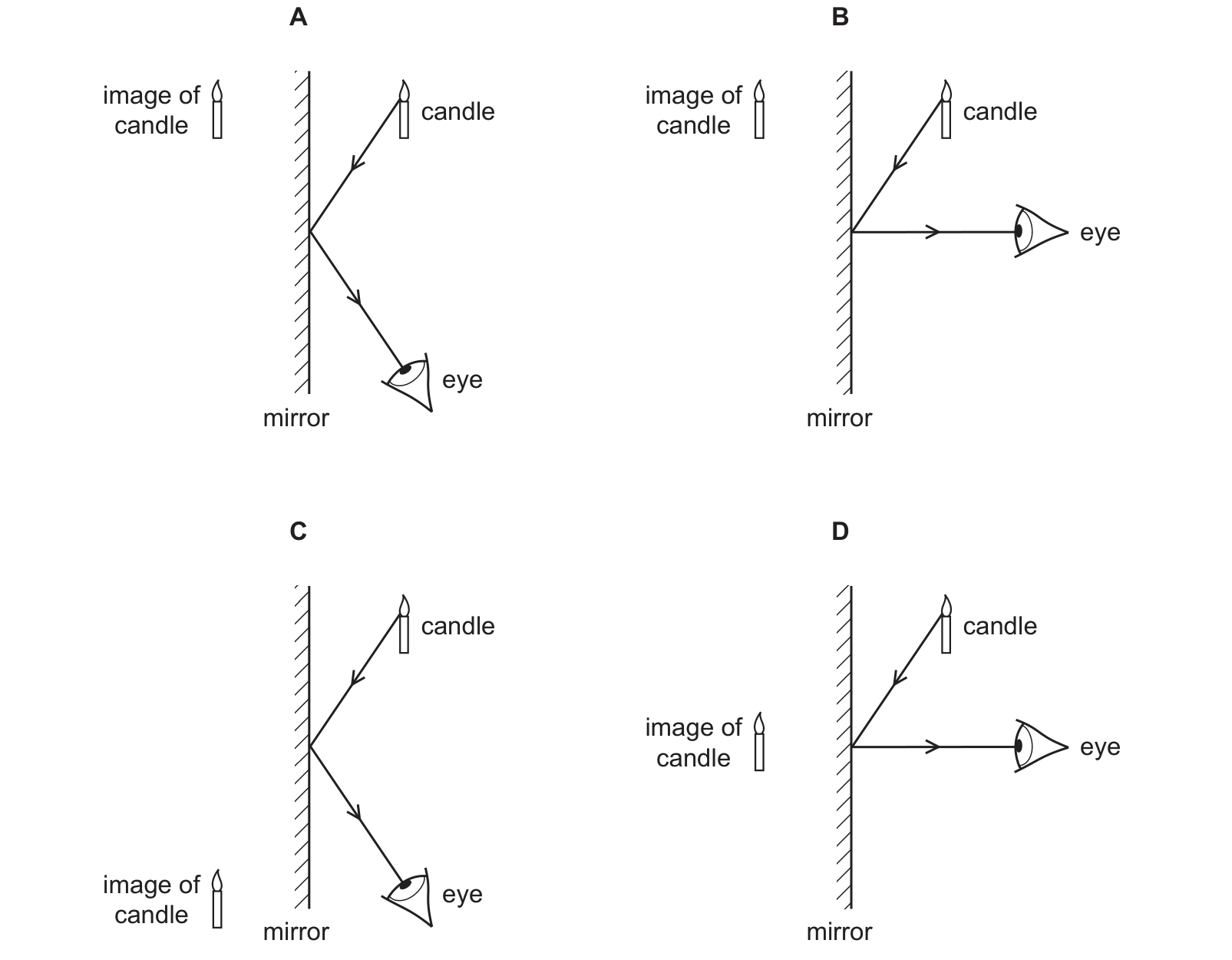
Which diagram shows how the light from a candle is reflected by a mirror, and shows the position of the image formed? Use the source image for M20 Paper 12, question 23.
Answer: A.
A has both, with the incoming and outgoing rays making equal angles either side of the mirror normal and the image drawn level with the candle. B and D show the light arriving at a slant but leaving horizontally, so the two angles are not equal. C draws the reflection correctly but drops the image far too low, roughly level with the eye instead of with the candle.
The eye does not fix where the image is. The image lies on the perpendicular from the object to the mirror whether anyone is looking or not, so read the candle's height off first and check which diagram matches it.
Question 2
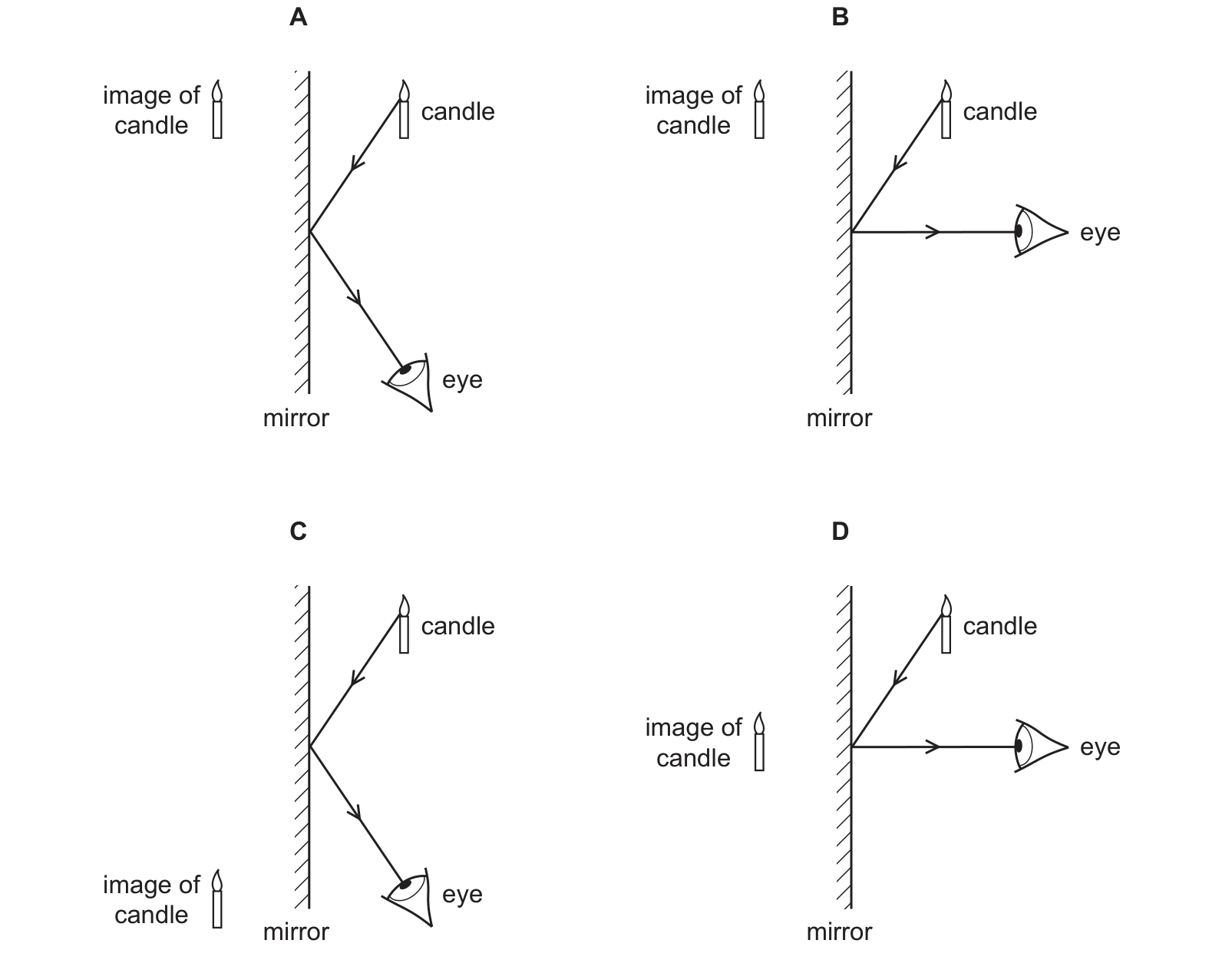
Which diagram shows how the light from a candle is reflected by a mirror, and shows the position of the image formed? Use the source image for M20 Paper 22, question 25.
Answer: A.
A has both, with the incoming and outgoing rays making equal angles either side of the mirror normal and the image drawn level with the candle. B and D show the light arriving at a slant but leaving horizontally, so the two angles are not equal. C draws the reflection correctly but drops the image far too low, roughly level with the eye instead of with the candle.
The eye does not fix where the image is. The image lies on the perpendicular from the object to the mirror whether anyone is looking or not, so read the candle's height off first and check which diagram matches it.
Question 3
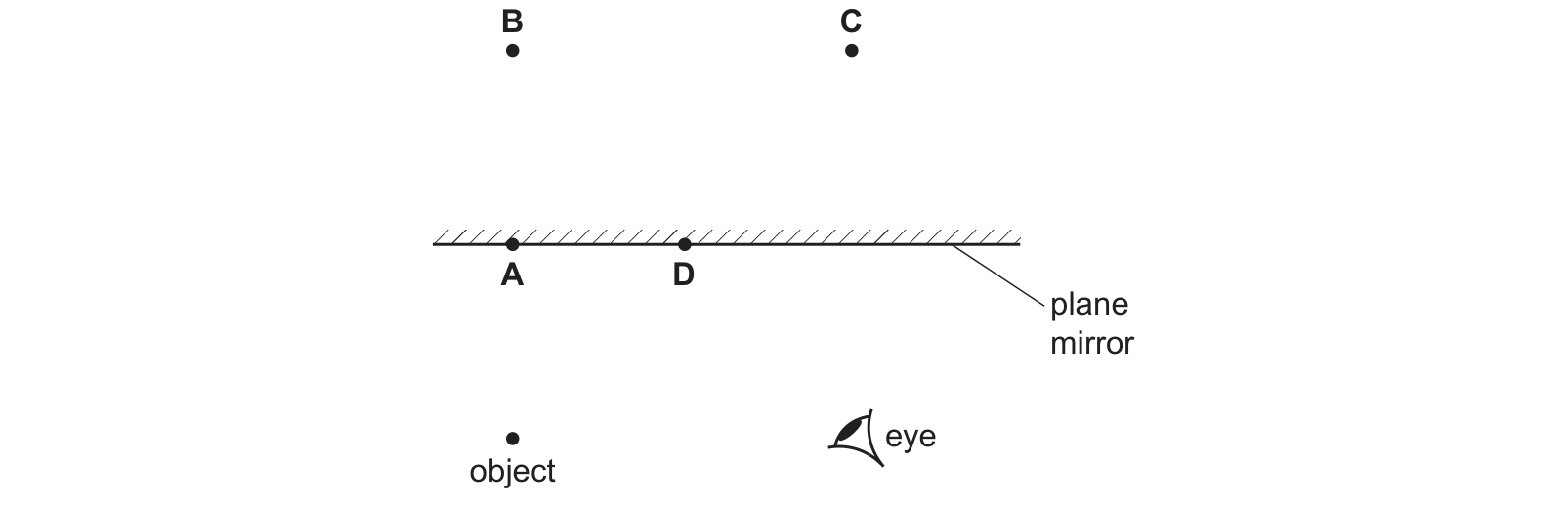
The diagram shows an object in front of a plane mirror. At which labelled position is the image of the object formed? Use the source image for W22 Paper 12, question 20.
Answer: B.
The object sits below the mirror and directly beneath the point marked A, so the image must lie on that same vertical line, an equal distance on the far side, which is position B.
C is the right distance behind the mirror but off to one side, so it is not on the perpendicular through the object. A and D lie on the mirror surface itself, where the light is reflected rather than where it appears to come from. The eye is drawn to tempt you into moving the image towards it, but the image position does not depend on where you stand.
Question 4
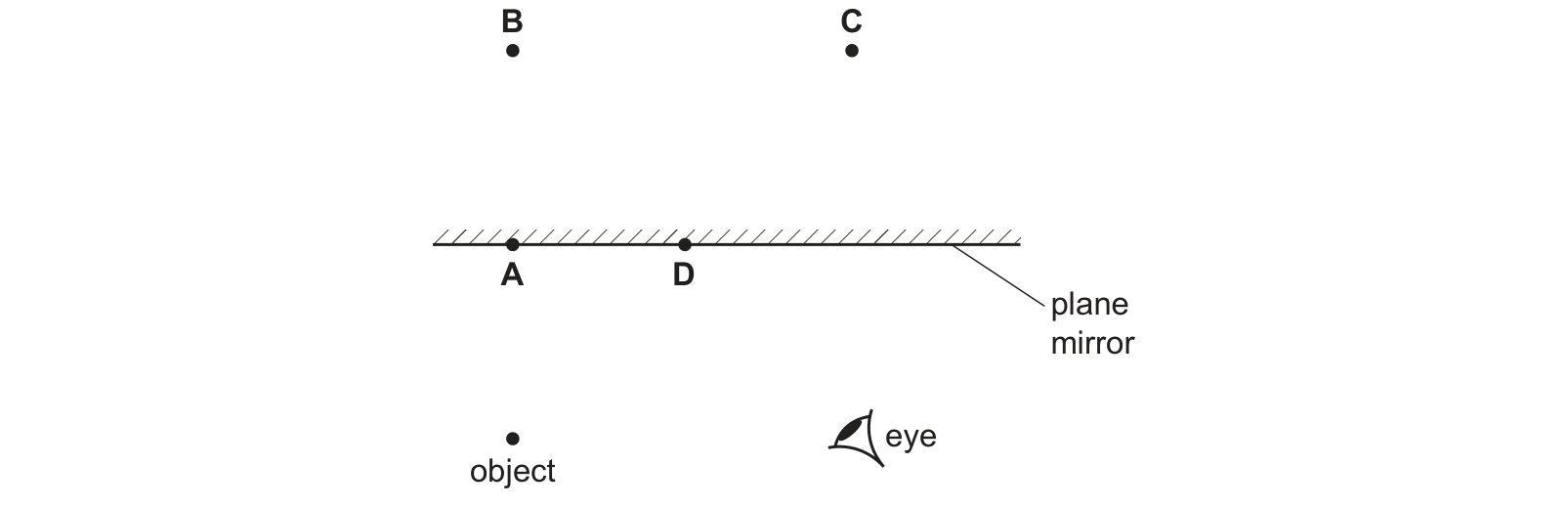
The diagram shows an object in front of a plane mirror. At which labelled position is the image of the object formed? Use the source image for W22 Paper 13, question 20.
Answer: B.
The object sits below the mirror and directly beneath the point marked A, so the image must lie on that same vertical line, an equal distance on the far side, which is position B.
C is the right distance behind the mirror but off to one side, so it is not on the perpendicular through the object. A and D lie on the mirror surface itself, where the light is reflected rather than where it appears to come from. The eye is drawn to tempt you into moving the image towards it, but the image position does not depend on where you stand.
Question 5
The diagram shows an object in front of a plane mirror. At which labelled position is the image of the object formed? Use the source image for W22 Paper 22, question 20.
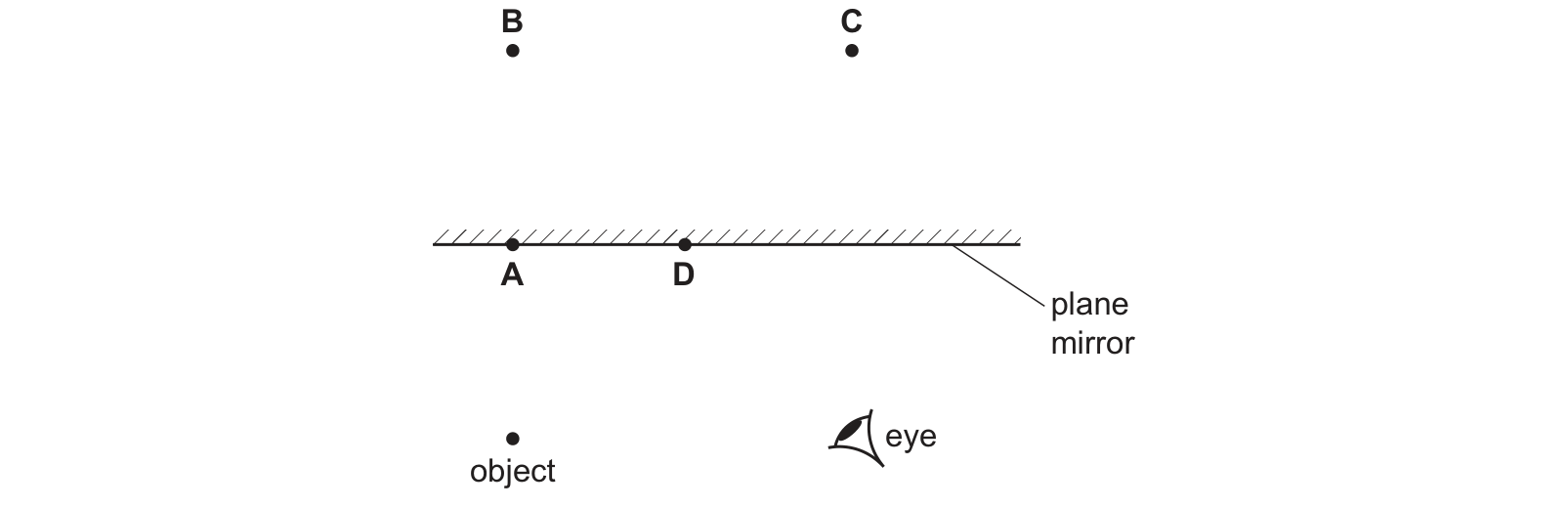
Answer: B.
The object sits below the mirror and directly beneath the point marked A, so the image must lie on that same vertical line, an equal distance on the far side, which is position B.
C is the right distance behind the mirror but off to one side, so it is not on the perpendicular through the object. A and D lie on the mirror surface itself, where the light is reflected rather than where it appears to come from. The eye is drawn to tempt you into moving the image towards it, but the image position does not depend on where you stand.
What this practice covers
These questions are drawn from past CIE 0625 Physics papers and filtered to light. You answer, you find out immediately whether you were right, and you get the reasoning for the correct option and for each distractor. Wrong answers go to a mistakes locker so you can come back to exactly those.
Practice is free. You need an account only so your progress and your mistakes are still there next time.
Keep going Paper 1 and Paper 2 MCQs →
What examiners see students get wrong here
These are the errors that cost marks on light, taken from our own topic notes. Read them before you practise and you will recognise the traps in the questions.
- Measuring angles from the surface instead of from the normal.
- Dividing the angles rather than their sines when finding a refractive index.
- Giving a speed of light in a medium greater than its speed in a vacuum.
- Saying total internal reflection can happen going from less dense to more dense.
- Forgetting that a larger refractive index means a smaller critical angle.
- Calling the image in a plane mirror real.
- Drawing a ray through the centre of a lens as if it bends.
- Saying red is refracted most in a prism.
Revise it first
If any of the above is unfamiliar, work through the notes before practising: Light revision notes.